
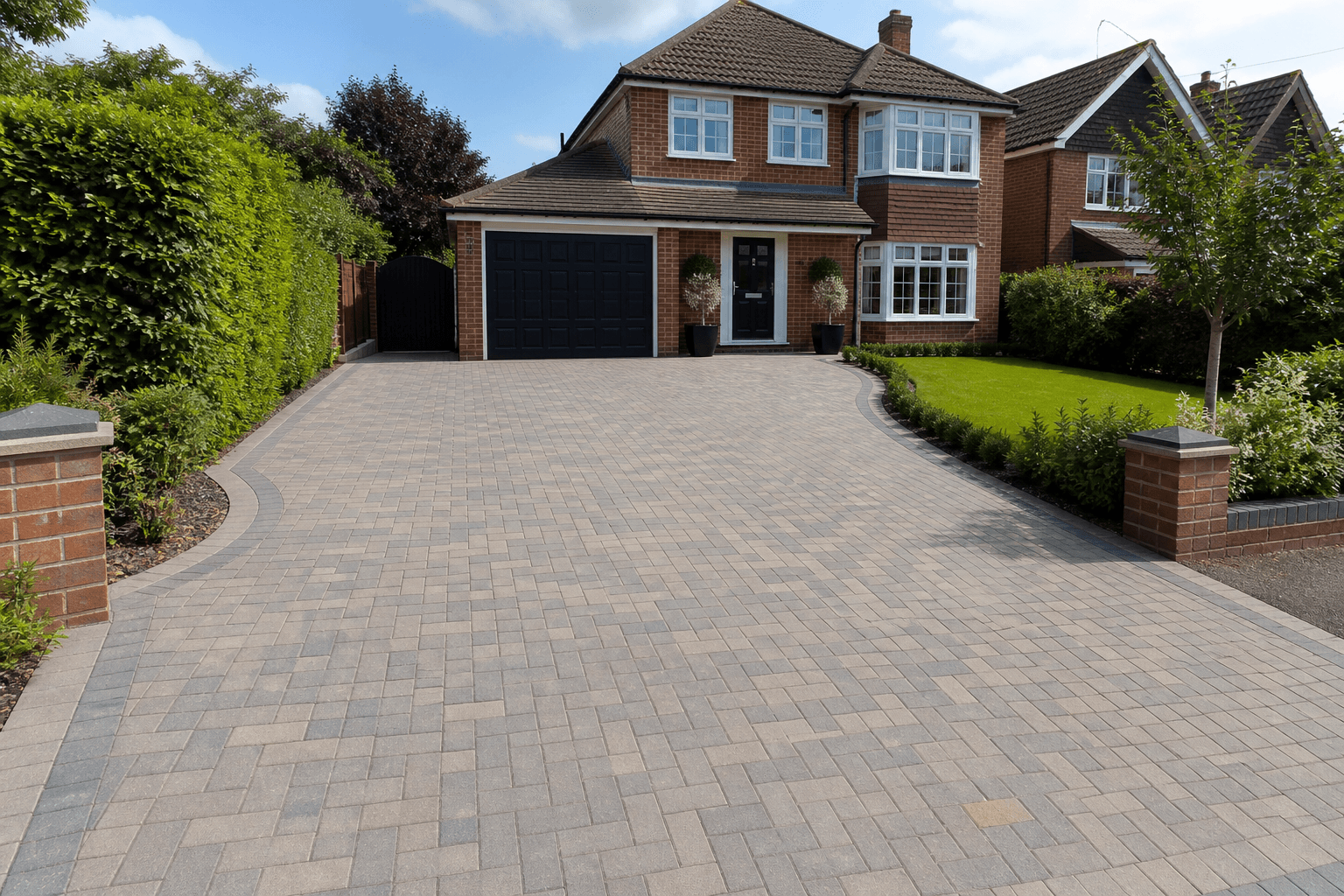
How to Lay Block Paving: A Step-by-Step Guide for UK Homeowners
Lay block paving the right way: sub-base depth, MOT Type 1, edging restraint, kiln-dried sand and 9 steps for UK driveways and patios, with SUDS notes.
Learning how to lay block paving comes down to four things: the sub-base, the falls, the edge restraint, and the jointing. Get those right and the rest is just patience. A fit DIYer can lay a 10m² patio over a weekend, or a 30m² driveway in four to five days.
TL;DR
- Difficulty 4/5. A 30m² driveway takes a fit DIYer 4-5 days; a 10m² patio takes a weekend.
- Hire the plate compactor and block splitter. Buy kiln-dried sand and sharp sand.
- Sub-base depth decides everything: 100-150mm of MOT Type 1 under driveways, 50-75mm under patios (Interpave, 2025).
- Stop and call a pro if it's a front garden over 5m² (SUDS 2008), or if drainage falls aren't obvious.
Before you start: is this a job you should actually DIY?
Roughly 28% of UK driveway failures within five years trace back to sub-base issues, not the blocks themselves (Interpave, 2024). The job is more groundwork than paving. If you're confident shifting two tonnes of aggregate and setting a falls line with string, you can probably do this. If not, hire it out.
Difficulty level (4/5) and what that means
The physical side is brutal. Expect to shovel one to two tonnes of MOT Type 1 per 10m² of finished area. Cutting blocks is repetitive, dusty work. The technical bit that catches most people out is the fall. You need a minimum 1:80 gradient running away from the house (Interpave, 2025), and you have to hold it the whole way across.
When this DIY is illegal in the UK
Some block paving jobs need permission before you lift a spade. The big three are worth memorising.
- Front gardens over 5m² without a permeable build or rainwater diversion to a soft area need planning permission under SUDS guidance (DEFRA, 2008).
- Tree removal during nesting season (March to August inclusive) can breach the Wildlife & Countryside Act 1981.
- Works that affect a shared boundary wall trigger the Party Wall etc. Act 1996, which means written notice and possibly a surveyor.
When it's legal but stupid
Legal doesn't mean sensible. Skip the DIY route if you've got a driveway over 50m², a slope steeper than 1:20, heavy clay soil, a job needing ACO channels or gully tie-ins, or anywhere you'd need to lift mature roots. The cost of a sub-base failure on a 50m² area runs to four figures.
Need help with Builders Waste Removal?
Tell us about your job and we will match you with the right professional for Builders Waste Removal.
What you'll need
Budget around £45-£70 per m² in materials and hire costs for a DIY block paving driveway, before you count tools you already own (WhatCost, 2026). The list below covers a typical 30m² job.
Tools (with B&Q / Wickes / Screwfix product names)
- Plate compactor, hire from HSS Hire or Speedy, around £50-£70 per day (HSS Hire rate card, 2026).
- Block splitter or wet-cut block paving cutter, hire £40 per day from HSS.
- Rubber mallet, 1.2m spirit level, string line, tape measure, builder's square. Spirit level from Screwfix runs £15-£25.
- Wheelbarrow (£35-£70 at B&Q), screeding bars (50mm box section), screeding board.
- Stiff broom for jointing sand.
Materials (UK-specific brands)
- MOT Type 1 sub-base from Travis Perkins or Jewson, loose or bulk-bagged.
- Sharp sand for the laying course, B&Q or Wickes bagged.
- Kiln-dried sand for jointing, Marshalls or Brett brand, B&Q 25kg bags £6-£9.
- Concrete blocks, Marshalls Drivesett, Brett Omega, or Tobermore Sienna in Northern Ireland.
- Concrete for the edge haunch, postcrete or a C20 mix.
Safety equipment (specific to this job)
This isn't optional. Cutting concrete blocks releases respirable crystalline silica, which the HSE classifies as a carcinogen under COSHH guidance (HSE, 2025). Wear steel-capped boots, knee pads, an FFP3 dust mask, ear defenders, safety glasses, and gloves.
| Item | Where to buy | £ | Reusable? |
|---|---|---|---|
| Plate compactor hire | HSS / Speedy | £50-£70/day | No |
| Block splitter hire | HSS | £40/day | No |
| Spirit level (1.2m) | Screwfix | £15-£25 | Yes |
| Wheelbarrow | B&Q | £35-£70 | Yes |
| Kiln-dried sand 25kg | B&Q | £6-£9 | No |
Step 1: Plan, measure and check SUDS compliance
Roughly 1 in 5 DIY front-garden paving jobs in England technically breach SUDS rules because the homeowner didn't realise the 5m² rule existed (DEFRA, 2008). Before anything else, measure the area, check the drainage strategy, and photograph the site.
Mark out your perimeter with string lines and timber pegs. Calculate the finished area in m². If your front garden paving exceeds 5m², plan a permeable build or a clear drain-to-soft route, otherwise you'll need planning permission. Confirm a 1:80 minimum fall running away from the house. Read more in our guide to block paving basics.
Common mistake. Skipping the fall calculation. Water that pools on a driveway will sit for years and stain the blocks.
Explore our Garden clearance service
See what is included, typical timings, and what to prepare before you book.
Step 2: Excavate to the right depth
The total dig depth is block thickness plus 30mm laying course plus 100-150mm of compacted sub-base. For standard 50mm blocks on a driveway, that's a 180-230mm dig (Marshalls installation guide, 2025). For a patio with 50mm blocks, 130-155mm.
Excavate by hand for areas under 10m², or hire a mini-digger for anything larger. Time-wise, allow four to six hours for a 10m² patio, a full day for a 30m² driveway. Your spoil counts as inert waste, so use a licensed carrier on the Environment Agency Public Register of Waste Carriers (or SEPA in Scotland, NRW in Wales, NIEA in Northern Ireland).
Common mistake. Digging too shallow. A sub-base failure means a full lift-and-relay later, which is the worst job in paving.
Step 3: Install edge restraints (the edging course)
Without a proper edge restraint, the field of blocks creeps outward and the joints open within twelve months (Interpave, 2024). On driveways, the edge is mandatory, not optional. Allow half a day for a 30m² perimeter.
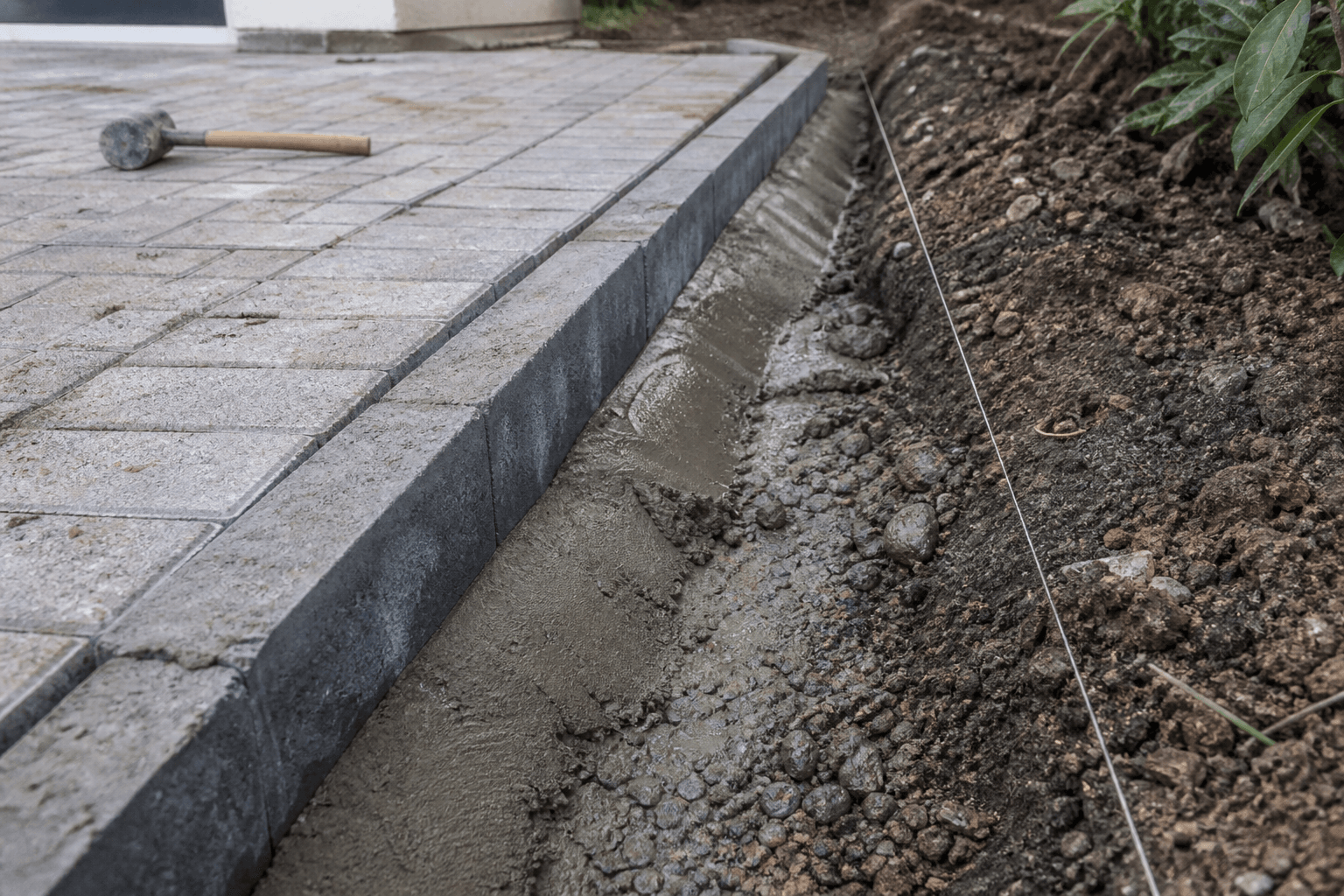
You've got three options for block paving edging: a kerb-style edging unit, a header-course of standard blocks set crossways, or a 90-degree upright soldier course. All three are bedded in a concrete haunch. The haunch must come up at least one-third of the block height behind the edge, otherwise the restraint moves under load.
Top tip. Lay your edge before the sub-base goes in deep. It gives you a fixed datum to screed against.
Ready to book One-Off Cleaning?
Send a quick enquiry — we typically respond the same working day.
Step 4: Lay and compact the MOT Type 1 sub-base
Sub-base costs around £53 per 50mm of compacted depth across a 10m² area (WhatCost, 2026). Spread it in two 50mm layers, not one 100mm dump. Compact each layer separately with the plate compactor, four to six passes per layer.
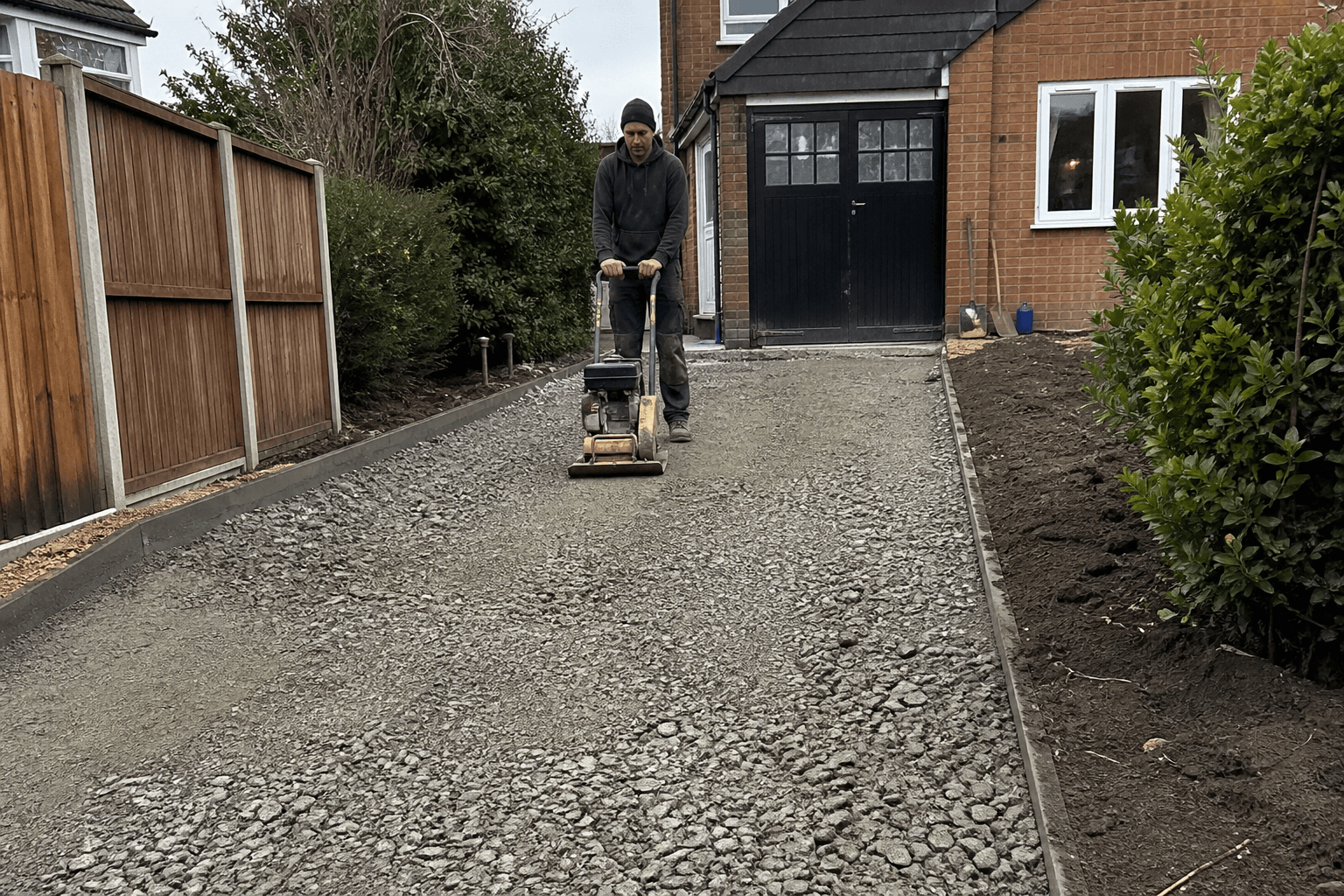
Target a finished compacted depth of 100mm for a patio or 100-150mm for a driveway. Check the falls with string and a spirit level after each compaction pass. If you've hired a Marshalls-approved plate compactor or equivalent from HSS, the weight will do the work, you just need to walk it slowly. Allow a full day for a 30m² driveway.
Common mistake. Trying to compact 150mm of MOT Type 1 in one pass. Only the top 50mm actually compacts. The rest stays loose and fails.
Step 5: Spread and screed the laying course
The laying course is 30mm of sharp sand, screeded to a flat surface that follows your falls. Use sharp sand only, never building sand and never kiln-dried sand. Marshalls is explicit: kiln-dried sand is for jointing only (Marshalls, 2025).
Lay your screeding bars (50mm box section steel) parallel along the area, sand between them, then pull a screeding board across. Don't step on the screeded sand once it's flat. Work backwards from your finishing edge. Allow one to two hours for a 30m² driveway.
Common mistake. Using kiln-dried sand for the laying course. It's the wrong grade, doesn't bind under load, and the blocks rock within days.
Learn more about Builders Waste Removal
Browse how we deliver Builders Waste Removal and the questions homeowners ask most often.
Step 6: Lay the blocks
Start from a fixed 90-degree corner against your edging, never in the middle. Tap each block down with a rubber mallet, leaving a 2-5mm joint gap. A 90-degree herringbone pattern gives the best load distribution for driveways; 45-degree herringbone looks tidier on patios but is more cuts.
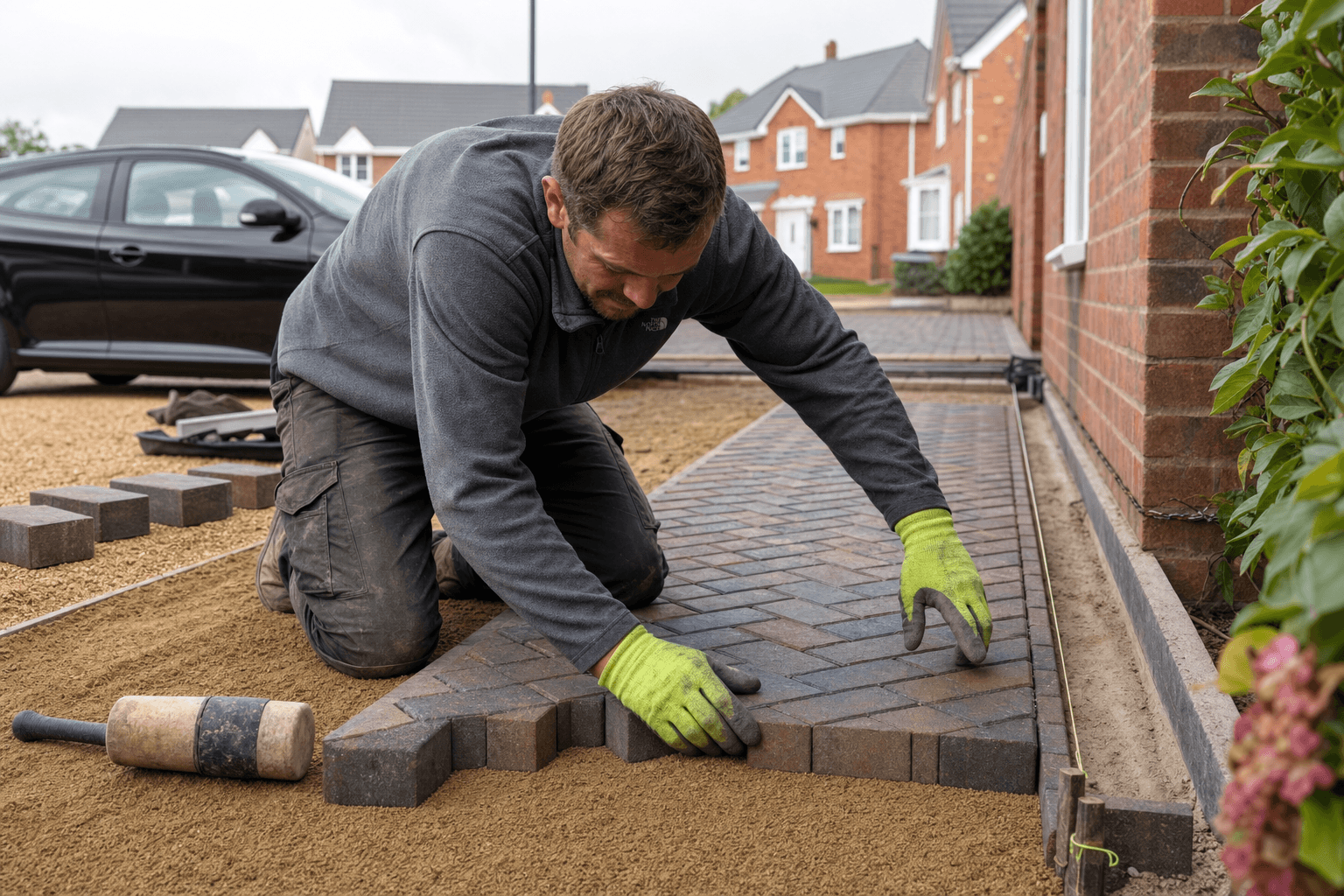
Work in roughly 1m² rows, checking your line every few rows with a long spirit level laid across the surface. Knee pads matter, because you'll be down there for hours. Most DIYers manage 8-12m² per day. The same approach broadly applies if you're learning how to lay paving slabs or laying a patio in slab format, though the joints are wider.
Common mistake. Starting in the middle. You'll lose your line within twenty blocks. Always work from one fixed edge outward.
Step 7: Cut blocks for edges and detail
Cuts are where the silica dust risk is highest. The HSE COSHH guidance requires an FFP3 mask, not the cheaper FFP2 (HSE, 2025). Wet-cutting with a block paving cutter or wet-cut saw also dramatically reduces airborne dust compared to dry splitting.
Mark every cut with chalk before you start. A hired block splitter is faster for straight cuts; a wet-cut saw is essential for angles and curves. Allow half a day to a full day for cuts on a 30m² area. Cuts smaller than one-third of a block fracture under compaction, so re-jig the layout rather than fitting tiny offcuts.
Safety callout. Wear an FFP3 mask, safety glasses, and ear defenders for every cut. Silica exposure is cumulative and not reversible.
Thinking about Garden clearance?
Share your postcode and job details for a no-obligation quote.
Step 8: Compact the field
Once all blocks are laid and cut, run the plate compactor over the entire field. Use a rubber compactor mat or a sheet of thick plywood to protect the block surface. Two passes minimum, three is better. This seats the blocks into the sharp sand laying course and locks them into the falls.
Do not compact before all your cuts are in. If you compact a partial field and then add cuts later, the cut blocks sit slightly proud and the finish looks uneven. Allow thirty minutes for a 30m² driveway, including overlaps.
Common mistake. Compacting before all cuts are placed. The cut blocks then fail to sit flush and the surface looks patchy.
Step 9: Joint with kiln-dried sand and seal
Brush kiln-dried sand into every joint until it stops disappearing, then compact, then brush again. Repeat until all joints are full to within 2-3mm of the block surface. This is what stops blocks moving laterally under load. Allow one to two hours for a 30m² driveway.
Wait 24-48 hours of dry weather, then seal if you want a darker, deeper colour and easier maintenance. Sealing typically costs £8.50-£12.50 per m² for a contractor (WhatCost, 2026), or £4-£6 per m² in materials if you're doing it yourself. Sealing is optional, jointing is not.
Common mistake. Jointing on a damp day. The sand clumps in the broom and the joints never fully fill.
Check scope and pricing for One-Off Cleaning
Compare options, add-ons, and what affects the final price before you commit.
How to check you did it right
Five checks tell you whether the block paving steps were laid correctly:
- Pour a bucket of water at the highest point. It should run off, not pool.
- Walk every joint with weight on one foot. No block should rock.
- Push hard on each edge restraint. It should not move.
- Inspect every cut. No fractures, nothing smaller than one-third of a block.
- Check sand level. Just below the block surface, all joints full.
Quote, Interpave technical guidance, 2024. "Failure of block paving is almost always a failure of the sub-base or the edge restraint, not of the blocks themselves."
When something goes wrong: troubleshooting
The three problems below cover roughly 80% of DIY block paving callbacks in the UK, based on installer survey data (Marshalls Register, 2024).
Problem 1: a row of blocks is sinking after a week
The cause is almost always missed compaction in one sub-base layer, or inadequate sub-base depth at that point. Lift the affected blocks, compact the sub-base again, re-screed the sharp sand, re-lay. Don't try to wedge sand underneath, it won't hold.
Problem 2: joints keep washing out
Heavy rain pulls kiln-dried sand out of unsealed joints, particularly on a sloped driveway. Top up the kiln-dried sand on a dry day, compact it in, then seal the surface once the joints are stable. A breathable sealer (£8.50-£12.50/m² installed) holds the sand in place.
Problem 3: efflorescence (white bloom on blocks)
A chalky white residue can appear in the first three to twelve months. This is natural lime migration from the concrete blocks, not a defect. Don't pressure-wash it hot. Wait six to twelve months, brush it off, or apply a proprietary efflorescence cleaner from Marshalls or Brett.
Need help with Builders Waste Removal?
Tell us about your job and we will match you with the right professional for Builders Waste Removal.
When to give up and call a driveway installer
Five signs you should stop DIY-ing and search for driveway installers near me instead. Be honest with yourself.
- Falls won't run off and water pools after rain.
- Edges keep creeping despite a haunch.
- The sub-base sinks under foot.
- A skip carrier has refused your spoil (it's not classified inert).
- You're more than half a day behind schedule on day two.
A Taskino-vetted block paving installer in Reading recently quoted £92/m² fitted for a 35m² Marshalls Drivesett Tegula driveway, including muck-away. For most people, that's cheaper in time and risk than finishing a botched DIY.
Roughly what a pro would charge for this
UK installed prices typically run £75-£140 per m² for block paving in 2026, depending on block range, layout complexity, and access (Checkatrade, 2026). Marshalls Drivesett Tegula sits around £85-£110/m² installed. Higher-end ranges like Tobermore Historic or Brett Alpha can push £130/m². Add 10-15% for tricky access or curved layouts. See our full block paving cost breakdown.
Explore our Garden clearance service
See what is included, typical timings, and what to prepare before you book.
How Taskino can help
Most people who start laying block paving themselves do fine on the first 5m². The wheels come off around day two, when the falls aren't running and the spoil pile won't fit in the skip. If you'd rather skip that bit, Taskino can put you in front of a Marshalls Register or BALI installer in your postcode. Three quotes, public liability checked, no leaflet drop. Worth a look before the bank holiday weekend disappears. See our driveway cleaning service once it's in. For lawn edges and beds round the new paving, our garden maintenance guide picks up where this one stops.
Sources
- Interpave technical guidance, paving.org.uk, 2024-2025.
- Marshalls installation guide, marshalls.co.uk/installation, 2025.
- DEFRA SUDS non-statutory technical standards, gov.uk, 2008.
- HSE COSHH silica dust guidance, hse.gov.uk, 2025.
- HSS Hire rate card, hsshire.co.uk, 2026.
- WhatCost UK paving cost data, whatcost.co.uk, 2026.
- Checkatrade block paving cost guide, checkatrade.com, 2026.
- Marshalls Register installer survey, 2024.
Frequently asked questions: How to Lay Block Paving: A Step-by-Step Guide for UK Homeowners
Short answers to common questions about this topic.
Our team will answer all your questions. we ensure a quick response.
Contact UsRelated posts
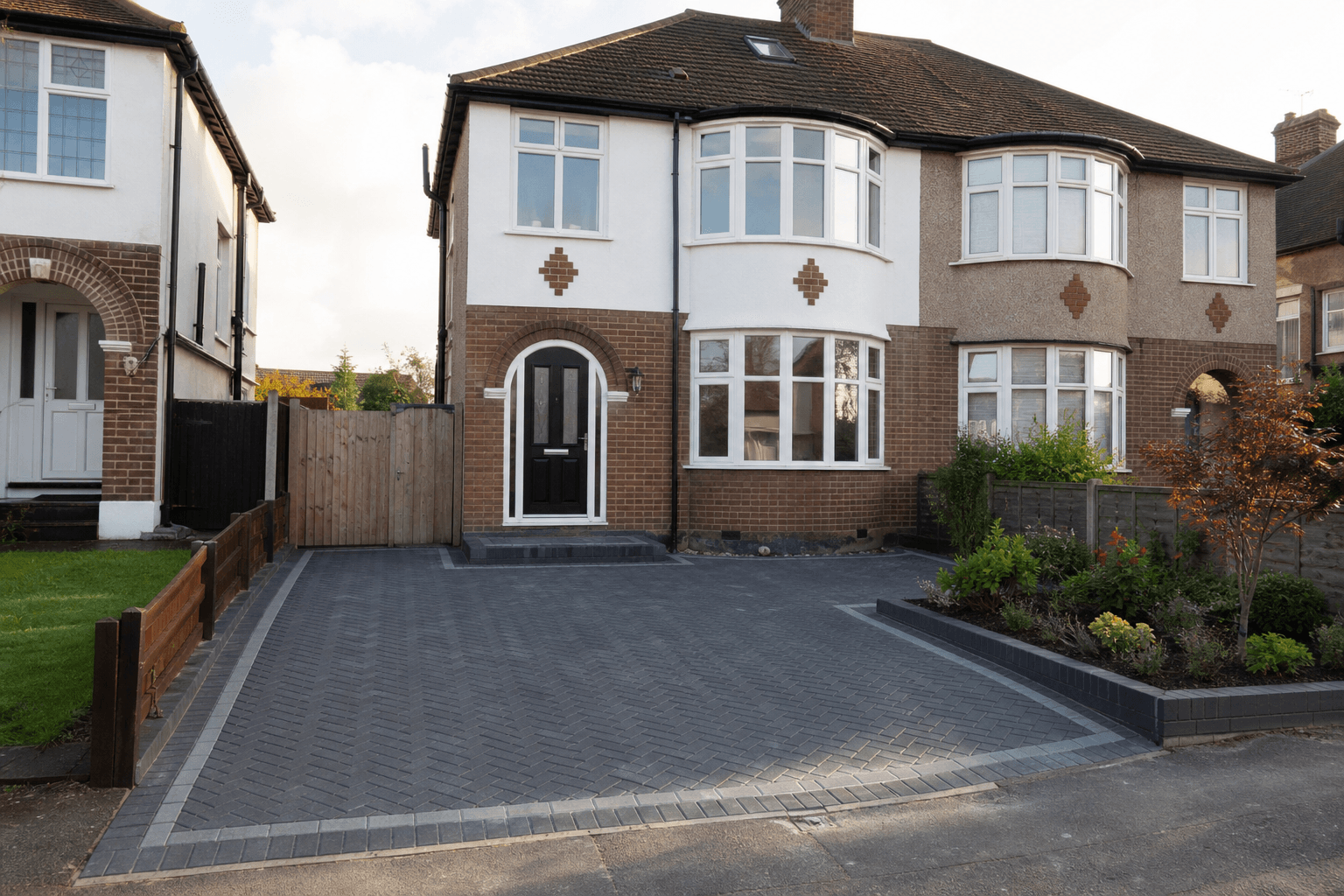
Complete UK 2026 guide to block paving: realistic costs per m², DIY laying steps, SUDS rules, comparison vs resin and tarmac, plus how to hire well.
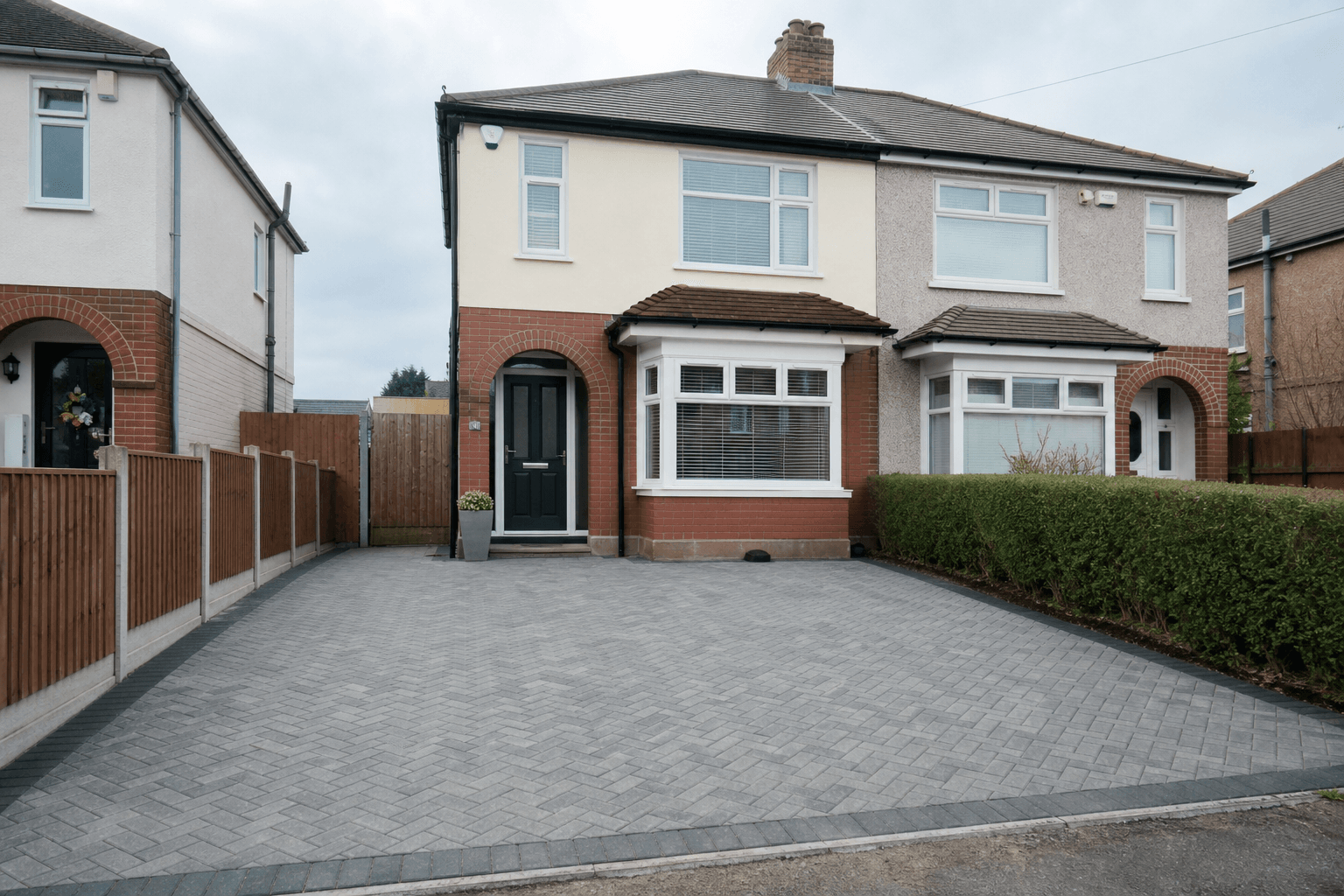
Real 2026 driveway installation costs by material and region. Block paving, resin, tarmac, gravel and concrete prices per m² and per job, with sources.
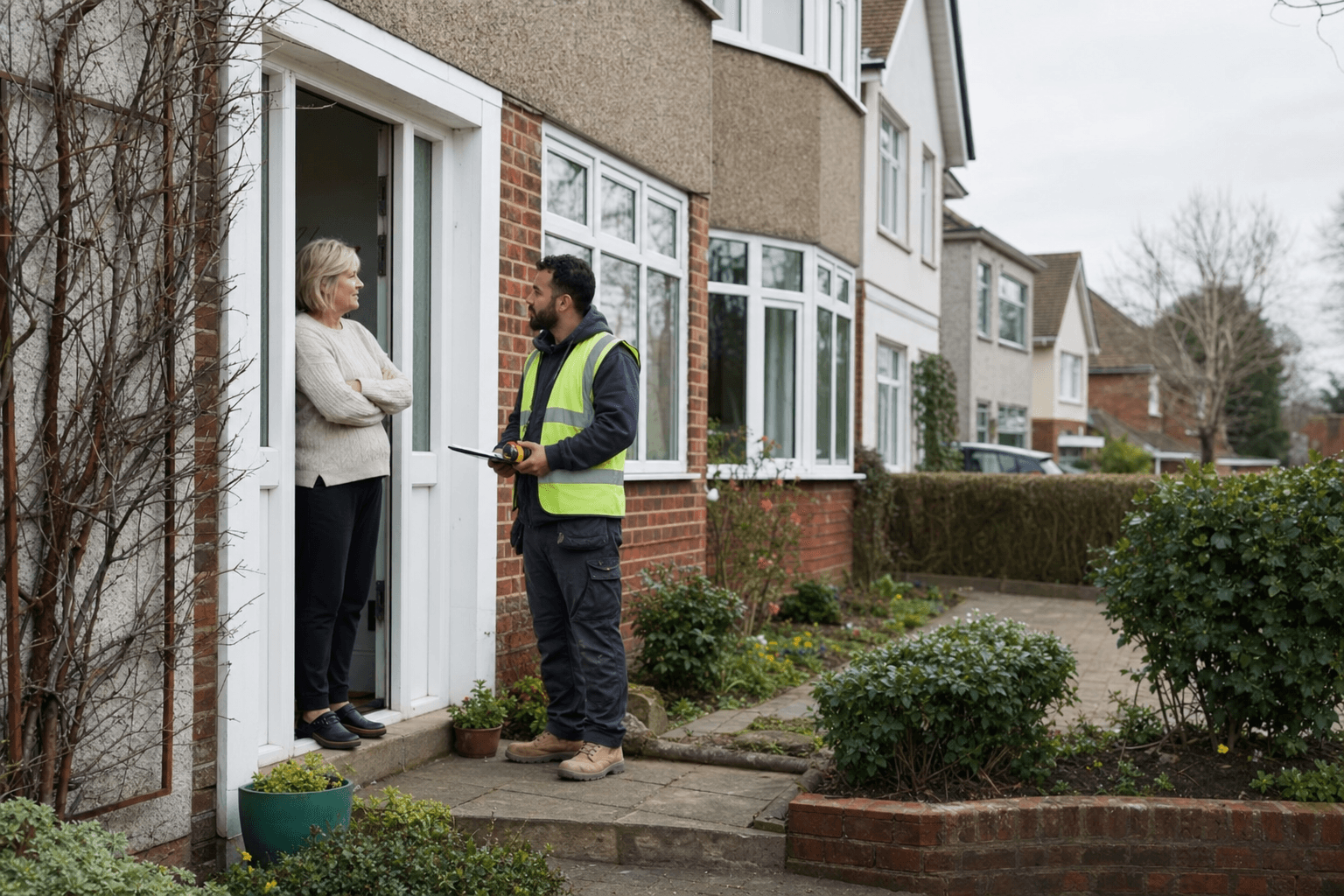
Find a trusted UK driveway installer in 2026, the 13 questions to ask, red flags to spot, and how to check Marshalls Register, BALI, APL and insurance.
Latest in Outdoor Services
View all in this category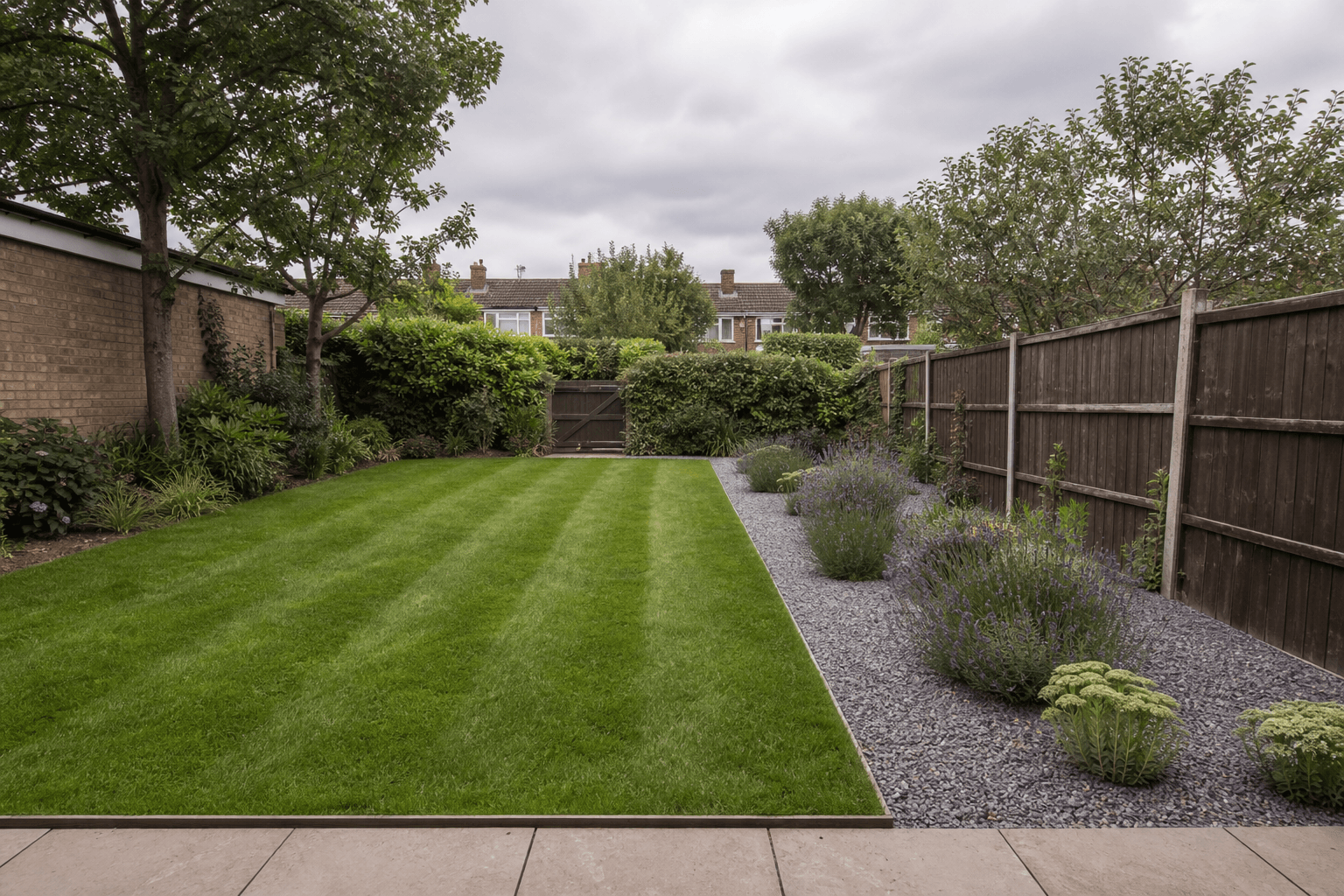
Compare real lawn, artificial grass and gravel for UK gardens: 10-year cost, climate fit, resale impact and which actually saves you time.
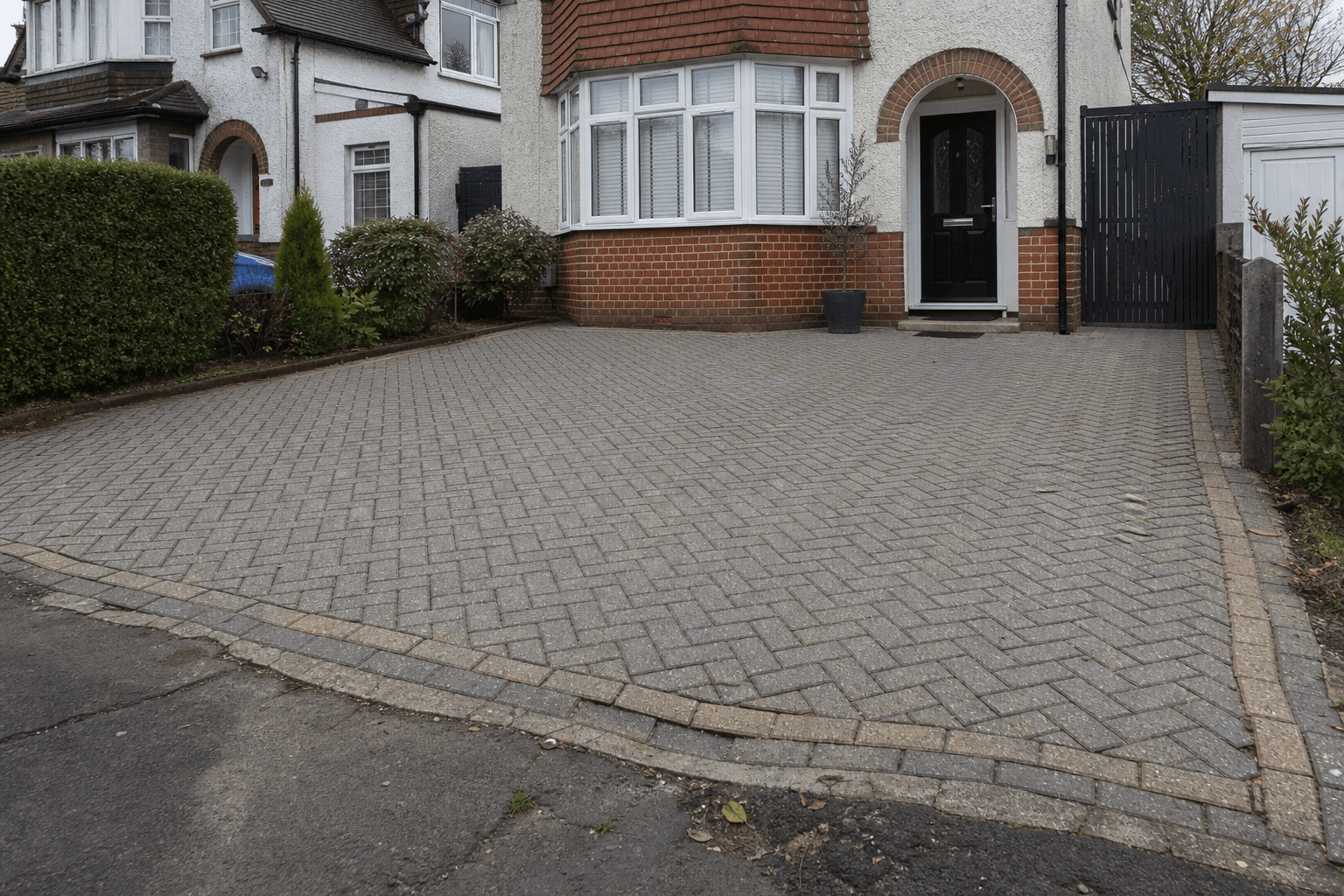
The 11 block paving driveway mistakes UK homeowners make in 2026, from missed edging to wrong sand, and how to avoid each one before it costs you.
UK garden mistakes that cost real money: illegal hedge cutting, wrong-season scarifying, over-fertilising. Fix each one, save up to £1,200/year.
Related services
Professional builders waste removal across the UK. Insured crews clear rubble, plasterboard and mixed site waste from renovations with clear quotes and licensed disposal.
Garden clearance across the UK: green waste, soil, rubble and project leftovers removed by licensed crews. Clear quotes, complete clear-up, no hidden fees. Contact us for a tailored quote.
One-off cleaning for homes and flats by vetted, insured professionals. Fast bookings, clear quotes and a thorough clean tailored to your needs. Ideal for end-of-tenancy, pre-event or seasonal deep tidy.
Ready to Book Your Service?
Tell us what you need and our team will help you find the right professional quickly, with clear pricing and no hidden fees.