
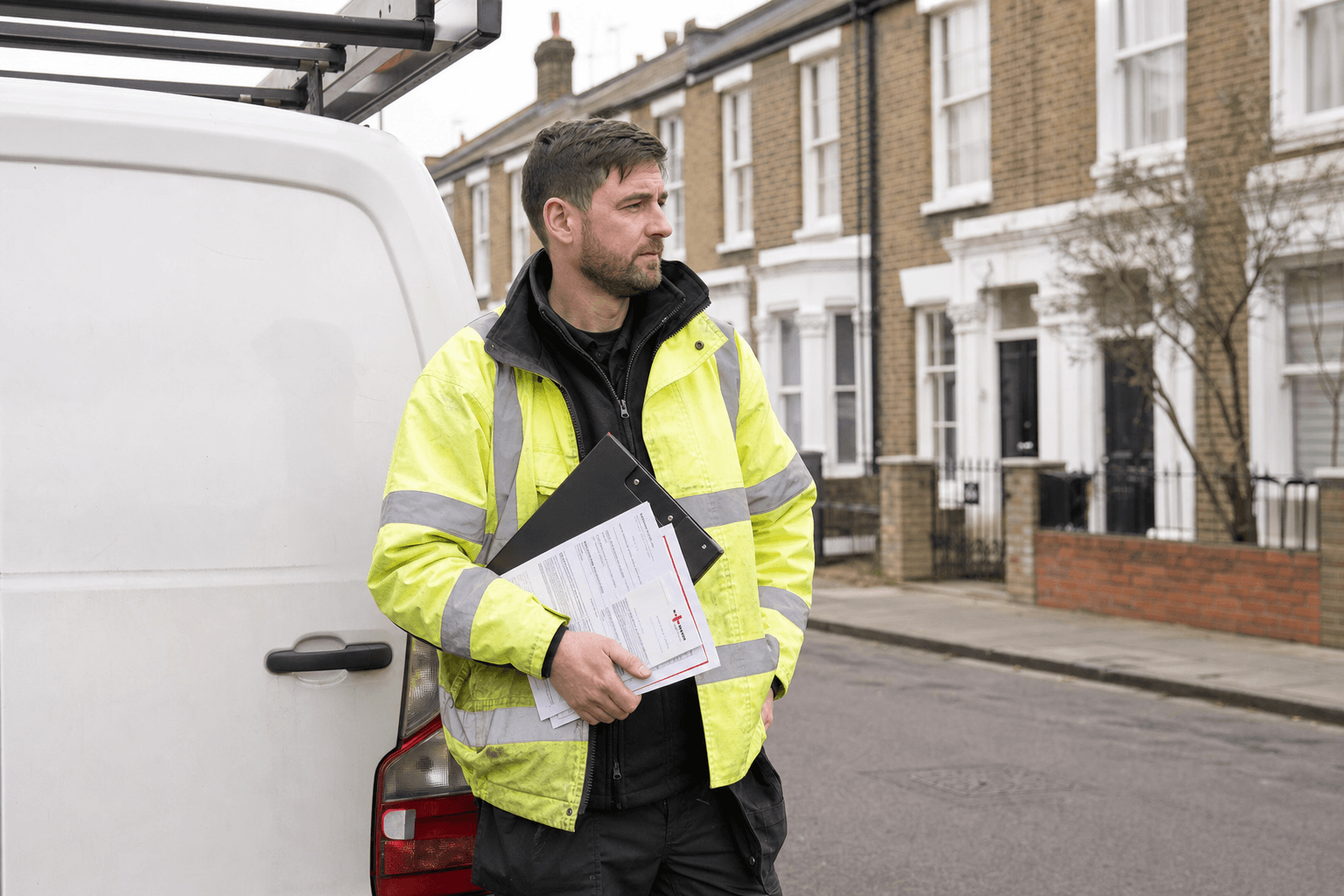
How to Hire a NICEIC Electrician in the UK: 14 Questions to Ask
How to hire a NICEIC electrician in the UK: 14 vetting questions, the red flags that end the call, and how to verify a commercial electrician's Part P in 5 minutes.
Hiring a NICEIC electrician (or NAPIT, ELECSA, STROMA equivalent) in the UK comes down to one thing: can you verify their enrolment number on the public register before they touch your consumer unit? A registered domestic installer or commercial electrician will hand you that number without flinching. Everyone else is a risk you legally carry yourself.
TL;DR
- The single best filter: "What's your NICEIC enrolment number and can I look you up?" A real registered electrician gives it without hesitation.
- The red flag that ends the conversation: "Cash only, no certificate." Walk away. The Building Act 1984 £5,000 fine sits with you, not them.
- Verify in 5 minutes: NICEIC register, NAPIT register, Companies House, then ask for the £2m public liability certificate.
- For any contract signed at your home or online, the Consumer Contracts Regulations 2013 give you 14 days to cancel.

For broader home electrical safety context — earthing, circuits, and when to call a pro — see our home electrical safety guide.
Before you contact anyone: what to prepare
Around 38,000 contractors sit on the NICEIC register (NICEIC, 2026), and most of them will ask you the same opening questions on the phone. Prepare the answers in advance and you cut quote time in half. A 60-second prep pack gets you sharper quotes from any commercial electrician or domestic installer.
Seven things to have ready before you dial:
- Take photos of the work area, the consumer unit, and any visible old wiring (rubber, fabric, or pyro = serious).
- Count the circuits on your CU (each MCB or RCBO equals one circuit).
- Note your property age (decade is enough: 1930s, 1970s, 2000s).
- Define the scope in writing (EICR? CU upgrade? New circuit? EV charger? Like-for-like swap?).
- Decide your budget range and your "absolute no" ceiling.
- Decide your timeline (urgent, this month, sometime).
- Plan parking, especially if you sit inside a London CPZ.
Citation capsule. The NICEIC scheme, run by Certsure, regulates roughly 38,000 registered electrical contractors across the UK and operates the largest Part-P competent-person register in the country (NICEIC, 2026). Verification of an enrolment number on the public register is free and takes under two minutes.
Need help with Electrical jobs?
Tell us about your job and we will match you with the right professional for Electrical jobs.
Where to find a NICEIC electrician you can trust
Roughly £2m public liability is the industry-standard minimum on domestic work, with £5m+ expected for commercial electrician jobs (Electrical Safety First, 2026). The right source decides whether you start that conversation with someone insured or someone who will go quiet when you ask for a certificate.
Trade body directories
Four free public registers cover most of the UK market:
- NICEIC "Find a Trusted Electrician" (the largest, c.38,000 firms).
- NAPIT "Find an Installer" (the second-largest competent-person scheme, NAPIT, 2026).
- ELECSA register, run by Certsure alongside NICEIC.
- STROMA Certification register.
All four are free, postcode-searchable, and show enrolment status today, not last year.
Marketplaces and review platforms
Checkatrade, MyBuilder, Which? Trusted Trader, Taskino, and RatedPeople each combine reviews with some level of vetting. Cross-check any name you find on a marketplace against the trade body register. Reviews tell you about politeness; the register tells you about Part-P competence.
Personal referrals
The right question to a neighbour is not "were they nice?" but "did they give you a certificate after the job, and was it on NICEIC headed paper?" That single question filters honest referrals from cheap ones.
Avoid these channels
Cold doorknocks after a storm, leaflets quoting a flat "24-hour-emergency electrician near me" callout fee with no firm address, certain Facebook groups, and "trader" listings with no Companies House record. A real emergency electrician near me trades under a registered limited company and answers the register check.
The 8 questions to ask BEFORE booking the visit
Eight phone-call questions filter most cowboys before anyone parks on your driveway. Each has a good answer and a bad one, and the bad answers fail in roughly the same way: vague, deflecting, or annoyed at being asked. A registered commercial electrician expects these questions.
1. "What's your NICEIC (or NAPIT / ELECSA / STROMA) enrolment number?"
- Good: They give it instantly and tell you the public register URL.
- Bad: "We use a NICEIC sub-contractor." (That means the firm itself is not registered.)
2. "Are you Part P registered as a competent person?"
- Good: "Yes, under NICEIC's Domestic Installer scheme, enrolment number ____."
- Bad: "Part P? That's just paperwork."
Part P is not paperwork. It is a Building Regulations requirement under Approved Document P and a £5,000 fine if breached.
3. "What public liability insurance do you carry?"
- Good: "£2m PL minimum, £5m for commercial work, happy to send you the certificate."
- Bad: "Self-insured." Walk away.
4. "Can you do an EICR or just minor works?"
- Good: They confirm and quote both BS 7671:2018+A2:2022 and the appropriate certificate type (EICR, MWC, or EIC).
- Bad: "We don't do certificates." See eicr certificate cost for typical 2026 prices.
5. "Do you issue an EIC / MWC / EICR on NICEIC headed paper?"
- Good: "Always, signed and within 5 working days."
- Bad: "I'll give you a receipt."
6. "Will you notify LABC for me if the job is Part-P notifiable?"
- Good: "Yes, NICEIC notifies on our behalf within 30 days of completion."
- Bad: "You'll need to do that yourself." A registered scheme member notifies via the scheme.
7. "Have you done a job of this type in a property of this age before?"
- Good: They name a specific recent job in the right decade of build, and they know the relevant uk wiring colours (red/black pre-2004 vs brown/blue post-2004).
- Bad: Hesitates or generalises.
8. "Can you give me three recent references I can call?"
- Good: Email a sheet within 48 hours, with first names, street, and job description.
- Bad: "All my work's confidential."
Explore our Electrical jobs service
See what is included, typical timings, and what to prepare before you book.
The 6 questions to ask DURING the quote visit
A registered scheme member of the national inspection council for electrical installation contracting (NICEIC) will give written quotes, fixed-price totals for rewires, and a clear payment schedule. Cash-on-the-day asks from a doorstep quote are a red flag, full stop.
9. "Is this quote fixed-price or hourly?"
Rewires and CU swaps should always be fixed-price. Hourly quotes on big-scope jobs end in surprise invoices.
10. "Does the quote include VAT? Materials? Make-good?"
Full transparency expected. Look for BG, MK, Hager, or Wylex named on materials, and the cable spec written (e.g. 2.5mm² T&E).
11. "What payment milestones do you take?"
Never more than 25% deposit. Balance on certificate completion. If they want full payment upfront for a £4,000 CU upgrade, that is your cue to leave.
12. "What's your guarantee period?"
NICEIC's Platinum Promise covers 6 years on workmanship for registered firms. Ask explicitly. Get it in writing.
13. "What happens if you find further faults mid-job?"
A Taskino-vetted NICEIC electrician in Newcastle reports that around 30% of his EICRs are second-opinion jobs, taken on because the homeowner could not verify the previous installer's certificate or chase the firm down for a variation. A good answer here: stop, photograph, agree a written variation, then continue.
14. "When will the certificate be issued?"
Within 30 days of completion per Building Regulations notification. If the firm is registered, the scheme notifies LABC for you.
Red flags that mean walk away
Most of these red flags appear inside the first ten minutes of contact. Listen for them. One is enough to end the conversation, and two together are a guarantee the certificate at the end will not stand up.
- Cash-only with no VAT receipt.
- "We're NICEIC registered" but won't give a number.
- "Pass guaranteed" on an EICR (no honest electrician promises that).
- Deposit request over 25% of total.
- Won't put the quote in writing.
- No public liability insurance proof.
- Pressures you to sign on the doorstep.
- Different person turns up than the one who quoted.
- No fixed date for certificate issuance.
- The van has no business name, no Companies House number, and no NICEIC sticker.
Walk-away rule. Hire a registered competent person, or the Building Act 1984 £5,000 fine sits with you, the homeowner, not the installer.
Ready to book Electrical jobs?
Send a quick enquiry — we typically respond the same working day.
How to verify their credentials in 5 minutes
Verification is free and takes under five minutes across four open websites. A registered commercial electrician passes all four checks. A cowboy fails at the first.
Trade body check
Use the NICEIC public register at niceic.com/find-a-tradesperson/, NAPIT at napit.org.uk/find-an-installer/, and ELECSA via Certsure. Search by enrolment number first, then by postcode.
Companies House check
Go to find-and-update.company-information.service.gov.uk. Confirm the limited company is active. Check its filing history. A firm filing dormant accounts on a £4,000 rewire is a red flag.
Insurance check
Ask for the PL certificate. Confirm £2m+ minimum and a current expiry date. £5m+ for commercial electrician work.
Reviews check
Cross-check Checkatrade, Google Business Profile, and NICEIC's own reviews. Look for verifiable photos, specific job details, and dates from the last 12 months.
How to read a written quote
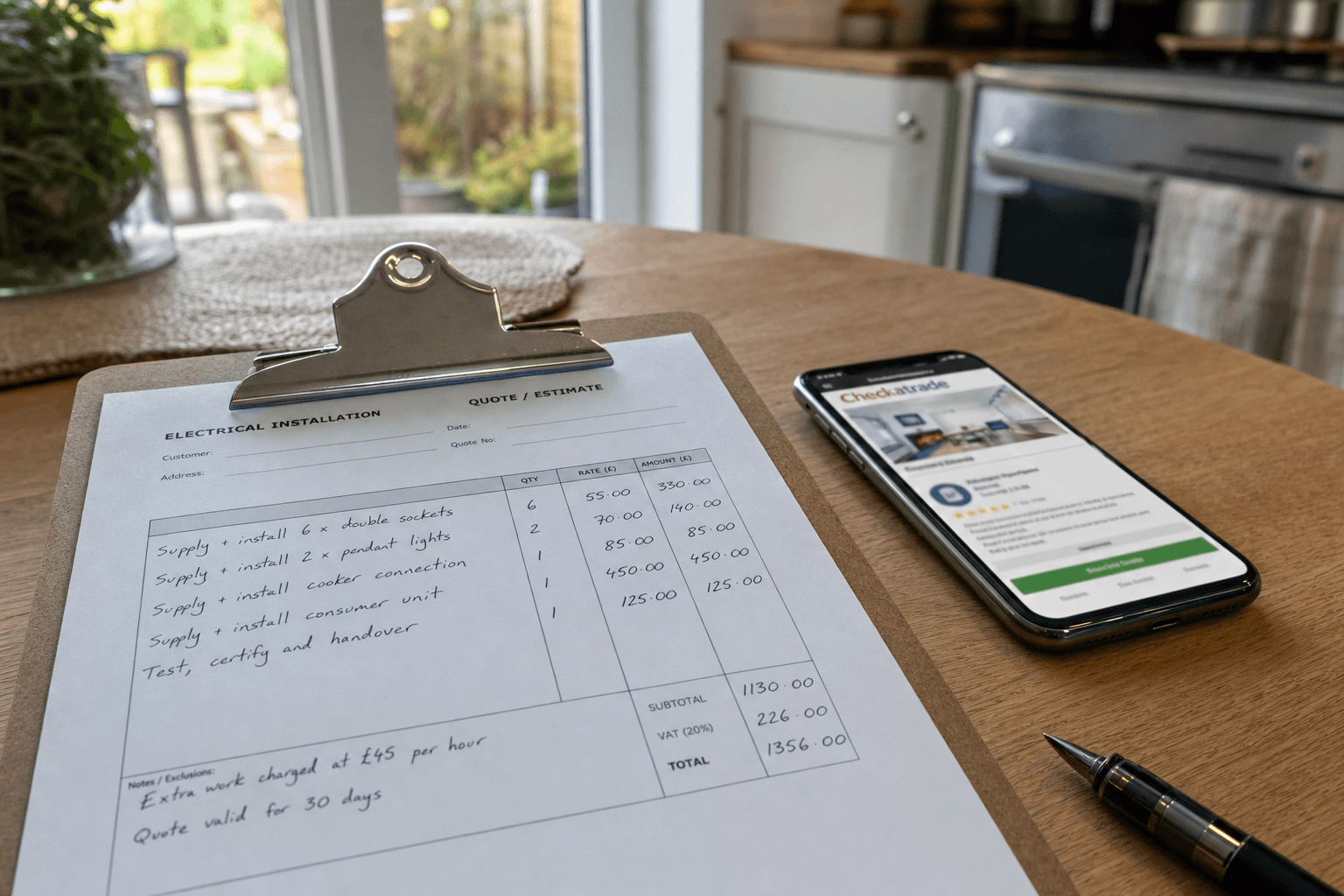
A written quote should not contain the word "various" anywhere. Every line should name a product, a circuit, a certificate type, or a fixed sum. The table below sets the bar.
| Line item | What it should look like | Red flag if missing |
|---|---|---|
| Scope of work | Named room, circuit, accessory count | "Various" |
| Materials | BG / MK / Hager / Wylex named, cable spec (2.5mm² T&E) | "As required" |
| Labour | Days plus hourly OR a fixed sum | "TBC" |
| Certificate type | EIC / MWC / EICR | Not mentioned |
| LABC notification | Included, by NICEIC | Not mentioned |
| VAT | Shown separately | "Tax extra" |
| Total | Including VAT | Excluding |
| Payment terms | 25% deposit, 75% on certificate | "Full up front" |
| Guarantee | 6-year NICEIC Platinum Promise | None |
Learn more about Electrical jobs
Browse how we deliver Electrical jobs and the questions homeowners ask most often.
Contracts and consumer protection
Any service over £42 sits under the Consumer Rights Act 2015 section 49, which requires services to be performed with "reasonable care and skill" (legislation.gov.uk, 2015). For contracts agreed at your home, the Consumer Contracts Regulations 2013 add a 14-day right to cancel.
When you legally need a written contract
Anything over £42, anything off-premises (agreed in your home, agreed online), and anything where the price could vary. Get it in writing or you make the dispute harder for yourself.
Cancellation rights
The Consumer Contracts Regulations 2013 give 14 days to cancel any off-premises or distance contract (legislation.gov.uk, 2013). The trader must tell you about this right in writing. If they don't, the cancellation window extends to 12 months.
Deposit limits
Never more than 25%. A firm asking for 50%+ on a £5,000 rewire is asking you to underwrite their cashflow. That is not your job.
How to pay safely
Avoid cash for jobs over £500. Bank transfer is fast but offers no built-in protection. Credit card adds Section 75 of the Consumer Credit Act 1974, which makes the card issuer jointly liable on goods and services priced £100 to £30,000 (legislation.gov.uk, 1974). That is the single best £-protection a UK homeowner has.
Section 75 callout. On a £4,000 CU upgrade paid by credit card, the card issuer is jointly liable with the electrician for any breach of contract. Pay £100+ by credit card on every big electrical job.
After the job: snagging, retention, and disputes
The certificate is the close-out, not the invoice. Hold final payment until the EIC, MWC, or EICR arrives on NICEIC headed paper and snag items are resolved. Most disputes evaporate when the certificate lands; the rest follow a clear UK escalation route.
How to snag properly
Test every accessory (socket, switch, light fitting). Check faceplate alignment and consistent screw orientation. Match the certificate against the scope: every circuit listed, every test result filled in, no blank fields.
When to release final payment
After the certificate is received and the minor snag list is signed off. Not before.
How to escalate if it goes wrong
- NICEIC complaint procedure first (niceic.com/consumer/help-and-advice/raising-a-complaint/).
- Citizens Advice second, for general consumer rights.
- Small Claims Court third, online portal on gov.uk for sums under £10,000.
Thinking about Electrical jobs?
Share your postcode and job details for a no-obligation quote.
Domestic vs commercial electrician — who do you need?
A commercial electrician handles offices, retail, and light industrial work, with three-phase competence and PL insurance at £5m+. Most domestic NICEIC firms can take small commercial jobs, but verify the firm holds the NICEIC Approved Contractor scheme (a higher tier than Domestic Installer) for anything beyond a single dwelling.
If your job is a tripping RCD on a single circuit at home, see electrical repairs near me for the diagnostic walk-through; a Domestic Installer can handle it. If your job is rewiring a shop or a small warehouse, ask specifically for the Approved Contractor scheme. The same logic applies on the gas side, where you would look for Gas Safe registration before booking any boiler problems work.
How Taskino vets the electricians on the platform
If 14 vetting questions across two phone calls feels like more diligence than a Saturday afternoon will give you, that's exactly the gap we sit in: every Taskino electrician is checked against the NICEIC or NAPIT public register, asked for current £2m+ PL, and screened on Companies House before they ever land in your shortlist. We don't promise miracles. We promise the boring checks are already done.

Check scope and pricing for Electrical jobs
Compare options, add-ons, and what affects the final price before you commit.
Sources
- NICEIC find-a-tradesperson register — https://www.niceic.com/find-a-tradesperson/
- NAPIT find-an-installer register — https://napit.org.uk/find-an-installer/
- Electrical Safety First hiring guidance — https://www.electricalsafetyfirst.org.uk/
- Consumer Rights Act 2015 section 49 — https://www.legislation.gov.uk/ukpga/2015/15/section/49
- Consumer Contracts Regulations 2013 — https://www.legislation.gov.uk/uksi/2013/3134/contents/made
- Consumer Credit Act 1974 Section 75 — https://www.legislation.gov.uk/ukpga/1974/39/section/75
- Building Regulations Approved Document P; Building Act 1984
- BS 7671:2018+A2:2022 IET Wiring Regulations
- NICEIC complaints procedure — https://www.niceic.com/consumer/help-and-advice/raising-a-complaint/
Frequently asked questions: How to Hire a NICEIC Electrician in the UK: 14 Questions to Ask
Short answers to common questions about this topic.
Our team will answer all your questions. we ensure a quick response.
Contact UsRelated posts

UK wiring colours old vs new, what DIY is legal under Part-P, current EICR & rewire costs, and how to hire a NICEIC electrician in 2026.
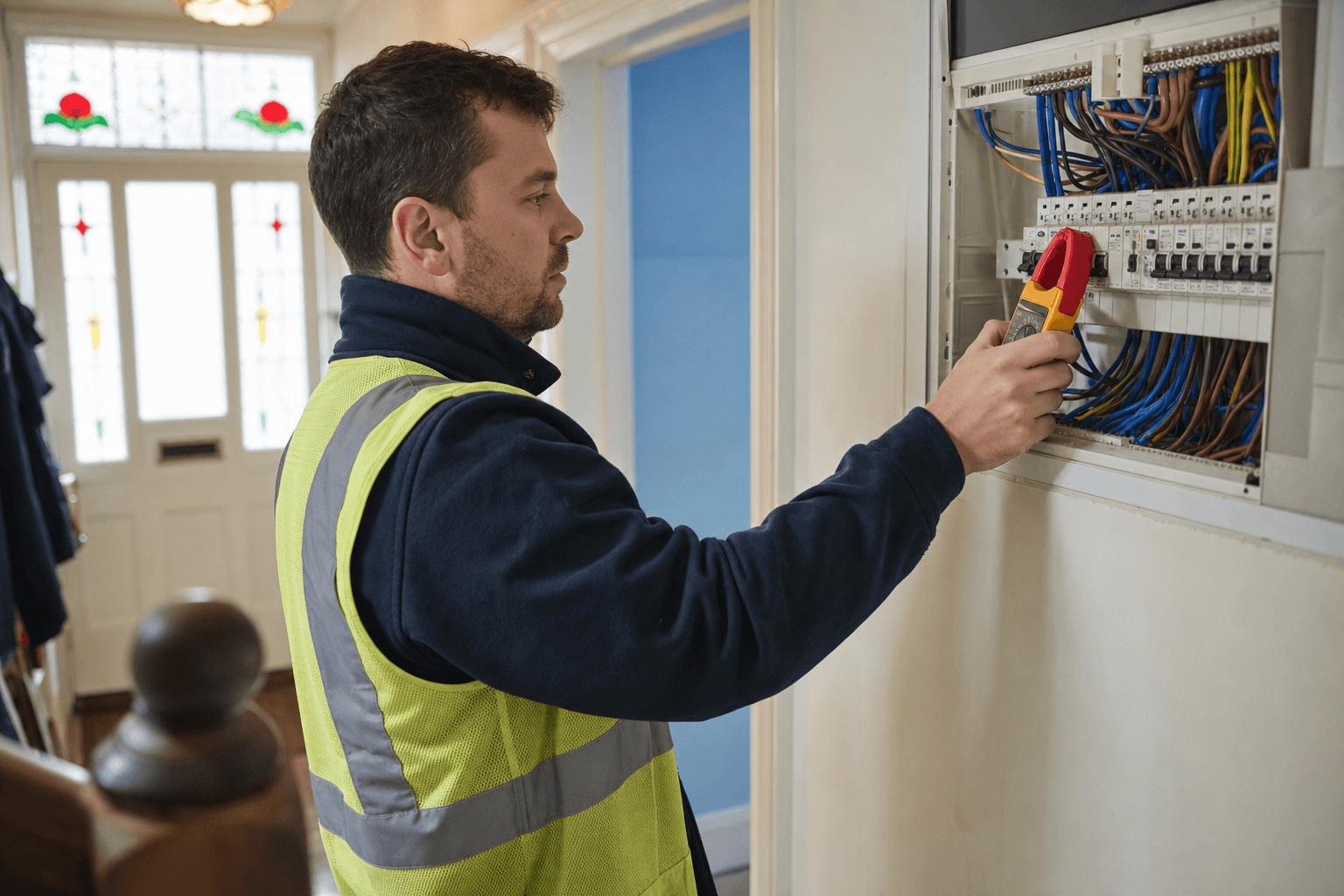
EICR certificate cost in the UK 2026: £150-£300 typical, by region, flat vs house. Plus rewire costs and electrician hourly rates explained.
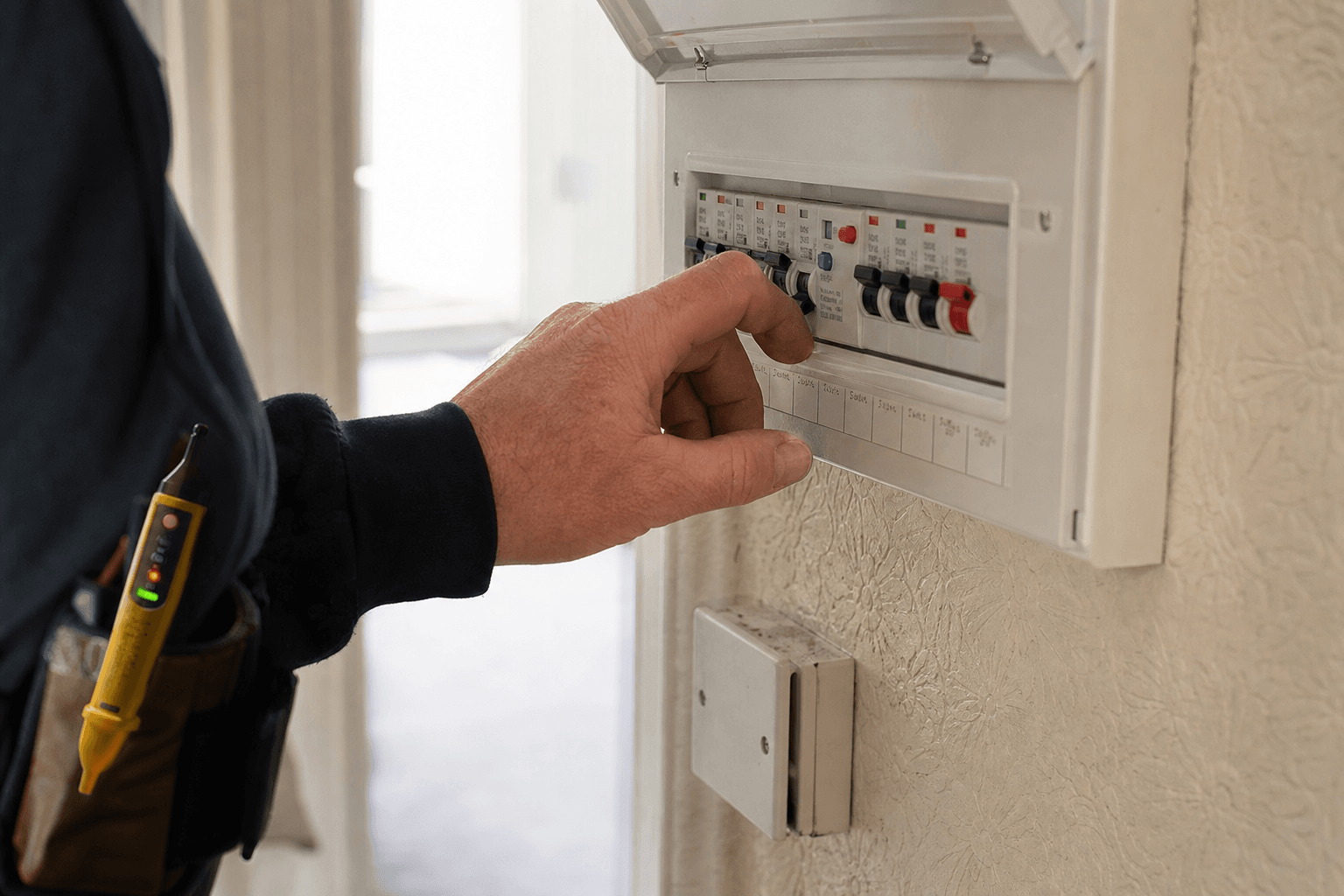
Why your RCD keeps tripping in the UK: 8 causes explained, what to safely check yourself, and when to book electrical repairs near you in 2026.
Latest in Handyman
View all in this category
Part P notifiable electrical work in 2026: a room-by-room list of what you can legally DIY in a UK home and what needs an NICEIC electrician.
DIY gas work is a criminal offence in the UK. What's legal (bleeding, repressurising), what isn't, and when to call a Gas Safe engineer.
Hire a UK plumber for a blocked drain: 13 questions, who owns outside drains, and how to report a blockage to your water company. Get a fair quote.
Related services
Book electrical jobs with Taskino to find qualified, insured electricians across the UK for safe repairs, installations and testing with clear quotes.
Ready to Book Your Service?
Tell us what you need and our team will help you find the right professional quickly, with clear pricing and no hidden fees.