
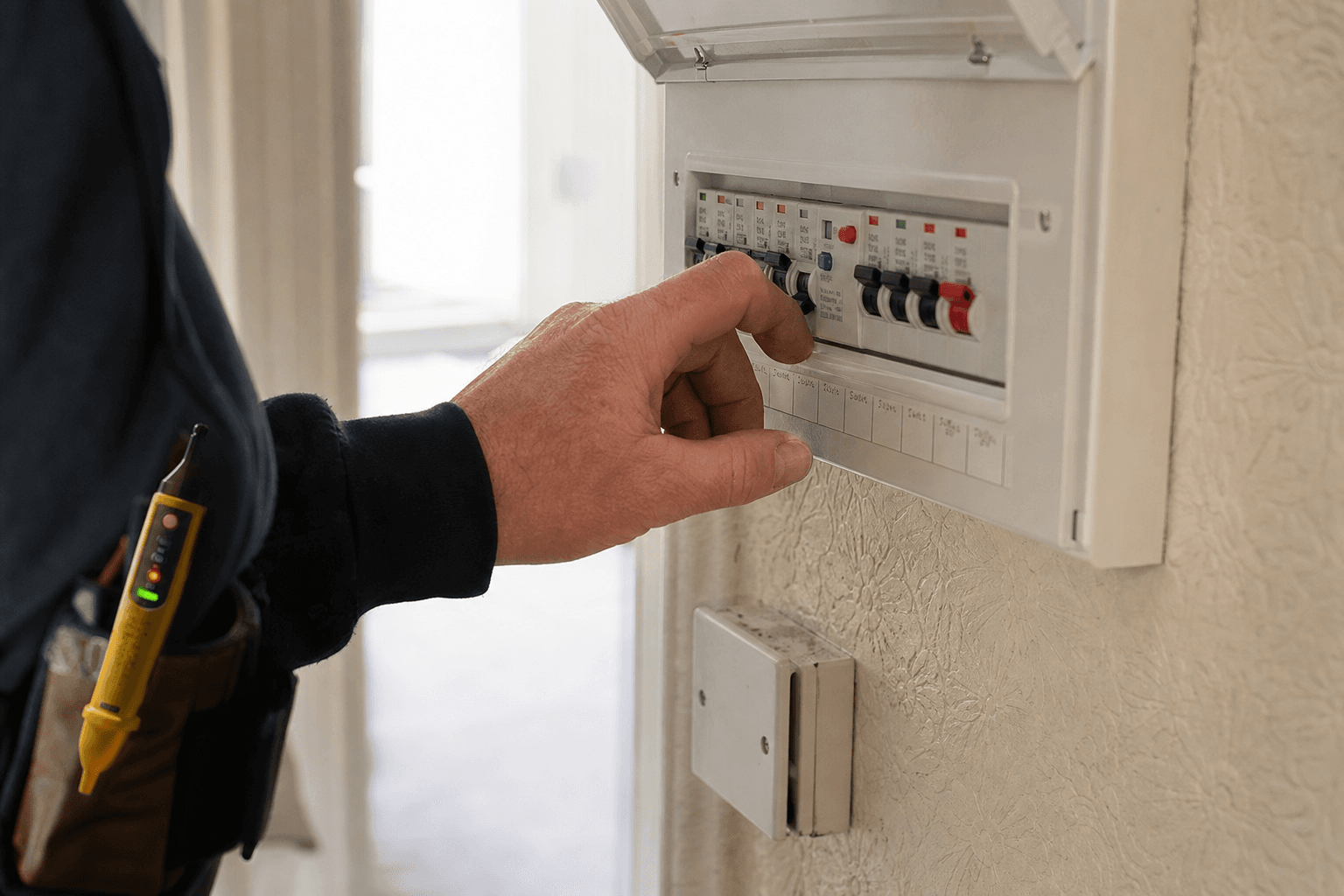
Why Does Your RCD Keep Tripping? 8 Causes Explained for UK Homeowners
Why your RCD keeps tripping in the UK: 8 causes explained, what to safely check yourself, and when to book electrical repairs near you in 2026.
If your fuse box keeps tripping the same RCD, the cause is almost always a single faulty appliance leaking current to earth, with washing machines, freezers and kettles the usual suspects. Before searching for electrical repairs near me, unplug everything on that RCD, reset the switch, and plug items back one at a time.
TL;DR
- Most common cause: a single faulty appliance leaking current to earth (kettle, washing machine, freezer, EV charger). Unplug everything on the affected RCD, reset, then plug back in one at a time.
- Cumulative leakage on split-load consumer units is the #1 cause in 1990s-2000s UK homes, solved by an all-RCBO upgrade.
- Emergency signs: burning smell, warm faceplate, or RCD won't stay reset. Isolate the main switch and call a NICEIC electrician immediately.
- Legal warning: Don't touch the consumer unit yourself. CU work is notifiable under Building Regulations Approved Document P, with fines up to £5,000 for non-compliance.
First: rule out the emergency
Around 53% of UK accidental house fires involve electricity, and consumer unit faults account for a measurable share of those (Electrical Safety First, 2024). Before you start diagnosing, scan for fire-risk signals. If any are present, stop testing and switch off at the main switch.
Citation capsule. Electrical Safety First's fire statistics report shows that over half of UK accidental dwelling fires involve electricity, with faulty appliances and overheating wiring the leading sources. This is why the burning-smell check comes before the diagnostic flowchart, not after.
Signs this is an emergency
- Burning smell from a socket or the consumer unit
- Warm, hot or discoloured faceplate
- Visible smoke or scorching at any accessory
- RCD trips immediately on reset and you can't isolate the cause
- A shock felt from a metal appliance casing
What to do in the next 60 seconds if any red flag is present
- Switch off the main switch on the consumer unit.
- Unplug everything on the affected RCD-protected side.
- Ventilate the room and clear people away from the CU.
- Open a window if there's a burning plastic smell.
- Do NOT pour water on any electrical fire (use a CO2 extinguisher only).
Who to call
If there's an active fire, dial 999 for the fire brigade first. For a suspected fault with smoke or sparking but no flame, the UK's national power-cut and electrical emergency line is 105 (Energy Networks Association, 2026). For a non-emergency callout, search for a local NICEIC-registered electrician.
For broader home electrical safety context — earthing, circuits, and when to call a pro — see our home electrical safety guide.
Need help with Electrical jobs?
Tell us about your job and we will match you with the right professional for Electrical jobs.
Cause #1: A single faulty appliance leaking current to earth
This is the single most common reason a UK fuse box keeps tripping, accounting for the majority of nuisance trips in homes built since 2000 (NICEIC, 2024). A 30mA RCD trips when current leaking to earth exceeds 30mA in roughly 40 milliseconds, the requirement under BS EN 61009. One ageing motor or element is often enough.
How to identify it
The RCD trips only when a specific appliance is plugged in or switched on. Freezers, washing machines, dishwashers, kettles and EV chargers are the usual culprits because they combine heating elements, water and motors. Note which appliance cycles when the trip happens.
Why it happens
Worn motor insulation, water ingress into a kettle base, or an ageing heating element creates a small leakage path to the appliance's earthed metalwork. Over time, that path widens until it crosses the 30mA threshold and trips the RCD instantly.
How to fix it
Unplug the appliance, have it repaired or replaced. Never bypass the RCD by moving the appliance to a non-RCD circuit, that defeats the legal protection required under BS 7671:2018+A2:2022 Chapter 41 (IET, 2022). If the offender is a combi boiler causing the trip, see our boiler problems guide for cross-pillar diagnosis.
Cost to fix
DIY-able if you can identify the appliance yourself. To confirm with an insulation-resistance test (a "megger" test), expect £45 to £90 for a local NICEIC electrician's diagnostic visit.
Cause #2: Cumulative earth leakage on a 30mA RCD
A Taskino NICEIC electrician working in Manchester reports that cumulative leakage on split-load consumer units is the #1 RCD trip cause in 1990s-2000s homes, solved with a £750 all-RCBO upgrade in roughly four hours of work. The maths are simple: every appliance leaks a few milliamps to earth, and a 30mA threshold adds up fast.
How to identify it
The RCD nuisance-trips only when several appliances run at once. Classic combination is a freezer plus a tumble dryer plus a kettle on the same side of a split-load CU. No single appliance is faulty, but together they tip the balance over 30mA.
Why it happens
Each modern appliance is allowed a small standing earth leakage. Sum a chest freezer (3mA), a tumble dryer (5mA), a dishwasher (4mA) and a washing machine (3mA), and you're at 15mA before anyone boils the kettle. Add a few LED drivers and you're past 30mA.
How to fix it
Move to an all-RCBO consumer unit. Each circuit gets its own 30mA RCBO, isolating the leakage. This is notifiable under Building Regulations Approved Document P (gov.uk, 2024) and must be done by a registered electrician.
Cost to fix
Expect £550 to £950 for an all-RCBO CU upgrade including parts, labour, and the EIC certificate. Higher in London and the South East.
Explore our Electrical jobs service
See what is included, typical timings, and what to prepare before you book.
Cause #3: A loose neutral
A loose neutral terminal is one of the harder faults to diagnose because the symptoms look random. Lights flicker, sockets work intermittently, and an RCBO trips on its own without an obvious trigger. The IET notes that loose terminations are the leading cause of dwelling fires originating in fixed wiring (IET, 2022).
How to identify it
Lights flicker on one circuit, sockets work intermittently, or an RCBO trips with no appliance change. People often Google "why are my lights flickering" before realising the cause is wiring rather than the lamp itself.
Why it happens
A backbox terminal screw has loosened over years of thermal cycling. Each time current flows, the joint heats and cools, and the screw slowly backs off. The arcing across the gap fries the insulation around it.
How to fix it
A NICEIC electrician performs safe isolation per HSE GS38 (HSE, 2024), removes the suspect accessory, tightens or replaces the terminal, then tests with a low-resistance ohmmeter. Don't open accessories yourself.
Cost to fix
£60 to £120 minimum callout for diagnosis and repair of a single accessory. Add more if multiple junctions need investigating.
Cause #4: A failing dimmer or LED driver
LED-compatibility issues are now the leading cause of lighting-circuit trips in UK homes refurbished between 2010 and 2020 (Electrical Safety First, 2024). Old leading-edge dimmers were designed for incandescent loads and don't cope well with LED drivers.
How to identify it
The RCD trips on the lighting circuit. One room of LED downlights flickers, or lights dimming when appliance turns on becomes a constant complaint. The trip is often instant when you press the dimmer.
Why it happens
Cheap LED drivers have poor power-factor correction, leaking small spikes of current to earth. Older dimmers aren't LED-compatible, so they overheat or send distorted waveforms that trigger the RCD.
How to fix it
Replace the dimmer with a trailing-edge LED-compatible model, for example a Varilight V-Pro available from Screwfix and CEF. If a single downlight driver has failed, replace that driver only, no need to swap the whole fitting.
Cost to fix
£25 to £60 for the dimmer at Screwfix or B&Q. £100 to £250 for a Taskino electrician to fit and test the new dimmer plus prove the circuit.
Ready to book Electrical jobs?
Send a quick enquiry — we typically respond the same working day.
Cause #5: Water ingress on an outdoor socket or garden lighting
UK weather is the silent enemy of outdoor accessories. Heavy rain following hot weather is the classic trip trigger, when cracked seals let water into a junction box and the next sunny afternoon's condensation finishes the job. Outdoor accessories must meet IP66 ratings under BS 7671 Section 522.
How to identify it
The RCD trips during or after rain. It trips only when the garden lighting circuit or outdoor socket is energised. Switch off that circuit at the CU and watch the rest of the house run normally.
Why it happens
Failed IP rating on outdoor accessories, a cracked enclosure, a perished gasket, or condensation in an unsealed junction box. Older "weatherproof" sockets often slip to IP44 once the seal hardens.
How to fix it
Replace with an IP66-rated accessory (Knightsbridge or BG Electrical from CEF or Screwfix). Refit the cable gland to BS 7671 outdoor standards. If you're adding a new outdoor circuit rather than repairing one, the work is notifiable.
Cost to fix
£80 to £200 for materials plus a 1-2 hour electrician callout. More if the buried cable itself has water in the conduit.
Cause #6: A nail or screw through a buried cable
In our experience, the timing tells the story. If the RCD trips immediately after a DIY job, hanging pictures, fitting shelves, laying skirting, you've almost certainly clipped a cable. BS 7671 designates safe zones around accessories, but they're not always respected by previous owners (IET, 2022).
How to identify it
The RCD trips immediately after a DIY job that involved hanging pictures, fitting shelves or laying skirting. The trip may be intermittent if the nail only just touches the cable, worsening as the copper oxidises.
Why it happens
BS 7671 safe zones (a 150mm band horizontal/vertical from accessories) aren't always followed. A nail or screw clips the cable insulation, creating a slow earth fault that worsens with humidity.
How to fix it
A NICEIC electrician traces the fault with an insulation-resistance test, locates the breach, and replaces the affected cable section. In some plastered walls, this means lifting flooring or chasing a new run.
Cost to fix
£150 to £400 depending on access. Lift-and-relay floorboards add labour at the upper end.
Learn more about Electrical jobs
Browse how we deliver Electrical jobs and the questions homeowners ask most often.
Cause #7: A faulty RCD or RCBO itself
The RCD device itself isn't immortal. Mechanical relays inside have a service life of roughly 10-15 years under domestic load cycling, and the test button stiffens or fails over time. BS EN 61009 requires the RCBO to trip at nominal 30mA within 40ms (BSI, 2022). After 15 years, that's no longer guaranteed.
How to identify it
The RCD trips with nothing plugged in. Pressing the 'T' (test) button feels stiff, doesn't click, or trips slowly. The device may have visible scorching around the terminals.
Why it happens
RCDs have a roughly 10 to 15-year mechanical service life. Older devices may not meet current BS EN 61009 testing standards, and the spring mechanism that pulls the contacts apart can weaken.
How to fix it
A registered electrician replaces the RCD or RCBO. This is notifiable because it's consumer unit work under Building Regulations Approved Document P.
Cost to fix
£100 to £200 for a single RCBO swap including the certificate. The new device should be tested with a calibrated RCD tester (Megger MFT1741 or similar) and the result logged on the EIC.
Cause #8: A cumulative ageing issue, old wiring colours installation
If your home still has pre-2006 red/black old wiring colours visible at the CU, age may be your enemy. The new harmonised colour scheme (brown/blue) became mandatory under BS 7671 Amendment 2 on 31 March 2006. Mixed installations are still legal but flag higher risk. For the full breakdown of uk wiring colours, see our pillar guide.
Cross-link. BS 7671 514.14 specifically requires a warning notice at any consumer unit where old and new wiring colours coexist. Article 059 covers the labelling rules, the legal status of pre-2006 installations, and how to convert safely. Pair the two articles for the complete picture.
How to identify it
Consistent trips on the same older circuit, especially with pre-2006 red/black wiring still in place. Trips correlate with humid weather. The insulation may smell faintly of "old electrics" when warm.
Why it happens
Insulation resistance drops as cables age. PVC from the 1970s-1990s is generally fine, but rubber-insulated cable from pre-1970s installations (a tell-tale sign: stiff, brittle, sometimes cloth-covered) is dangerous and well past its service life.
How to fix it
Commission an EICR (Electrical Installation Condition Report) and act on its findings. If rubber-insulated cable is visible anywhere, expect a full rewire to be recommended.
Cost to fix
Partial rewire £1,500 to £3,500. Full rewire £4,000 to £12,000 for a three-bed semi. See our eicr certificate cost guide for itemised pricing.
Thinking about Electrical jobs?
Share your postcode and job details for a no-obligation quote.
How to figure out WHICH cause you have
Most "8 causes" articles list the causes but never tell you which one you have. The flowchart below routes you in under five minutes. Run it before you call electrical repairs near you, the diagnosis dramatically affects the quote.
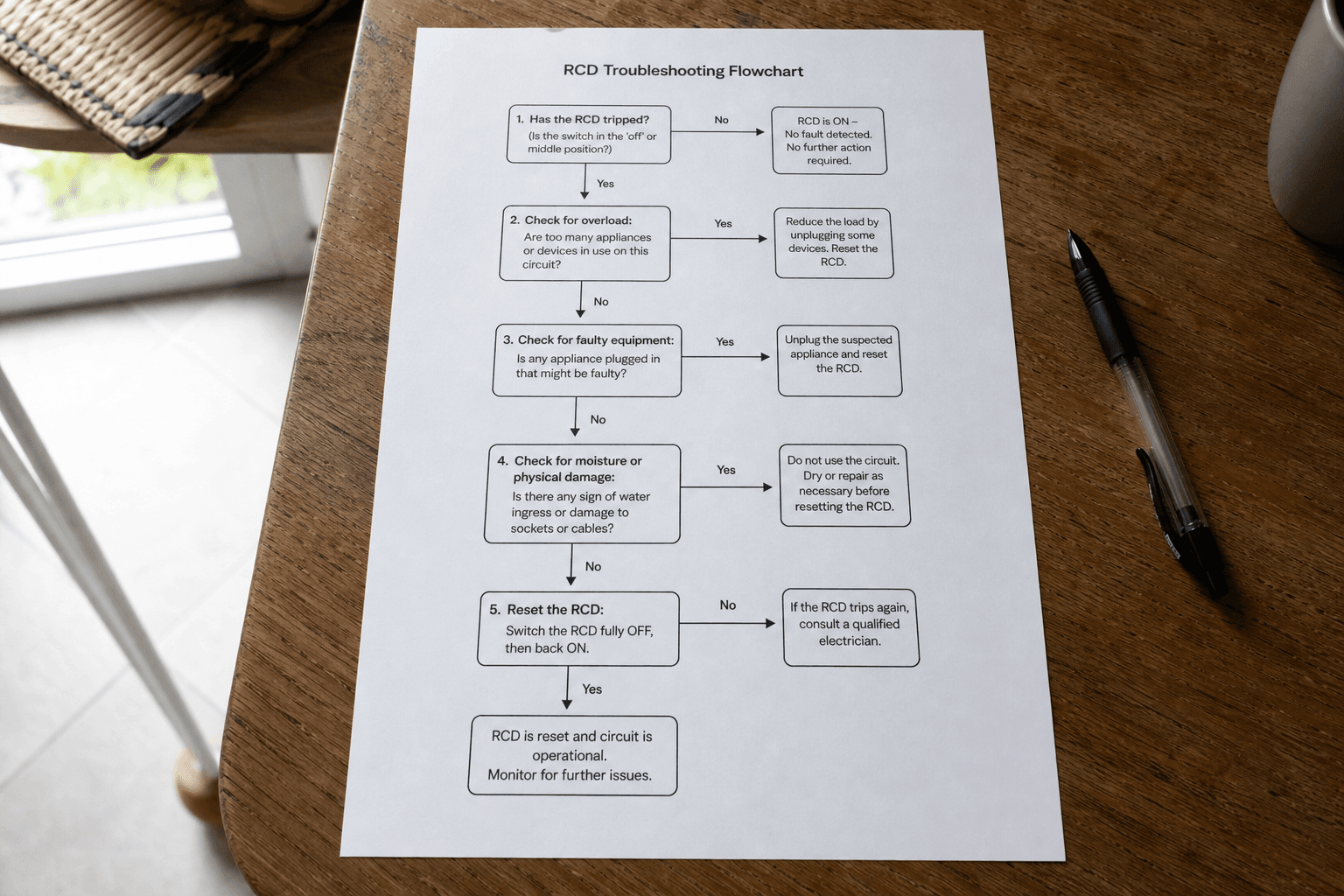
Step 1. Switch everything off at every socket, then reset the RCD.
- Trips immediately with nothing plugged in → Cause 7 or Cause 8
- Holds with everything off → go to Step 2
Step 2. Plug appliances back in one by one.
- Trips on a specific appliance → Cause 1
- Trips only with several running → Cause 2
- Trips on a specific circuit only when energised → go to Step 3
Step 3. Is the affected circuit a lighting or dimmer circuit?
- YES → Cause 4
- NO → go to Step 4
Step 4. Has it just rained, or is the affected circuit outdoor?
- YES → Cause 5
- NO → go to Step 5
Step 5. Did you recently put nails or screws into walls?
- YES → Cause 6
- NO → Cause 3 (loose neutral) or Cause 8
What you'll need to investigate safely
You can do a lot of useful diagnosis without ever opening the consumer unit. Stick to the front face, the reset switch, and the test button. The HSE's GS38 guidance on safe isolation is clear: only trained, competent persons should work inside accessories or distribution boards.
- A GS38 two-pole voltage indicator (Fluke T90, Martindale VT12, from CEF or Screwfix, £35 to £75)
- A torch (a head torch leaves hands free)
- A pen and paper to log which combination of plugs trips the RCD
- Pen and timestamps, weather notes if outdoor
Don't do this. Don't touch the CU itself other than the test button and the main switch. Don't remove faceplates if you suspect water ingress or burning smell. CU work is notifiable, and unregistered work risks a fine up to £5,000 under Building Regulations.
Check scope and pricing for Electrical jobs
Compare options, add-ons, and what affects the final price before you commit.
When the diagnosis is beyond DIY
Some symptoms move straight past DIY to professional territory. If any of the below are true, stop diagnosing and book an electrician.
- RCD won't stay reset even with the main switch off
- Burning smell or warm faceplate
- Pre-2006 red/black wiring visible at the trip point
- Shock from a metal appliance casing
- RCD doesn't trip when you press the 'T' button (RCD is dead, major safety issue)
- You've never opened the CU and shouldn't start now
Citation capsule. BS 7671 Chapter 41 requires additional protection by 30mA RCD on socket circuits up to 32A in domestic premises. If your RCD has failed silently, the entire protection layer is gone. Replacing it is notifiable consumer unit work under Approved Document P and must be carried out by a registered electrician.
How to describe the problem to a tradesperson
How you phrase the symptom changes the quote. A vague "my electrics are tripping" invites an open-ended hourly rate. A specific symptom invites a targeted diagnostic.
| What to say | Why it helps |
|---|---|
| "Intermittent RCD trip on the upstairs lighting circuit" | Narrows the test area to one circuit |
| "Trips only when freezer compressor cycles" | Points at Cause 1, insulation-resistance test will confirm |
| "Consistently trips within 2 minutes of resetting" | Suggests Cause 2 cumulative leakage, prompts an RCBO upgrade quote |
| "Trips correlate with rain" | Points at Cause 5 outdoor accessory |
| "Started after I hung a shelf in the lounge" | Points at Cause 6 buried cable |
Photos to take before the visit: the consumer unit (whole), the specific tripped RCD/RCBO close-up, and the affected accessory if visible. Measurements to gather: which appliances were on at trip, time of day, weather conditions.
Need help with Electrical jobs?
Tell us about your job and we will match you with the right professional for Electrical jobs.
How Taskino's electricians diagnose this
If you've worked the flowchart and ended up at Cause 3, 6, 7 or 8, that's the moment to book electrical repairs near you, and we can route you to a Taskino NICEIC electrician who'll arrive with an insulation-resistance tester, find the fault on the first visit, and put it in writing for your next EICR. Book a diagnostic visit via Taskino electrical jobs. You'll get a fixed callout, a certified fix, and the paperwork your insurer wants.
The short version
Eight causes, one flowchart. Most UK RCD trips trace back to a single faulty appliance (Cause 1) or cumulative leakage on a split-load CU (Cause 2), and you can identify both yourself in under ten minutes. The remaining six causes need a NICEIC electrician with a tester. Whatever the diagnosis, don't open the consumer unit yourself, CU work is notifiable under Building Regulations Approved Document P with fines up to £5,000. If you've reached Cause 3, 6, 7 or 8, or you spotted an emergency red flag, that's your cue to book electrical repairs near you and get the fault on paper before it becomes a fire.
Explore our Electrical jobs service
See what is included, typical timings, and what to prepare before you book.
Sources
- BS 7671:2018+A2:2022 Chapter 41 and 53 — RCD/RCBO requirements (IET, 2022)
- BS EN 61009 — RCBO product standard, 30mA nominal trip in 40ms (BSI, 2022)
- 105 — UK national power cut and electrical emergencies number (Energy Networks Association, 2026)
- Building Regulations Approved Document P — consumer unit work notifiable (gov.uk, 2024)
- Electrical fire statistics in UK dwellings (Electrical Safety First, 2024)
- HSE GS38 — safe isolation guidance (HSE, 2024)
- NICEIC registered electrician scope and reporting (NICEIC, 2024)
Frequently asked questions: Why Does Your RCD Keep Tripping? 8 Causes Explained for UK Homeowners
Short answers to common questions about this topic.
Our team will answer all your questions. we ensure a quick response.
Contact UsRelated posts

UK wiring colours old vs new, what DIY is legal under Part-P, current EICR & rewire costs, and how to hire a NICEIC electrician in 2026.

EICR certificate cost in the UK 2026: £150-£300 typical, by region, flat vs house. Plus rewire costs and electrician hourly rates explained.
The 11 DIY electrical mistakes that cost UK homeowners £5,000 a year, including the old wiring colours trap and what BS 7671 says to do about it.
Latest in Handyman
View all in this category
Part P notifiable electrical work in 2026: a room-by-room list of what you can legally DIY in a UK home and what needs an NICEIC electrician.
DIY gas work is a criminal offence in the UK. What's legal (bleeding, repressurising), what isn't, and when to call a Gas Safe engineer.
Hire a UK plumber for a blocked drain: 13 questions, who owns outside drains, and how to report a blockage to your water company. Get a fair quote.
Related services

Book electrical jobs with Taskino to find qualified, insured electricians across the UK for safe repairs, installations and testing with clear quotes.
Ready to Book Your Service?
Tell us what you need and our team will help you find the right professional quickly, with clear pricing and no hidden fees.