
8 Boiler Mistakes That Cost UK Homeowners £900 a Year
The eight UK boiler mistakes that quietly cost £900 a year, plus how to reduce boiler pressure, fix sludge, and call a Gas Safe engineer.
The fastest way to learn how to reduce boiler pressure, cut wasted gas, and protect your warranty is to stop making the eight quiet mistakes below. Together they cost UK households around £900 a year in gas, repeat callouts, and shortened boiler life (Energy Saving Trust, 2025). Most of them take ten minutes to fix.
TL;DR
- Biggest single mistake: leaving boiler flow temperature at 80°C when the system was designed for 60°C. Fix saves £150–£250 a year (Energy Saving Trust, Money Saving Boiler Challenge).
- Most common: overfilling the filling loop on a boiler, which dumps water through the pressure-relief valve and stresses the expansion vessel.
- Anything inside the boiler casing is a Gas Safe job under the Gas Safety (Installation & Use) Regulations 1998. DIY gas work is a criminal offence.
- Combined annual saving across all eight fixes: £700–£950.
Why most boiler mistakes happen
Around 23 million UK homes run on gas central heating, and roughly 1.7 million new boilers go in every year (BEIS / DESNZ, 2024). The problem is not the kit. UK boilers are oversized, undermaintained, and run on factory defaults set for cold-weather worst-case. Nobody told the homeowner what to change, and the installer didn't have time to explain. That's where the £900 leaks out.
Related reading: boilers and heating guide.
Citation capsule. UK homes lose around £900 a year through eight common boiler mistakes, with incorrect flow temperature and oversized boilers contributing the largest share (Energy Saving Trust, 2025; Money Saving Boiler Challenge, gov.uk-endorsed, 2024).
Need help with Plumbing?
Tell us about your job and we will match you with the right professional for Plumbing.
Mistake #1: Running flow temperature at 80°C on a condensing boiler
This is the most expensive single mistake in the UK housing stock. Turning the flow temperature dial from the factory default of 75–80°C down to 55–60°C saves 6–8% on gas for a condensing boiler, worth £150–£250 a year on an average 4-bed semi (Energy Saving Trust / Money Saving Boiler Challenge, 2024).
What it looks like
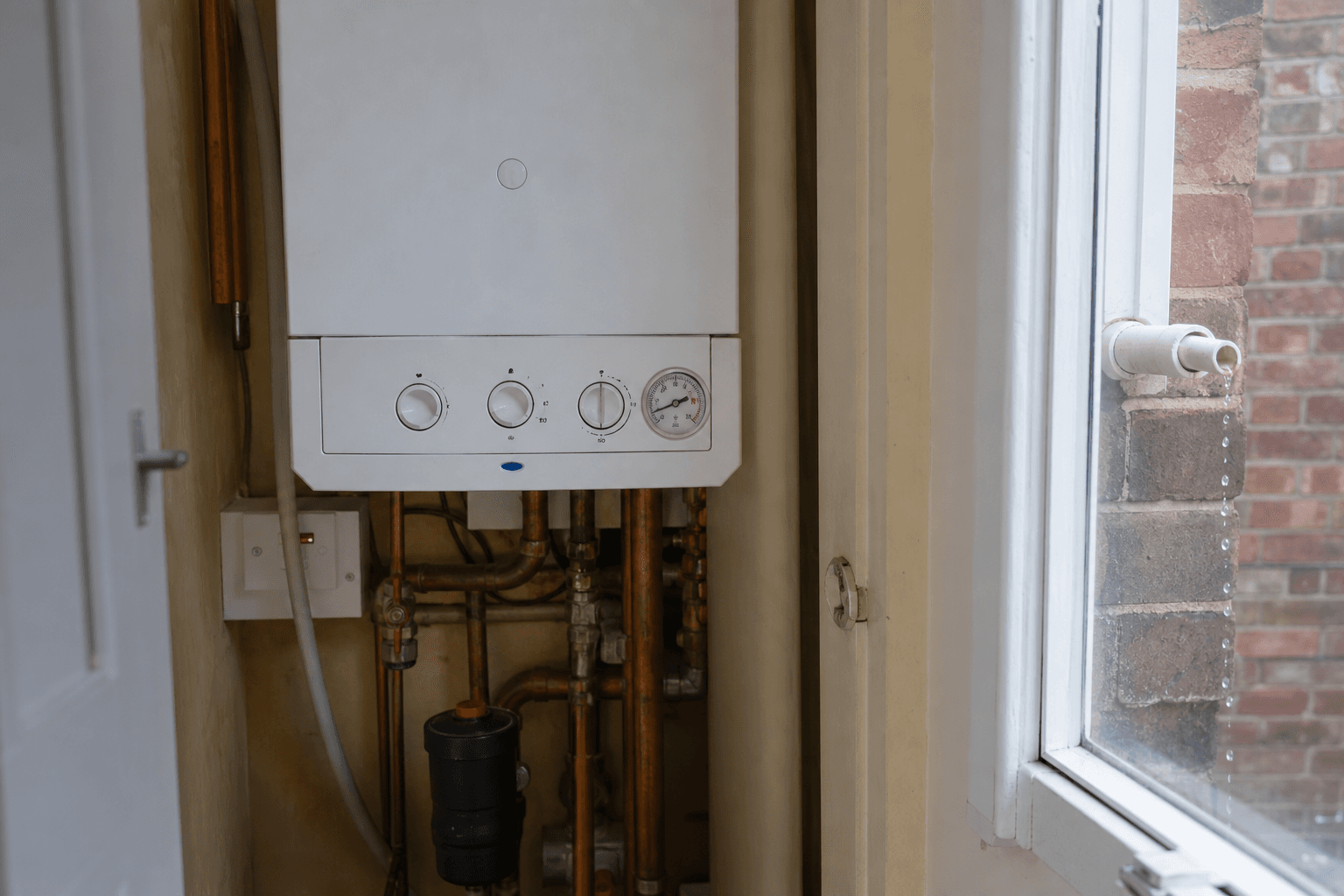
Two dials on the front of the boiler. One controls hot water, one controls radiator flow. The radiator one is sat at 75°C or higher. The boiler never gets cool enough to condense, which is the whole point of a condensing boiler.
Why people do it
Hotter feels better. Installers commission new boilers on the default setting because the customer didn't ask for anything different. Boiler Plus 2018 forces controls to be fitted, but it doesn't force the engineer to commission them at the right temperature for your radiators.
What it actually costs
£150–£250 a year in wasted gas, every year, for the life of the boiler. Over a 12-year boiler life that's roughly £2,400 left on the meter.
How to avoid it
Turn the radiator flow temperature dial to 55–60°C. Keep hot water flow at 60°C or above for Legionella safety (HSE guidance). Set it once. The house warms a bit slower on the coldest days, but you save four figures over the boiler's life.
Money Saving Boiler Challenge. A gov.uk-endorsed campaign launched in 2022 telling households to drop flow temperatures on combi boilers. The number on the dial is not the room temperature, it's the water temperature into the radiators.
Mistake #2: Overfilling the filling loop (the £150 mistake that creates the £400 one)
One Taskino-vetted Gas Safe engineer in Manchester told us the single most common callout he sees is a customer who has been topping up the filling loop on a boiler to 2.5 bar cold because "more must be better". The pressure-relief valve dumps the excess outside, the customer tops up again, and the cycle quietly destroys the expansion vessel.
What it looks like
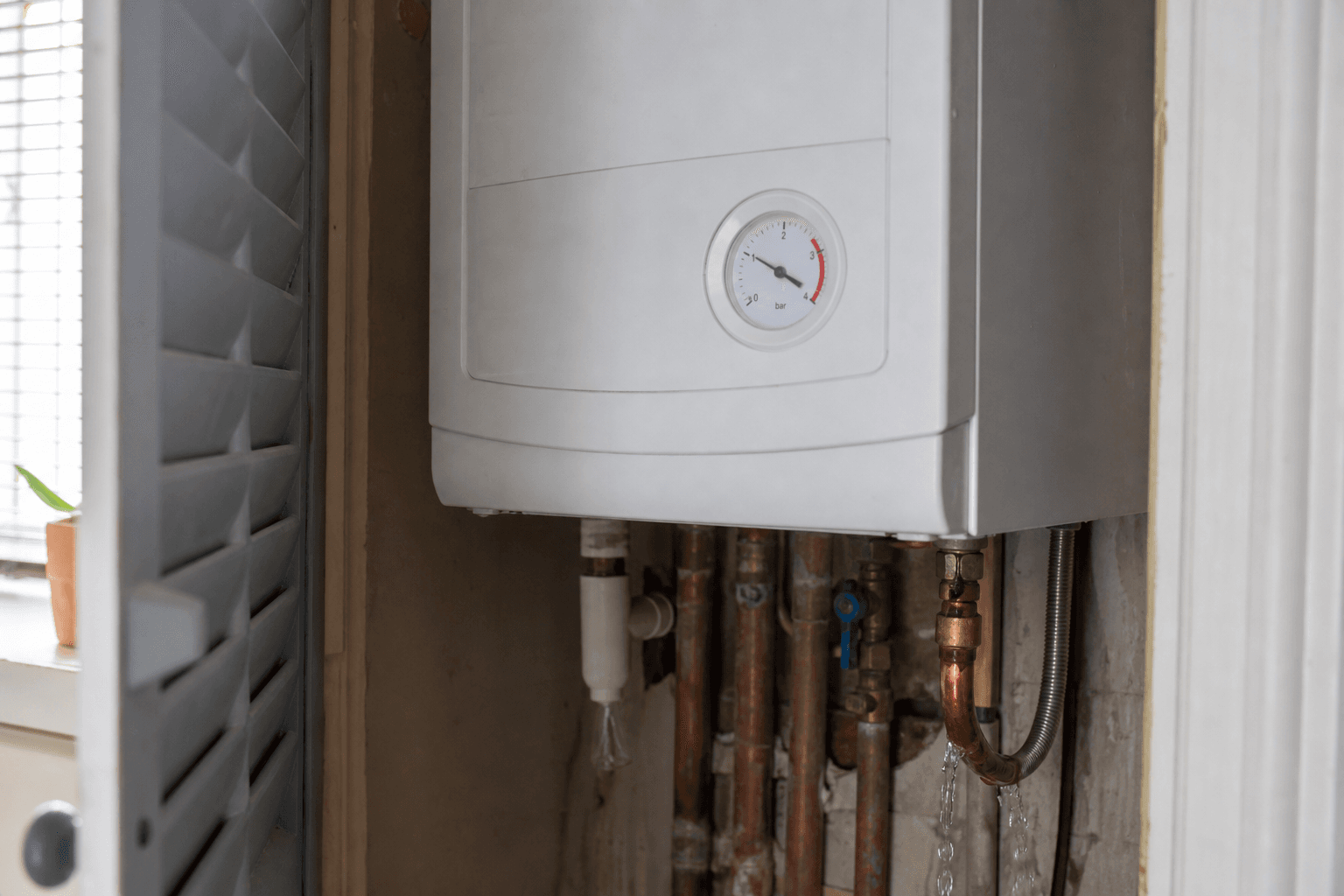
Pressure gauge reads above 2.5 bar cold. Water dripping from a thin copper pipe poking through the kitchen wall outside. That pipe is the pressure-relief discharge.
Why people do it
Online guides say "between 1 and 2 bar" so people aim for 2. They overshoot. The relief valve trips at 3 bar. They top up again next week because pressure dropped overnight.
What it actually costs
£400+ over a few years. Expansion vessel fatigue from repeated overfills, treated water replacement, eventual heat-exchanger pinhole leak. Heat exchanger replacement runs £350–£600 (Checkatrade, 2026).
How to reduce boiler pressure safely
If you've overfilled, the safe fix is bleeding a radiator with the boiler off and the filling loop closed. Catch the water in a jug. Stop when the gauge reads 1.2 bar. If the gauge climbs back above 2 bar hot, the expansion vessel needs recharging, which is a Gas Safe job.
| Pressure state | Gauge reading (cold) | Action |
|---|---|---|
| Too low | Below 0.8 bar | Repressurise via filling loop to 1.2 bar |
| Correct | 1.0–1.5 bar | Leave alone |
| Too high | Above 2.0 bar cold | Reduce boiler pressure by bleeding a radiator |
| Critical | Above 2.5 bar or PRV dripping | Stop, call Gas Safe |
Related reading: plumbing and drains guide.
Explore our Plumbing service
See what is included, typical timings, and what to prepare before you book.
Mistake #3: No magnetic system filter (the slow-burn £600 mistake)
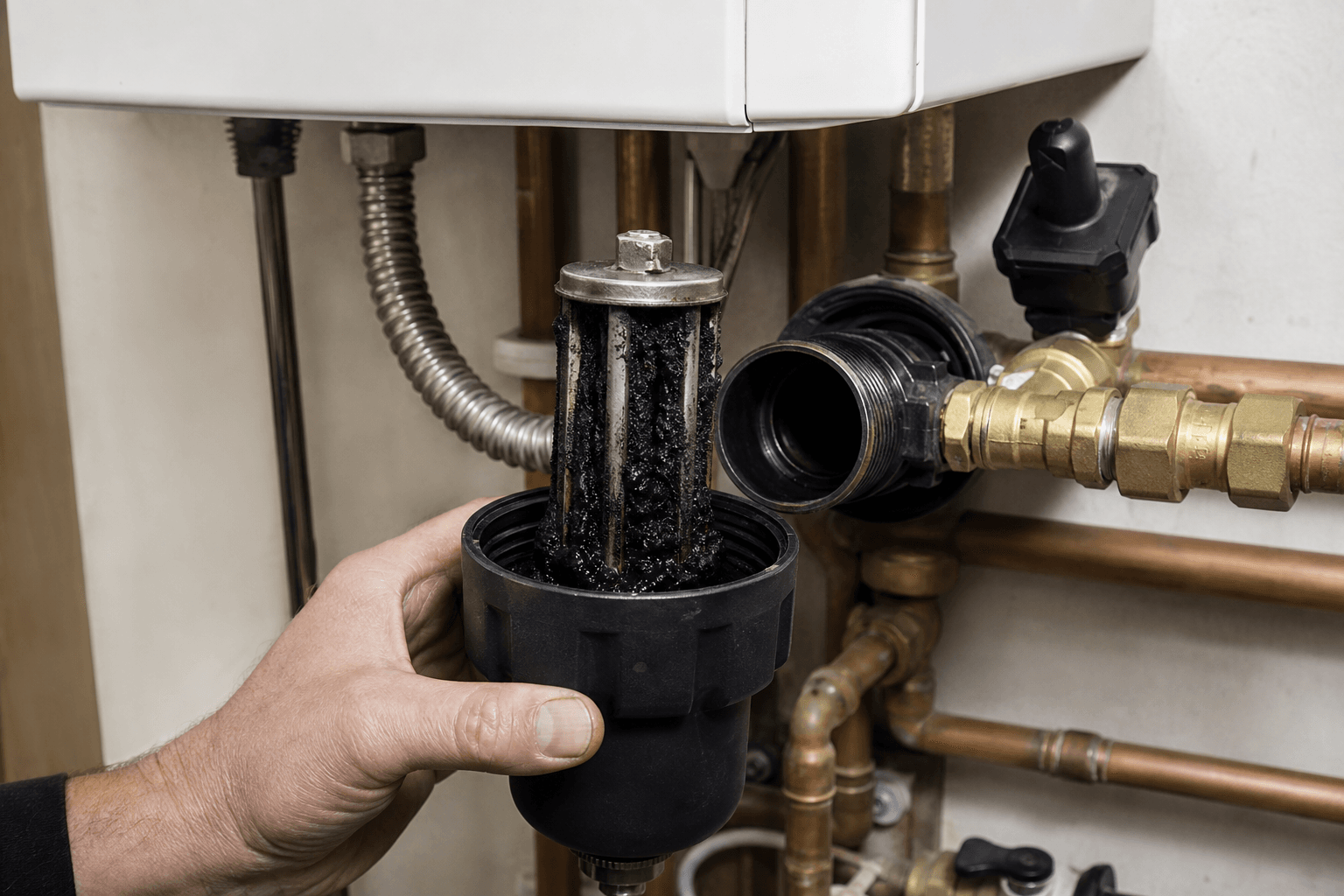
A magnetic filter catches the iron oxide sludge that forms inside every radiator system. Without one, sludge accelerates heat-exchanger failure (£350–£600 replacement) and pump failure (£200–£350) (Checkatrade, 2026). A typical 12-year boiler lifespan gets cut to 7–8.
What it looks like
Black water when you bleed a radiator. Radiators cold at the bottom, warm at the top. The boiler kettles, makes a rumbling noise on start-up.
How to avoid it
Fit a Sentinel Eliminator or Magnaclean magnetic filter. Parts are £55–£90 at City Plumbing or BES; fitted price by a Gas Safe engineer is £100–£170 (City Plumbing / BES, 2026). Have it serviced at the annual boiler service, no extra charge if it's already on the work order.
Mistake #4: Ignoring fault codes and resetting repeatedly
Around 41% of UK homeowners admit they reset the boiler without reading the fault code (Which?, June 2025 survey of 10,064 UK adults). The cost curve is brutal: a sensor fault becomes a PCB fault becomes a heat-exchanger fault. £200 callout becomes £600 part swap becomes £2,500 replacement.
What it looks like
Boiler trips. Owner resets. It runs for a day. Trips again. Repeat for six weeks until something gives.
How to avoid it
Write down the code. Look it up in our F1 boiler fault causes. If it's anything other than low pressure (F22, EA, E10), call Gas Safe. Repeated resets on a fault that isn't pressure-related are how you turn a £70 part into a new boiler.
Related reading: how to hire a Gas Safe boiler engineer.
Ready to book Plumbing?
Send a quick enquiry — we typically respond the same working day.
Mistake #5: Sealing the boiler cupboard
Boiler manufacturers' warranties are voided by inadequate clearances more often than by missed services, but homeowners rarely know that. Worcester Bosch and Vaillant both specify minimum clearances in the install manual: typically 5mm sides, 200mm front, 25mm bottom for combi units (Worcester Bosch / Vaillant install manuals, 2024).
What it looks like
A neat kitchen redesign. Shelving built right up against the boiler. A magnet-sealed door to cut noise. No ventilation grille.
What it actually costs
Overheats the boiler PCB and voids the manufacturer warranty. Repair cost £300–£800 with no warranty cover.
How to avoid it
Keep the manufacturer's clearances. If your boiler cupboard front needs to be solid for kitchen continuity, fit a ventilation grille from Wickes or Screwfix. £8–£20 for the grille, £40–£90 for a Gas Safe engineer to confirm the clearance is compliant.
Mistake #6: Skipping the annual service (the warranty-killer)
Worcester Bosch, Vaillant and Ideal warranties all run 10–12 years and all require annual service by a Gas Safe registered engineer (brand T&Cs, 2026). Skip one year and the warranty is void. A heat-exchanger replacement under warranty: £0. Without: £350–£600 (Checkatrade, 2026).
Why people do it
"It's working fine, why pay £100?". The service feels like a tax on a boiler that hasn't broken yet.
How to avoid it
Book the service in October before the heating goes on. £70–£110 for a standard service (Which?, June 2025). Ask the engineer to update the Benchmark commissioning checklist in the back of the boiler manual, and to set the flow temperature to 55–60°C while they're there.
Warranty trap. A 10-year Worcester warranty is worth roughly £1,200 in avoided repair bills. Skipping one £90 service to "save money" can write off the whole thing.
Learn more about Plumbing
Browse how we deliver Plumbing and the questions homeowners ask most often.
Mistake #7: Bleeding radiators without topping the pressure back up
A common pattern, and one that triggers a panic call to Gas Safe within 24 hours. You bleed the radiators, finally get the heating hot at the top, then a fault code (F22, EA, or E10) appears later that evening. Bleeding always drops the boiler pressure, and people don't know to top it back up.
How to avoid it
After bleeding any radiator, check the boiler pressure gauge. If it reads below 1.0 bar, learn how to repressurise a boiler using the filling loop. Open both filling-loop valves slowly, watch the gauge, close them at 1.2 bar. Step-by-step process in our how to bleed a radiator.
Mistake #8: Replacing a boiler without checking Boiler Upgrade Scheme eligibility
The Boiler Upgrade Scheme offers £7,500 towards an air-source heat pump for eligible homes (Ofgem / gov.uk, 2026). Most UK installers don't mention it because the quote is faster on gas. That's £7,500 left on the table for every household that does a straight like-for-like swap without checking.
How to avoid it
Get one ASHP quote from an MCS-certified installer alongside two gas quotes. Even if you stay on gas, you'll know the comparison. Costs in 2026 sit at £2,500–£4,000 for a like-for-like combi replacement and £7,000–£13,000 for an ASHP after the BUS grant (Checkatrade, 2026).
Related reading: UK boiler replacement cost guide.
Thinking about Plumbing?
Share your postcode and job details for a no-obligation quote.
If you've already made one of these mistakes
How to limit the damage right now
Turn the flow temperature to 60°C tonight. Book a Gas Safe service for next week. Check your warranty status against your boiler install date. Photograph the pressure gauge cold and hot for a baseline.
When to call a pro to undo it
Fault codes that return within 24 hours of a self-reset. Black water from a bled radiator. Pressure that won't hold above 1.0 bar overnight. Water dripping from boiler joints or from the external pressure-relief pipe.
What insurance might or might not cover
Home insurance covers escape-of-water damage in many policies. It does not pay for the boiler repair itself unless you have a separate boiler-cover plan from British Gas HomeCare, HomeServe, or a similar provider.
The one mistake even Gas Safe engineers make
Here's the uncomfortable one. Most Gas Safe engineers leave the boiler flow temperature at the factory default of 75–80°C on modern condensing boilers because "the customer didn't ask". Boiler Plus 2018 forces controls to be fitted, but doesn't force them to be commissioned at the right temperature for the home.
In our experience working with UK homeowners, this single oversight is responsible for more wasted gas than the other seven mistakes on this list combined. Ask your engineer at the next annual service to set the flow temperature to the lowest figure your radiators can comfortably run at. On most UK systems that's 55–60°C. The Money Saving Boiler Challenge calls this the single highest-value adjustment a household can make in under two minutes.
If the engineer pushes back, ask them to weather-compensate the controls instead. Both routes get you the same gas saving.
Citation capsule. Dropping condensing-boiler flow temperature from 80°C to 55–60°C improves efficiency by 6–8% and saves a typical UK 4-bed semi £150–£250 a year (Energy Saving Trust / Money Saving Boiler Challenge, gov.uk-endorsed, 2024).
Check scope and pricing for Plumbing
Compare options, add-ons, and what affects the final price before you commit.
A simple checklist to avoid all of these
- Pressure gauge cold: 1.0–1.5 bar. Hot: not over 2 bar.
- Flow temperature dial: 55–60°C for radiators.
- Magnetic filter fitted and serviced annually.
- Fault codes logged, not just reset.
- Boiler cupboard ventilated, clearances respected.
- Annual Gas Safe service booked October.
- Filling loop topped up after every radiator bleed.
- Boiler Upgrade Scheme quote obtained at every replacement.
- Gas Safe registration verified on gassaferegister.co.uk before any engineer crosses the threshold.
- National Gas Emergency 0800 111 999 saved in your phone.
How Taskino's vetted Gas Safe engineers catch these before they happen
Most of these mistakes are quiet. Nothing breaks. The bill just creeps up by £75 a quarter. A good Gas Safe engineer at the annual service will set the flow temperature, check the filter, and tell you what your filling loop should read, without the upsell. Taskino lists Gas Safe registered engineers in your postcode at boiler repair, with their registration numbers visible before you book, so you can verify them on gassaferegister.co.uk.
Related reading: how to hire a Gas Safe boiler engineer.
Need help with Plumbing?
Tell us about your job and we will match you with the right professional for Plumbing.
The short version
Eight mistakes, around £900 a year, all fixable in an afternoon. Knowing how to reduce boiler pressure, how to repressurise a boiler, and what flow temperature to run is the foundation. Knowing when to stop and call Gas Safe is the rest of it. DIY gas work inside the casing is a criminal offence under the Gas Safety (Installation & Use) Regulations 1998, and not worth the risk.
Related reading: boilers and heating guide.
Sources
- Energy Saving Trust — flow temperature 55–60°C saves 6–8% on gas
- Money Saving Boiler Challenge (gov.uk-endorsed campaign, 2024) — flow temperature guidance
- Checkatrade, 2026 — heat exchanger £350–£600, pump £200–£350, boiler replacement
- Ofgem / gov.uk, 2026 — Boiler Upgrade Scheme £7,500 grant
- Which?, June 2025 — annual service £70–£110, survey of 10,064 UK adults
- City Plumbing / BES, 2026 — Sentinel / Magnaclean magnetic filter £100–£170 fitted
- Worcester Bosch / Vaillant / Ideal warranty T&Cs, 2026 — annual Gas Safe service required
- Gas Safe Register — Gas Safety (Installation & Use) Regulations 1998
- Boiler Plus 2018 — time/temp control + comp method requirement
- National Gas Emergency: 0800 111 999
Frequently asked questions: 8 Boiler Mistakes That Cost UK Homeowners £900 a Year
Short answers to common questions about this topic.
Our team will answer all your questions. we ensure a quick response.
Contact UsRelated posts
Diagnose the 12 most common UK boiler problems, get 2026 repair and replacement prices, and learn when only a Gas Safe engineer is legal.
14 questions to ask a Gas Safe boiler engineer before they cross your threshold, red flags, deposit limits, Benchmark certificate rules.
Real 2026 boiler replacement cost: combi swap £1,790–£4,500, full system £3,500–£6,000. Regional table, £7,500 Boiler Upgrade Scheme details.
Latest in Handyman
View all in this category
Part P notifiable electrical work in 2026: a room-by-room list of what you can legally DIY in a UK home and what needs an NICEIC electrician.
DIY gas work is a criminal offence in the UK. What's legal (bleeding, repressurising), what isn't, and when to call a Gas Safe engineer.
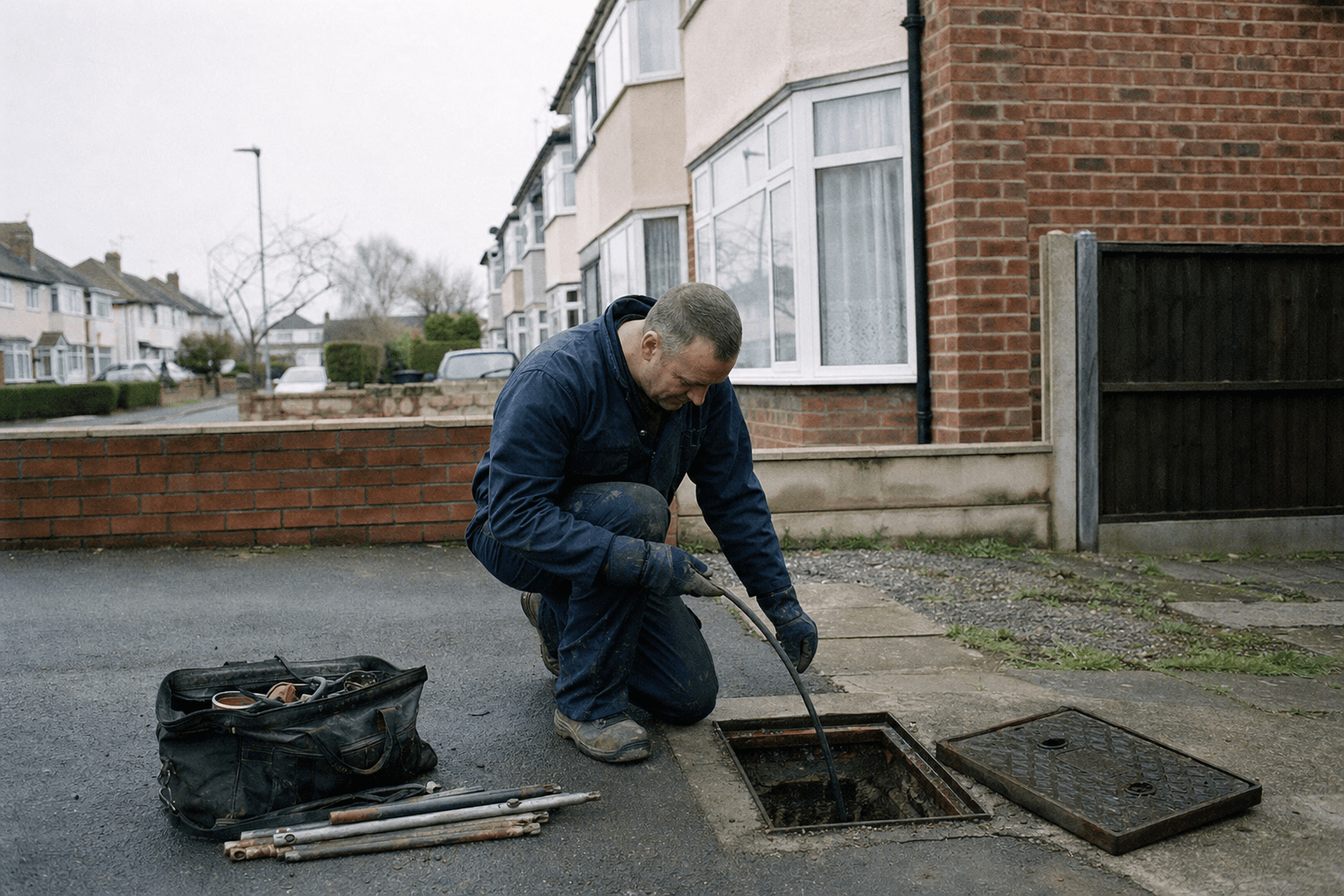
Hire a UK plumber for a blocked drain: 13 questions, who owns outside drains, and how to report a blockage to your water company. Get a fair quote.
Related services
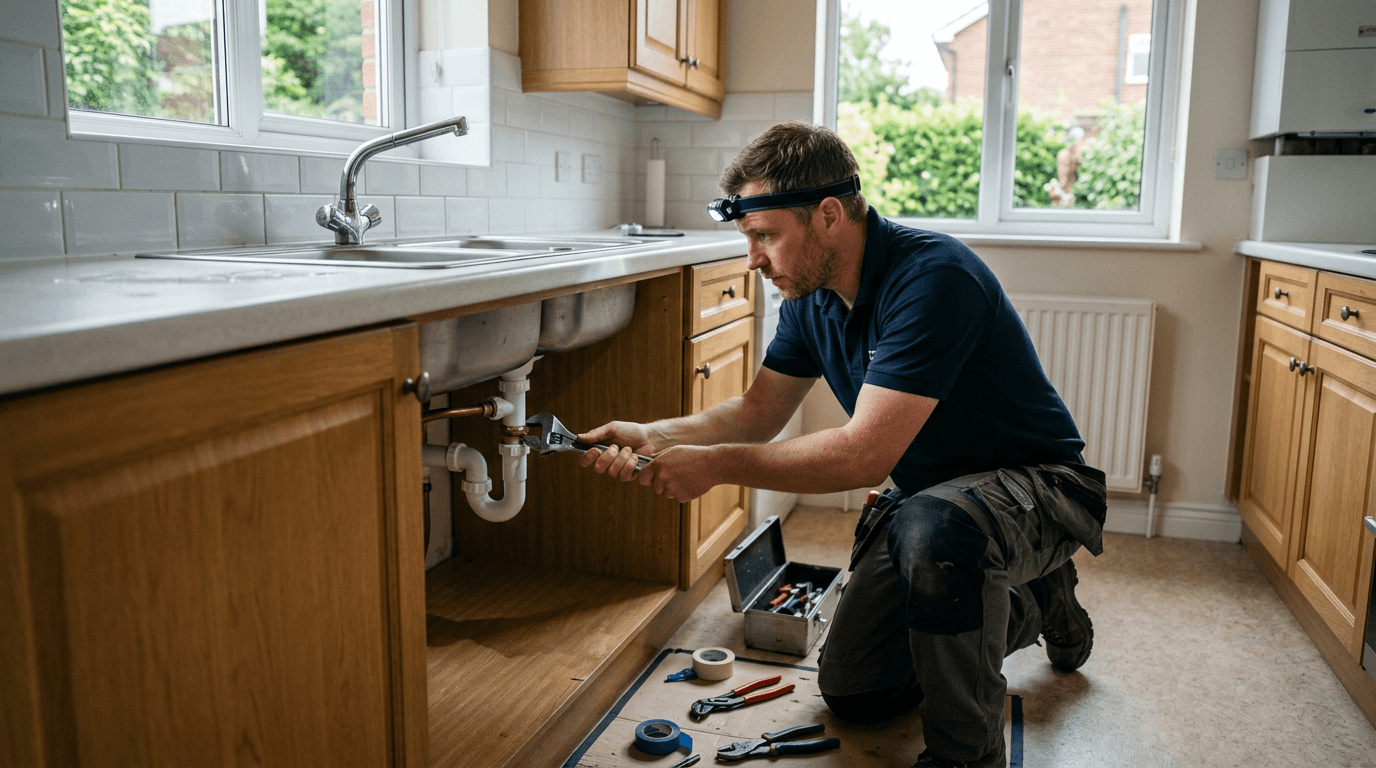
Reliable plumbing services for repairs, installations and emergencies. Taskino connects you with insured local plumbers who deliver clear quotes, fast response times and quality workmanship.
Ready to Book Your Service?
Tell us what you need and our team will help you find the right professional quickly, with clear pricing and no hidden fees.