
How to Deep Clean Your Kitchen: A Step-by-Step Guide for UK Homeowners
Learn how to deep clean kitchen surfaces, ovens, dishwashers and grout in a UK home. Tools, time, and safety rules included.
Knowing how to deep clean kitchen surfaces, racks, gaskets and grout takes one weekend afternoon, about £20 of kit from B&Q or Wilko, and a willingness to move the toaster. This is a 4-6 hour job, broken into nine steps, with the chemical-mixing rules you must not break.
TL;DR
- Difficulty: 2/5. More endurance than skill. 4-6 hours for a typical UK fitted kitchen.
- Tools: 6 items (nitrile gloves, microfibres, soda crystals, white vinegar, Astonish or HG degreaser, soft brush). Around £20 from B&Q or Wilko.
- Stop and call a pro if: gas hob removal is needed, the oven self-clean cycle has faulted, or grout damage is beyond a top-up.
- Never mix bleach and vinegar. It releases chlorine gas (HSE COSHH 2002).
This guide draws on our pillar on deep cleaning and the BICSc Domestic Cleaning Code. Every product price was checked at UK retailers in May 2026. The timings come from a Taskino editor's own 1990s fitted kitchen in a Reading semi-detached, clocked step-by-step.
Before you start: is this a job you should actually DIY?
Most UK kitchen deep cleans are DIY-able for under £20 in materials, but two scenarios are non-negotiable handover jobs: gas appliance interior work, and any pre-2000 textured ceiling that hasn't been tested for asbestos. The Health and Safety Executive treats both as regulated risks (HSE, 2024).
Difficulty level (2/5)
A 2/5 means the bottleneck is your back, not your brain. There are no electrical, gas or plumbing tasks if you stick to the surfaces. You will spend two of the four hours bent over a hob or kneeling at a fridge. Wear knee pads. Take breaks. Hydrate. Most people finish a typical galley kitchen in 4 hours and a U-shape kitchen in 6.
When this DIY is illegal in the UK
Gas hob removal for behind-the-unit cleaning is Gas Safe Register territory. Under the Gas Safety (Installation and Use) Regulations 1998, only a Gas Safe registered engineer may disconnect, move or reconnect a gas appliance. The same applies to gas oven igniters. If your home was built or refurbished before the year 2000 and has a textured Artex ceiling, do not scrape, sand or wet-scrub it without an asbestos test, per HSE guidance.
When it's legal but stupid
Five scenarios where nine out of ten DIY-ers regret it: a new £800 oven still under manufacturer warranty (caustic cleaners void coverage on many Bosch and Neff models); a dual-fuel range with cast-iron pan supports (specialist re-seasoning needed); polished granite worktops with visible food stains (DIY poultices can etch); a kitchen with mould on the ceiling rosette (a damp survey is wiser); and any property with a working AGA, which has its own service protocol. For these, comparing the trade-off in our deep cleaning services near me guide is sensible before you commit a Saturday.
Need help with Deep cleaning?
Tell us about your job and we will match you with the right professional for Deep cleaning.
What you'll need
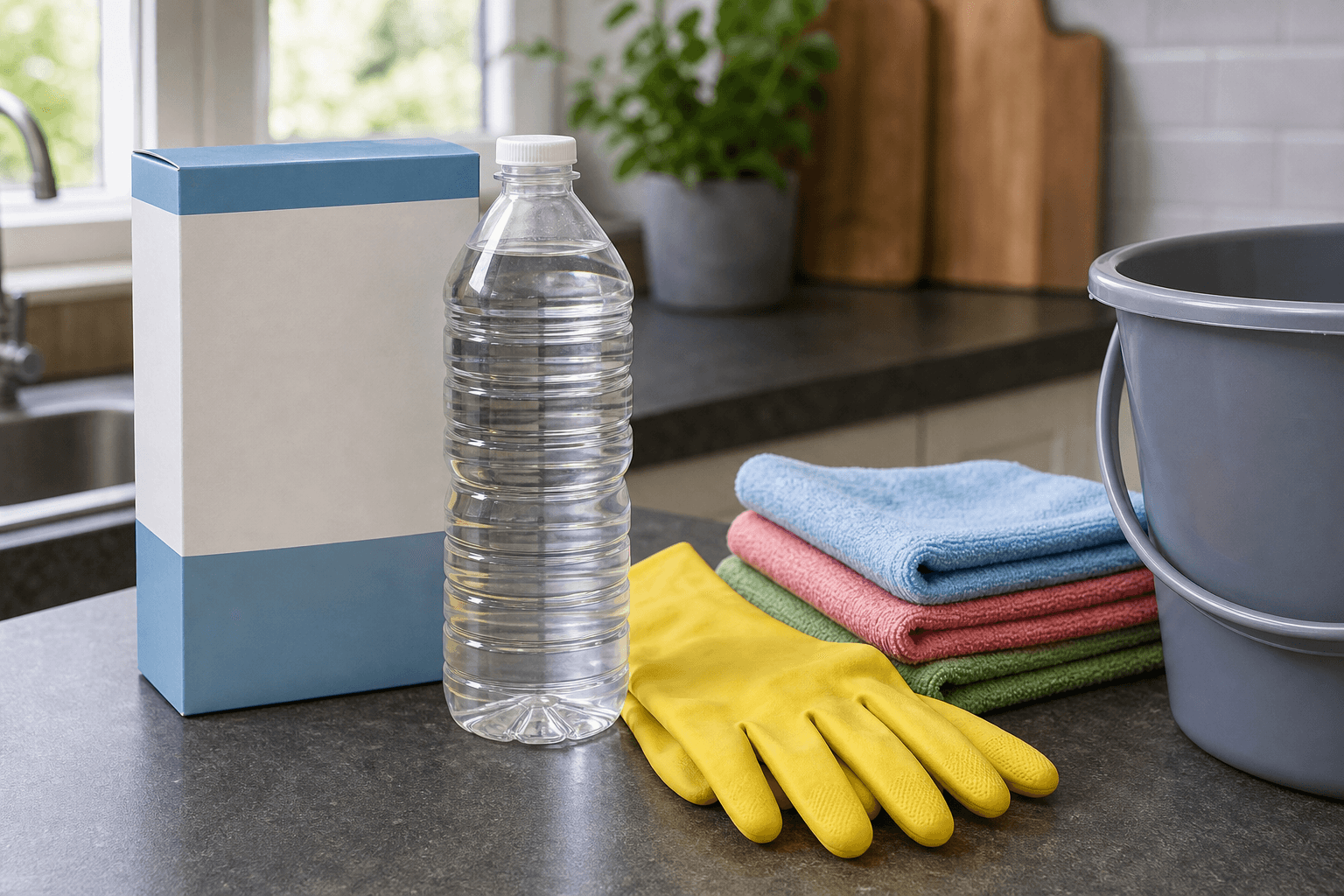
Total spend for a first-time UK kitchen deep clean is around £20 at B&Q, Wilko or Tesco, assuming you already own a bucket and a vacuum (B&Q, 2026). The list below is the minimum kit. Reusable items pay back across bathrooms, hallways and patios.
Tools
You need six tools, all available high street:
- Minky M Cloth pack of 3 (~£3, Wilko)
- Lakeland eCloth Window Cloth (~£5, Lakeland)
- Spontex Scourer 4-pack (~£2, B&Q)
- Generic soft brush set, 5 brushes (~£4, B&Q)
- 5L plastic bucket (~£3, B&Q)
- Microfibre flat mop (~£12, Robert Dyas, reusable across rooms)
Materials
Five materials cover 95% of UK kitchen surfaces:
- Astonish Oven and Grill Cleaner, 250g (~£2, Wilko or Tesco)
- HG Grout Cleaner, 500ml (~£6, B&Q)
- Soda crystals, 1kg bag (~£1.50, Tesco)
- White vinegar, 5L (~£4, Amazon UK)
- Bar Keepers Friend powder, 250g (~£3.50, Asda)
Safety equipment
Three items, non-optional. Nitrile gloves rated EN 374 (~£4 a box, Toolstation) protect against caustic oven cleaners. An FFP2 mask is wise if you use spray oven cleaner in an enclosed galley kitchen. Open every window. The Control of Substances Hazardous to Health Regulations 2002 (COSHH) require ventilation when using cleaning chemicals in workplaces, and the same principle is the safe-home standard.
| Item | Where to buy | £ | Reusable for other jobs? |
|---|---|---|---|
| Minky M Cloth pack | Wilko | £3 | Yes, bathroom and hall |
| Lakeland eCloth | Lakeland | £5 | Yes, windows |
| Spontex Scourer | B&Q | £2 | Yes, all rooms |
| Soft brush set | B&Q | £4 | Yes, grout and patio |
| 5L bucket | B&Q | £3 | Yes, any cleaning job |
| Astonish Oven Cleaner | Wilko | £2 | Oven only |
| HG Grout Cleaner | B&Q | £6 | Bathroom grout too |
| Soda crystals 1kg | Tesco | £1.50 | Drains, laundry |
| White vinegar 5L | Amazon UK | £4 | Limescale anywhere |
| Bar Keepers Friend | Asda | £3.50 | Stainless steel only |
Step 1 — Clear and pre-soak (30 min)
Empty every worktop. Lift hob covers and oven racks. Drop the racks into your 5L bucket with hot water and one mug of soda crystals (about 200g). Leave to soak for the full deep clean. By Step 7 they will rinse clean with a Spontex.
Common mistake. Do not pre-soak racks with a bleach and vinegar mix. The reaction releases chlorine gas, banned for domestic mixing under COSHH 2002. Use soda crystals only.
Explore our Oven and fridge cleans service
See what is included, typical timings, and what to prepare before you book.
Step 2 — Ceiling, lights, extractor (30 min)
Start high so debris falls onto surfaces you'll clean later. Dust ceiling cobwebs with a long-handled brush. Drop LED light covers into warm Fairy and soda crystal water. Lift extractor hood filters out and submerge them too. Wipe the hood fascia with Astonish all-purpose spray.
Common mistake. Never spray water at an electrical extractor housing while live. Switch the circuit off at the consumer unit first. If you do not know which fuse controls the extractor, leave the housing alone and just degrease the fascia.
Step 3 — Cupboards inside and out (45 min)
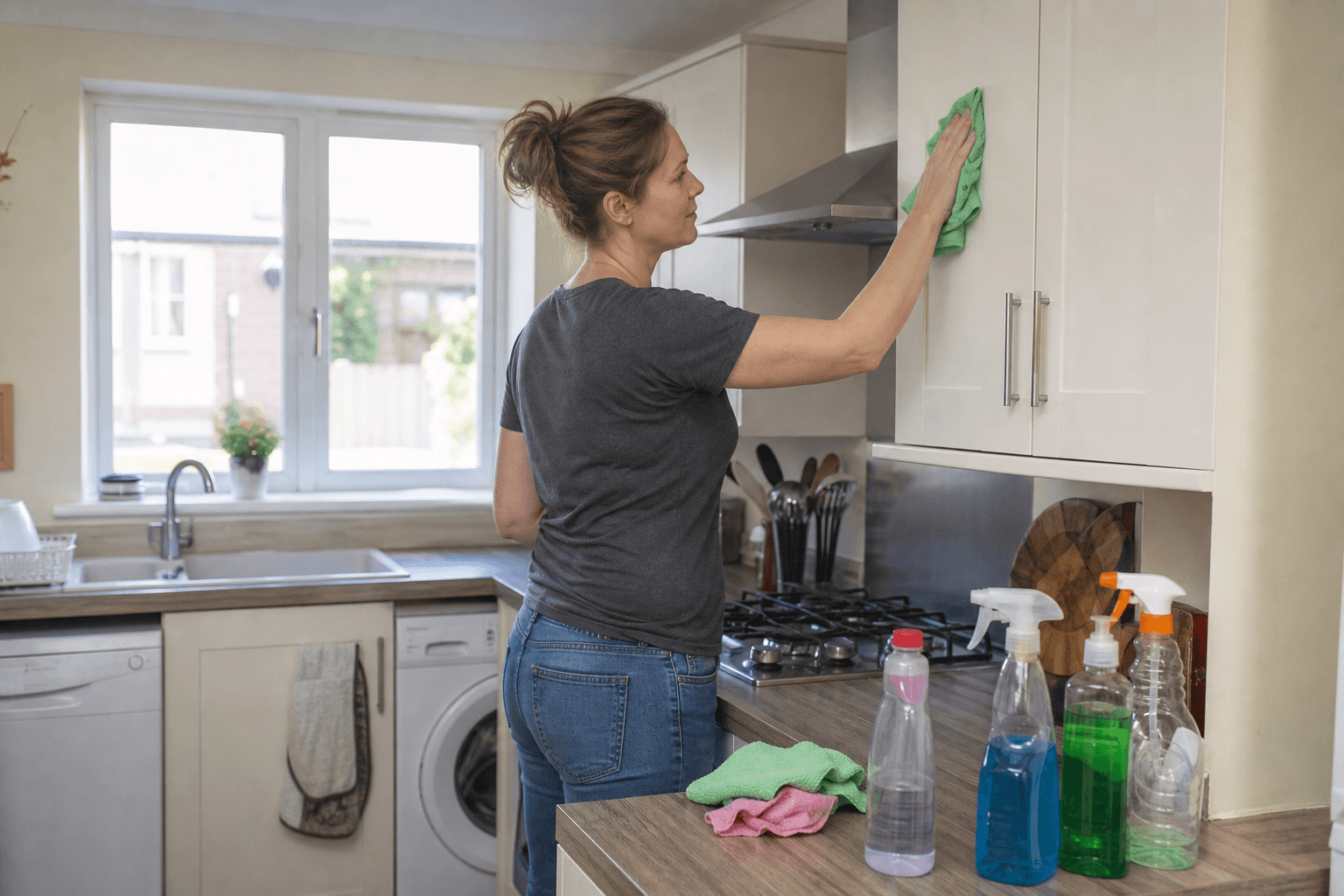
Empty top to bottom, one cupboard at a time. Check every sell-by date. Wipe the interior with hot soapy water and a Minky cloth. The exterior takes a light degreaser, then a soft microfibre dry-buff to prevent streaks. Soft-close hinges should be wiped not soaked.
Common mistake. Bar Keepers Friend on painted MDF doors will strip the paint inside three uses. Use it only on the stainless sink and chrome taps.
Ready to book One-Off Cleaning?
Send a quick enquiry — we typically respond the same working day.
Step 4 — Worktops, splashbacks, tiles (30 min)
Clear the worktops fully. Spray HG or Astonish surface cleaner, leave to dwell for 3 minutes, then wipe with a damp Lakeland eCloth. To learn how to clean grout, spray HG Grout Cleaner along the tile lines and agitate with the soft brush. Rinse. Buff dry.
Common mistake. Never mix bleach with vinegar for grout, ever. The chlorine gas risk is the same as Step 1. One product at a time, fully rinsed before another goes near it.
Step 5 — Hob, oven, microwave (60 min)
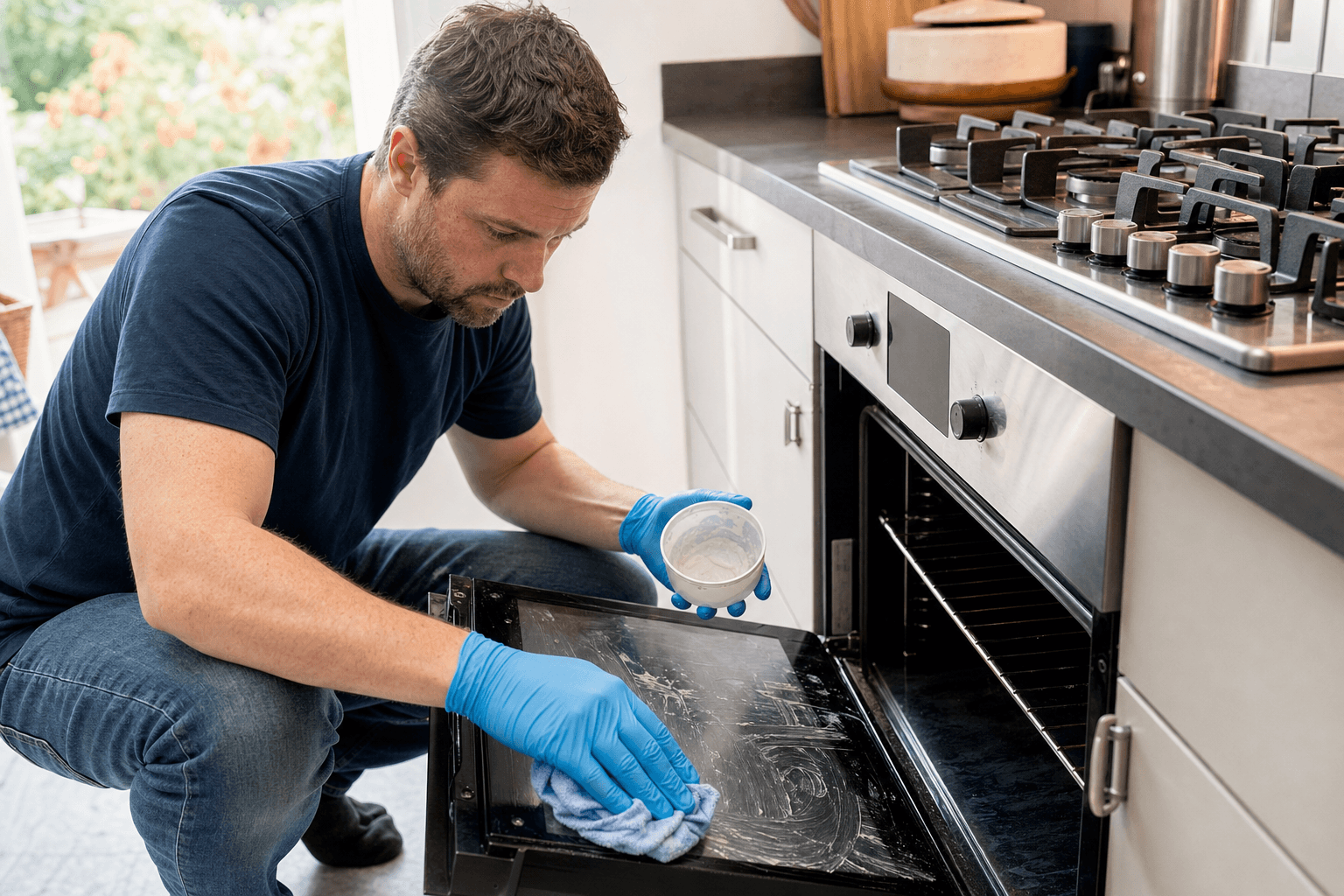
This is the slowest step. If you only want to learn how to clean an oven properly, this is the section. The hob covers from Step 1 should now rinse clean under the tap. Apply Astonish paste to the cold oven interior with a gloved hand, leave 30 minutes, then wipe with a damp cloth. For the microwave, put a sliced lemon in a bowl of water, run on full power for 3 minutes, then wipe the steam-loosened grime.
Common mistake. Do not use caustic oven cleaner on aluminium oven liners or hob trims. It pits the metal permanently. Read the label twice.
For product picks, our companion guide to UK kitchen cleaning supplies has the side-by-side test data.
Learn more about Deep cleaning
Browse how we deliver Deep cleaning and the questions homeowners ask most often.
Step 6 — Sink, taps, waste disposal (20 min)
Limescale on chrome taps surrenders to a white vinegar wrap: soak kitchen roll in vinegar, wrap around the tap, leave 20 minutes. Then scrub with a Spontex. Polish the stainless sink with a damp Bar Keepers Friend paste, working with the grain. If you have a food waste disposal unit, flush it with a tray of ice cubes and a halved lemon, motor running.
Common mistake. Bar Keepers Friend dulls copper and brass on first contact. If your taps are unlacquered brass, use a microfibre with warm soapy water only.
Step 7 — Fridge and freezer (45 min)
Empty the fridge into a cool bag. Defrost the freezer if iced (allow 2-3 hours, towels at the base). Clean the fridge interior with a bicarbonate of soda paste (3 parts bicarb to 1 part water). Wipe door seals with a soft cloth dipped in white vinegar, which kills mould spores in the gasket folds. For visible black mould in seals, follow our guide on how to remove mould before the spores spread.
Common mistake. Never use bleach inside a food fridge. The residue contaminates packaging and the smell takes weeks to fade. Bicarb and vinegar only.
Thinking about Oven and fridge cleans?
Share your postcode and job details for a no-obligation quote.
Step 8 — Dishwasher, washing machine if in kitchen (30 min)
If you only need to know how to clean dishwasher parts, start here. Pull the filter from the floor of the dishwasher. Soak it in hot soda crystal water for 10 minutes, then rinse under the tap. Run an empty cycle with Finish Dishwasher Cleaner (~£3, Tesco) on the hottest programme. If your washing machine sits in the kitchen, the same principle applies, but the detergent drawer and door gasket need separate attention.
Pricing line. "Finish Dishwasher Cleaner, single dose, £3 at Tesco" (Tesco, May 2026).
Step 9 — Floors (30 min)
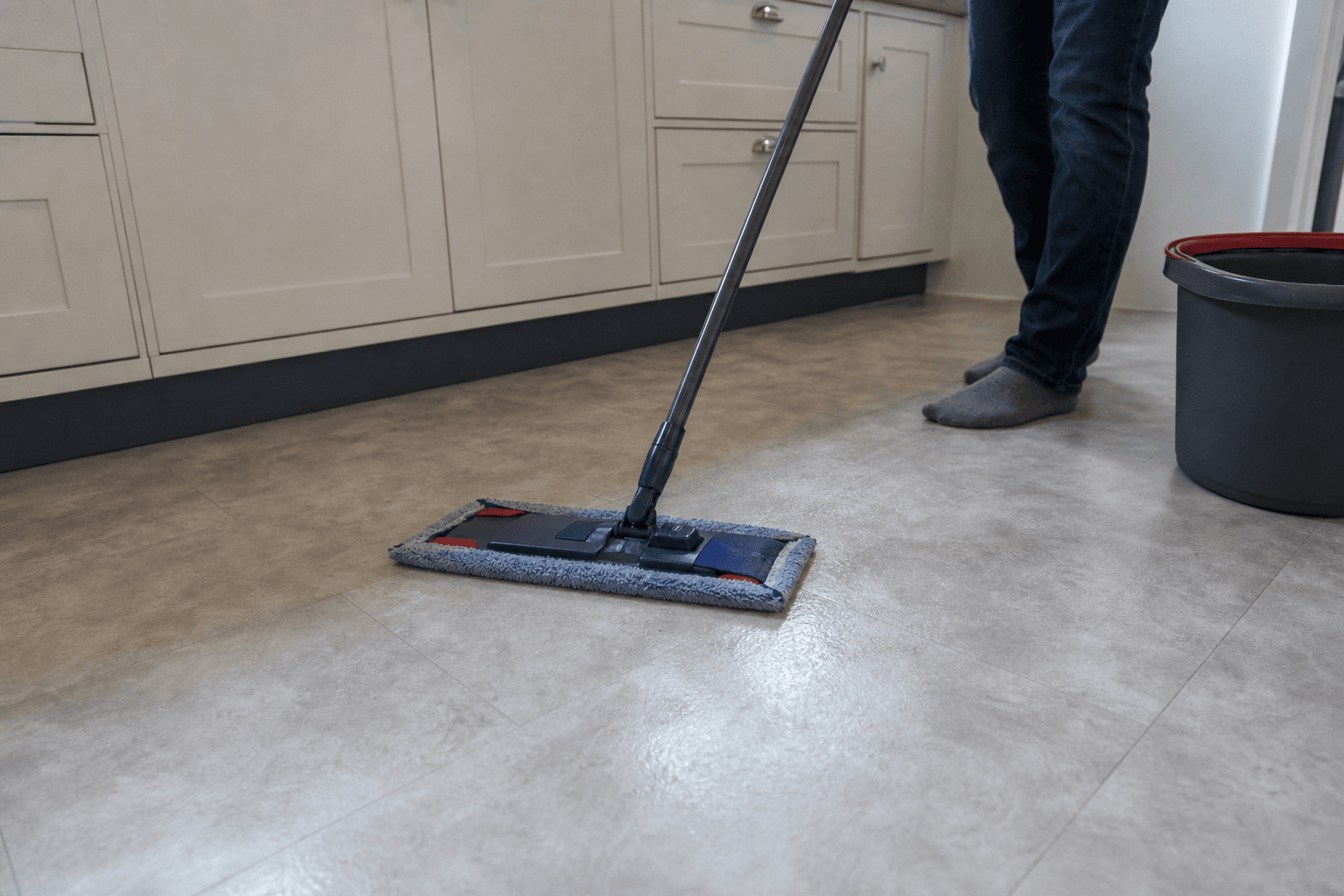
Vacuum edges and corners first, including the toe-kick under base units. Mop with hot soapy water if you have tile or LVT. For laminate, use a barely damp mop and a laminate-rated cleaner (Bona ~£8, Robert Dyas). Dry-buff with a microfibre.
Common mistake. Do not soak laminate floors. Standing water seeps into the joints and swells the fibreboard core, which cannot be reversed without replacing planks.
Check scope and pricing for One-Off Cleaning
Compare options, add-ons, and what affects the final price before you commit.
How to check you did it right
A finished deep clean has six visible signs. The oven interior is a uniform light grey or cream. Grout lines are uniform in colour, no dark patches. The stainless sink dries to a streak-free shine. Fridge door gaskets are clean and flexible, no black spotting. Worktops have no tacky residue. The whole room smells faintly of vinegar or nothing at all, not perfume.
When something goes wrong: troubleshooting
Three issues come up in nearly every UK kitchen deep clean. The fixes are simple if you know the cause.
Problem 1: Grout still discoloured after cleaning
Cause: an organic stain (tea, red wine, cooking oil) has penetrated below the surface dirt. Fix: make an oxygen bleach paste (sodium percarbonate plus a splash of water), apply, leave 20 minutes, scrub with the soft brush, rinse. Do not use chlorine bleach near any surface that has touched vinegar in the last 24 hours.
Problem 2: Oven cleaner residue smell on first use
Cause: insufficient rinse after the Astonish dwell. Fix: damp-cloth wipe the interior twice with clean water, then bake the empty oven at 100 degrees Celsius for 30 minutes with the door slightly ajar (in a ventilated room). The residue burns off cleanly.
Problem 3: Streaky stainless steel
Cause: wiped against the grain, or the cloth was too wet. Fix: identify the grain direction (run your finger across the surface), then re-buff with a dry Lakeland eCloth in line with the grain. The streaks disappear in one pass.
Need help with Deep cleaning?
Tell us about your job and we will match you with the right professional for Deep cleaning.
When to give up and call a pro
Five signs you should book a house cleaners near me search instead of finishing yourself: any gas line work; oven door glass with dirt between the panes (most modern ovens require door disassembly, which voids warranties); grout failure beyond a touch-up (regrouting is a tiler's job); deep stains in granite or quartz needing a professional poultice; and a dishwasher with a seized motor or knocking pump.
Roughly what a pro would charge for this
A UK professional kitchen deep clean runs £90-£180 depending on oven type and the number of appliances, based on quotes pulled in May 2026 from Checkatrade. A small galley kitchen with a single fan oven and an integrated dishwasher will sit at the lower end. A range cooker and an American-style fridge-freezer pushes you to £180.
"A standard kitchen deep clean by a domestic cleaner typically takes 3 to 4 hours and costs £90 to £180 in 2025" (Checkatrade, 2025).
Explore our Oven and fridge cleans service
See what is included, typical timings, and what to prepare before you book.
How Taskino can help
If you got to Step 5 and clocked that the oven racks alone are eating your Saturday, there is no shame in handing the keys over. A Taskino-vetted cleaner does a typical kitchen deep clean in around four hours flat, and they bring the Astonish and HG kit with them. Find a local cleaner at Taskino cleaning services and get your Saturday back. Tea is on you.
Sources
- Astonish Cleaning Tips, manufacturer guidance, https://astonishcleaners.com
- HG Hagesan UK product guides, https://www.hg.eu/en-gb
- BICSc Domestic Cleaning Code, British Institute of Cleaning Science
- HSE Control of Substances Hazardous to Health Regulations 2002, https://www.hse.gov.uk/coshh/
- Gas Safety (Installation and Use) Regulations 1998, https://www.legislation.gov.uk/uksi/1998/2451
- Checkatrade Cost Guide, kitchen deep clean prices May 2026, https://www.checkatrade.com
- B&Q product pricing, May 2026, https://www.diy.com
- Tesco product pricing, May 2026, https://www.tesco.com
Frequently asked questions: How to Deep Clean Your Kitchen: A Step-by-Step Guide for UK Homeowners
Short answers to common questions about this topic.
Our team will answer all your questions. we ensure a quick response.
Contact UsRelated posts
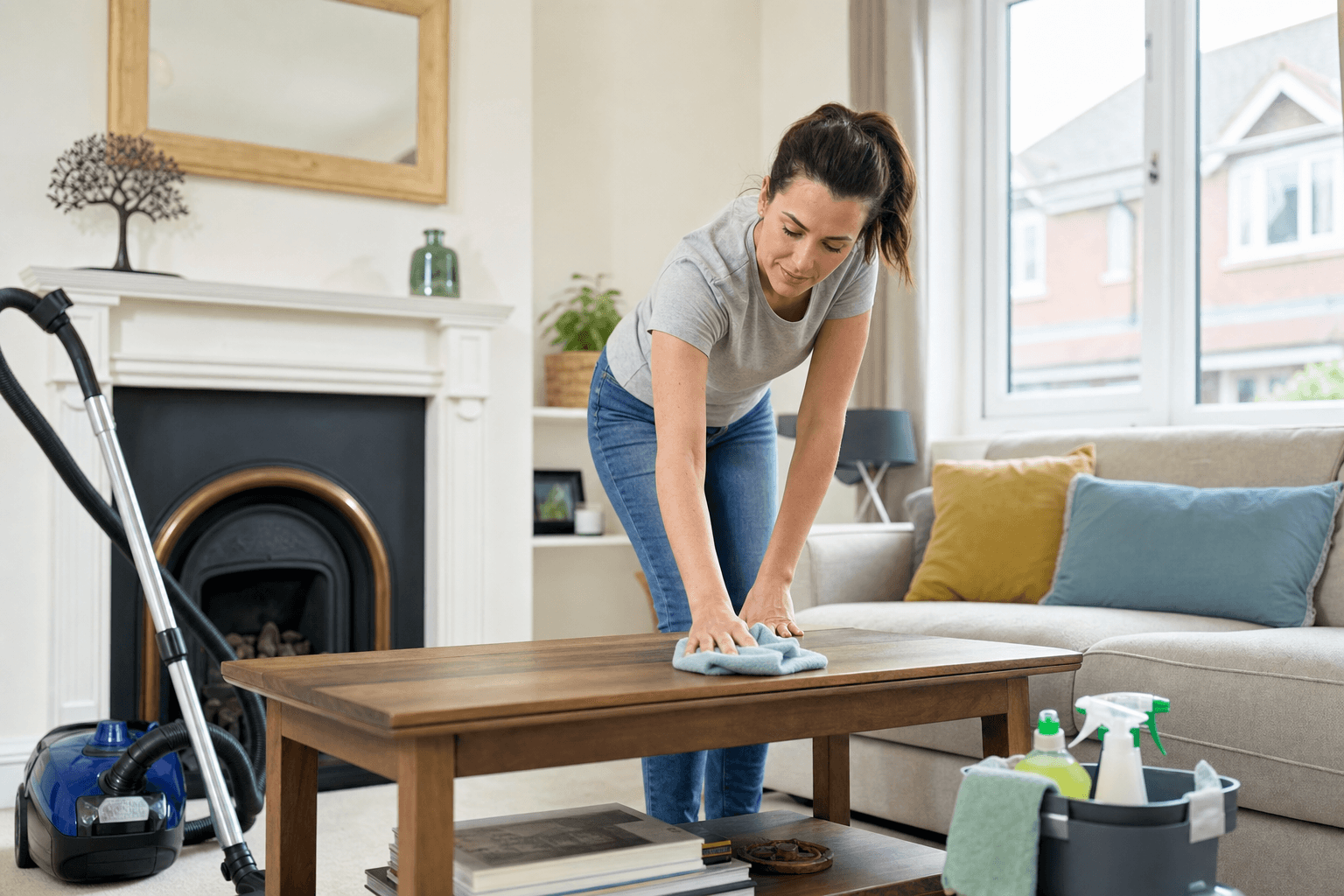
Plan a UK deep clean: real per-room costs, DIY vs hire, COSHH safety on bleach + vinegar, and how to hire a vetted cleaner in 2026.
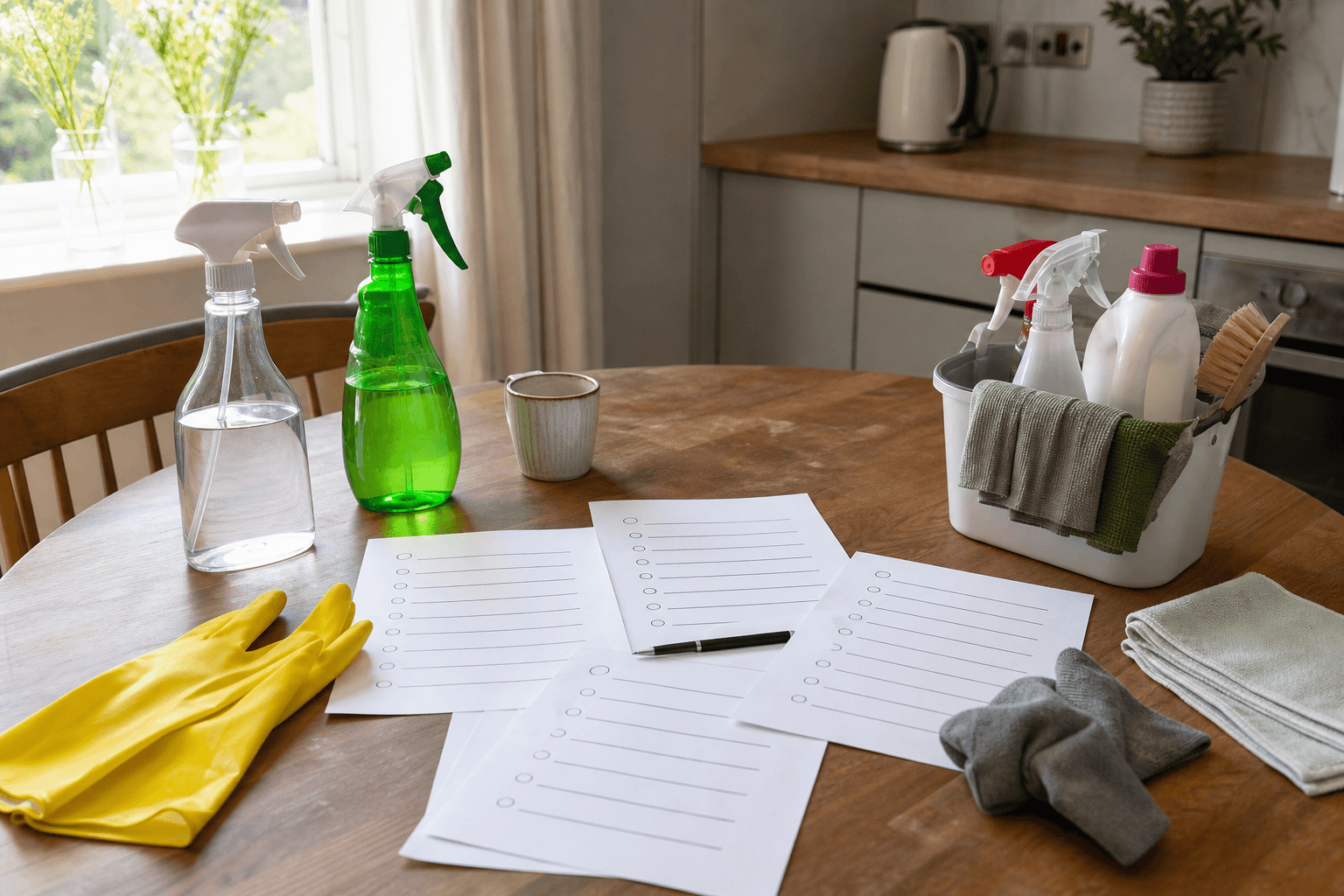
Searching for deep cleaning services near me but unsure? Compare DIY cost, time and finish vs a UK pro - with a real worked example.

Searching for house cleaners near me? Use these 14 vetting questions, plus UK insurance and BICSc checks to avoid cowboys in 2026.
Latest in Cleaning Services
View all in this category
Five reasons professional office cleaning is essential for your business, from productivity and image to hygiene, smart spending and specialist support.

How to hire an NCCA-registered carpet cleaner or oven cleaning pro in the UK: 12 questions, red flags, contract rules and how to verify credentials.
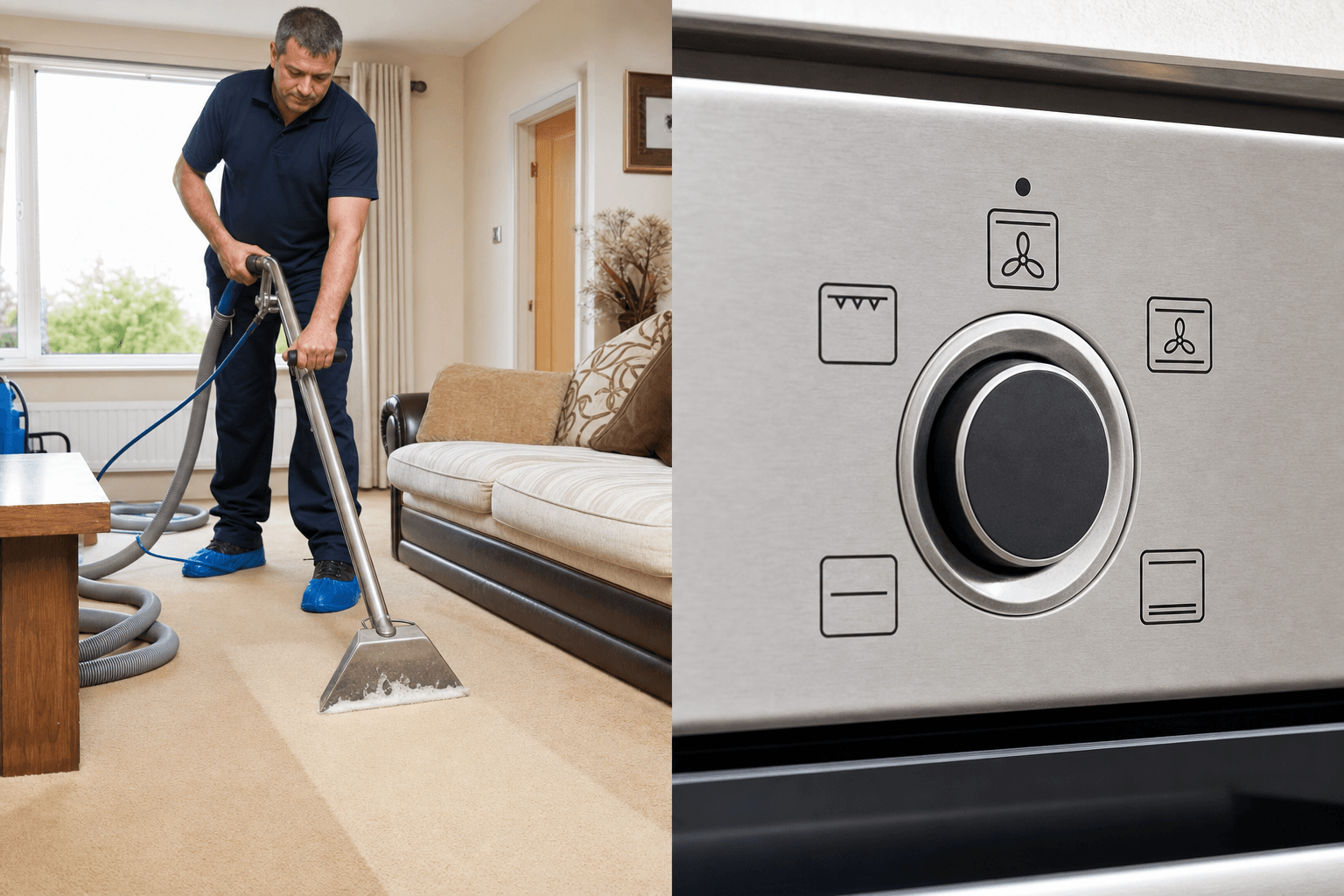
Steam vs dry vs hot-water carpet cleaning compared, plus every UK oven symbol decoded (fan, grill, broiling, pyrolytic) and which is right for your home.
Related services
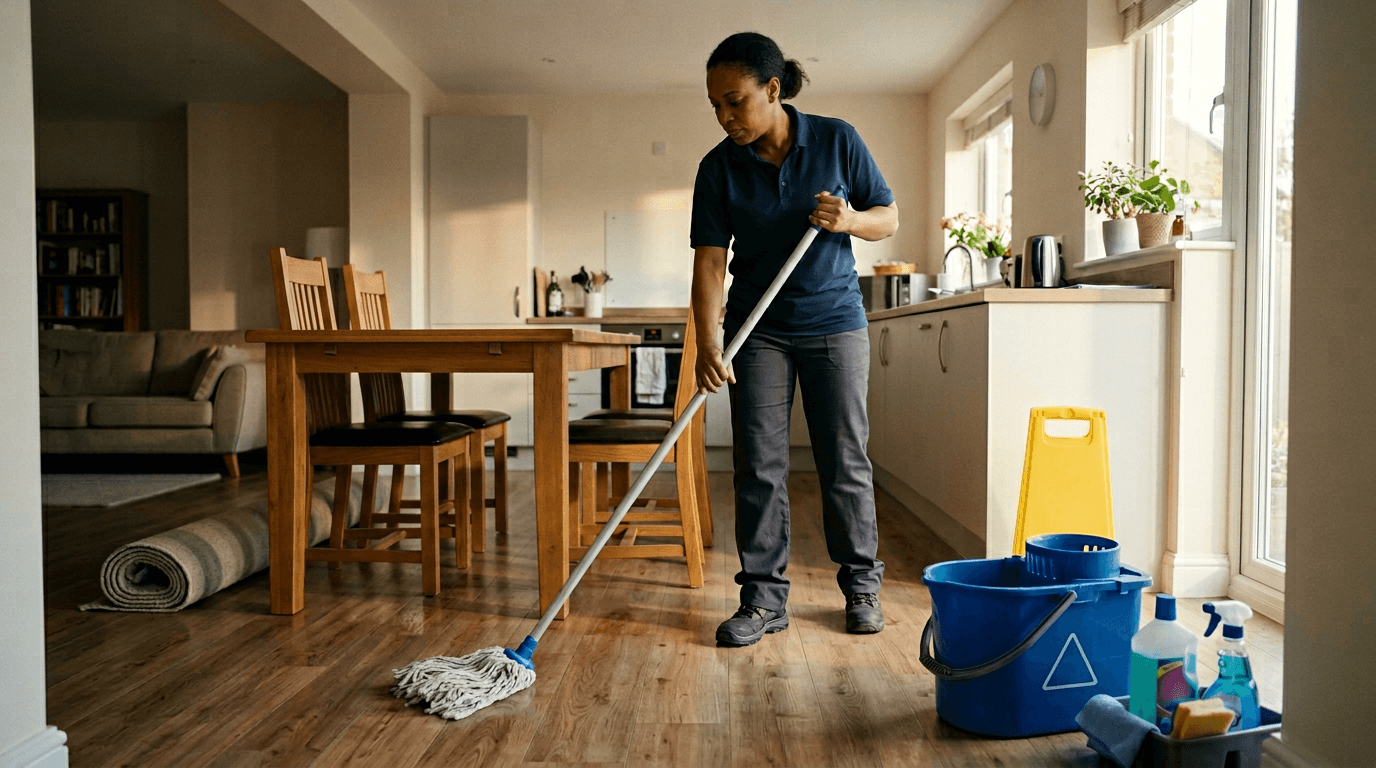
Professional deep cleaning for homes and flats across the UK. Taskino connects you with insured cleaners who tackle built-up dirt, grime and neglected areas for a fresher finish.
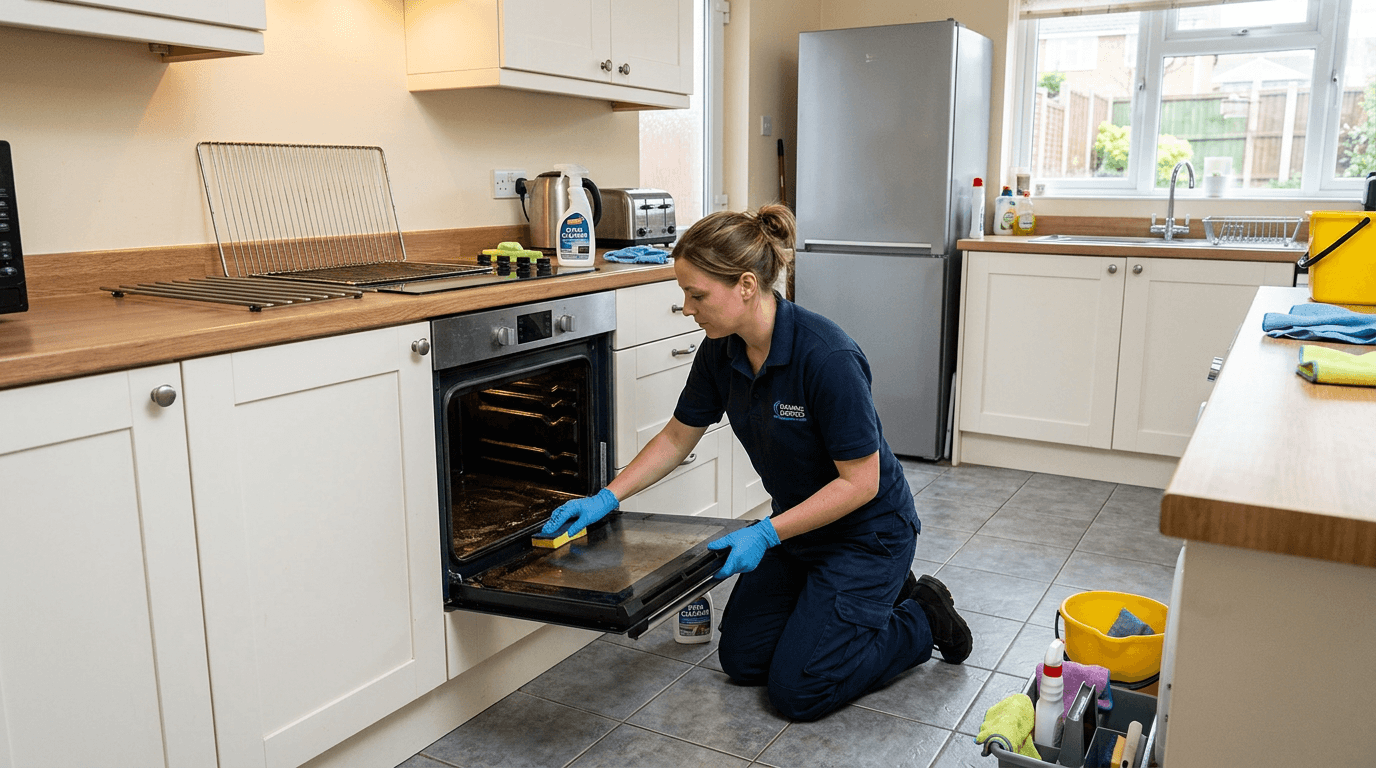
Professional oven and fridge cleans for UK homes. Remove grease, food residue and odours with trusted cleaners, safe products, tidy results and clear quotes.
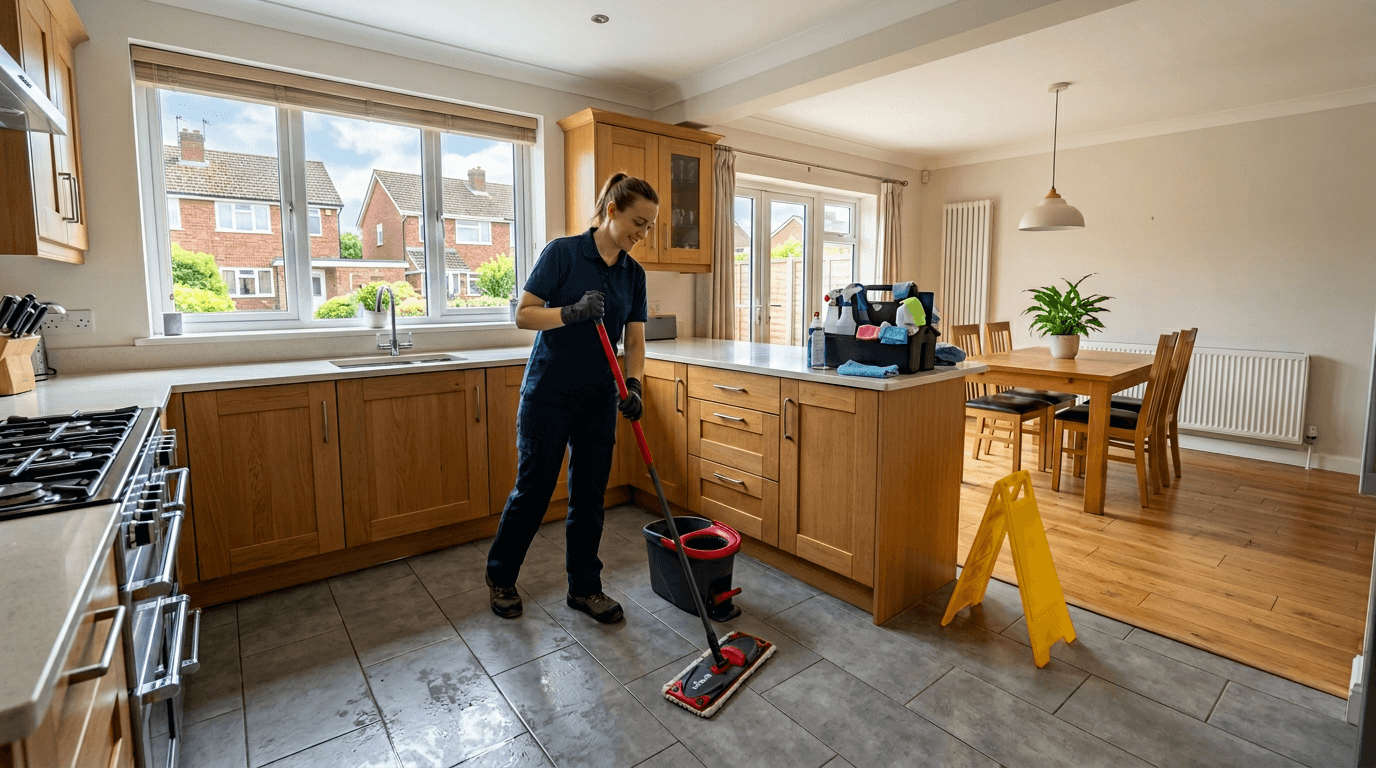
One-off cleaning for homes and flats by vetted, insured professionals. Fast bookings, clear quotes and a thorough clean tailored to your needs. Ideal for end-of-tenancy, pre-event or seasonal deep tidy.
Ready to Book Your Service?
Tell us what you need and our team will help you find the right professional quickly, with clear pricing and no hidden fees.