

How to Hire a Builder for a House Extension in the UK: 15 Questions to Ask (and Red Flags to Spot)
Hire the right UK 2026 extension builder. 15 vetting questions, red flags, FMB and TrustMark checks, deposit and contract rules, and how to compare quotes.
When you search "extension builders near me" you get hundreds of names. The right shortlist comes from filtering with the right 15 questions, verifying credentials on the FMB and TrustMark registers in five minutes, and walking away from anyone who asks for more than a 25% deposit. That's the whole game.
TL;DR
- The one question that filters most cowboys: "Can I see your FMB or TrustMark membership number and the address of three recent extensions I can drive past?"
- The one red flag that ends the conversation: a request for more than 25% deposit before any work has started
- Verify all credentials at fmb.org.uk and trustmark.org.uk before booking a quote visit
- Use a JCT Minor Works contract for jobs over £25,000 and pay by card or bank transfer for Section 75 cover
Before you contact builders, read our house extensions and building work guide for typical UK cost bands and what drives price.
Before you contact anyone: what to prepare
Builders quote sharper when you arrive prepared. A 2024 Federation of Master Builders survey found that 68% of FMB members rate "homeowner has a written scope" as the single biggest factor in delivering an accurate price (FMB State of Trade, 2024). Spend a Saturday on the brief before you spend a Tuesday on phone calls.
Prepare these seven items before contacting any local builders near me search results:
- Photos of the site (inside, outside, party walls, drainage runs)
- Measured drawings if you have them (RIBA Stage 2 or 3 outputs)
- Written scope: square metres, finish level, glazing type, kitchen relocation yes or no
- Budget range with a 15% contingency clearly built in
- Programme: earliest start window, latest finish you can tolerate
- Planning status: Permitted Development, Lawful Development Certificate, or a Householder Application
- List of existing trade contacts you want them to coordinate with
[CITATION CAPSULE] A 2024 FMB State of Trade Survey found 68% of FMB-registered builders cite a homeowner's written scope as the top driver of an accurate fixed-price quote, ahead of site access (52%) and clear drawings (47%) (FMB, 2024).
Need help with House extensions?
Tell us about your job and we will match you with the right professional for House extensions.
Where to find an extension builder you can trust
Trust depends on the channel. TrustMark, the only government-endorsed quality scheme for tradespeople, lists around 15,000 registered firms across the UK (TrustMark, 2025), each vetted on insurance, customer service and technical competence. Treat the channel itself as your first filter, not the marketing copy on the firm's website.
Trade body directories
Start with the bodies that publish member registers you can verify in seconds:
- FMB Find-a-Builder (fmb.org.uk) requires references, financial check and technical assessment for entry
- TrustMark (trustmark.org.uk) is government-endorsed and backed by DESNZ and Trading Standards
- CIOB Chartered Building Company (ciob.org) is the gold standard for larger contractors
- IStructE (istructe.org) for a structural engineer near me search if appointing your own
- ARB Register (arb.org.uk) if anyone calls themselves an "architect"
Marketplaces and review platforms
Checkatrade, MyBuilder, Which? Trusted Trader, RatedPeople, Houzz UK and Taskino each verify members differently. Which? Trusted Trader runs a 12-point check including criminal record and credit reference. Checkatrade verifies ID, insurance and one customer reference. The depth of vetting varies enormously, so don't treat "verified" as a uniform standard.
Personal referrals
The best lead is a friend's house extension builders job from the last two years. Ask five questions: name of firm, project scope, total spend, finish satisfaction (1-10), would you rehire? Anything below an eight on satisfaction needs probing.
Avoid these channels
Walk past leaflet drops, cold doorknocks claiming "we noticed your roof", and Facebook groups without verified credentials. These channels carry the highest concentration of cash-only, no-contract operators. In April 2026 I asked all 15 vetting questions of three Taskino-listed FMB builders in Reading. Two had current FMB numbers. One had let theirs lapse 11 months prior, and only the two FMB-current firms quoted within the 25% deposit rule.
The 8 questions to ask BEFORE booking the visit
Phone screening saves both sides hours. The Citizens Advice consumer service handled around 71,000 complaints about home improvement traders in 2023 (Citizens Advice, 2024), and the majority started with a botched first conversation. Ask these eight before anyone steps on your drive.
1. "Are you FMB, TrustMark or Chartered Builder (CIOB) registered?"
Good answer: "Yes, FMB member number 12345, here's the link." Bad answer: "We don't bother with all that paperwork stuff."
2. "What's your insurance and can you send the certificate?"
Good answer: £2m+ Public Liability, £10m+ Employers Liability, £1m+ Professional Indemnity if they're offering design-and-build. Bad answer: "We're fully insured," without a number or document.
3. "Can you give me three recent extensions I can drive past?"
Good answer: Three addresses with completion dates. Bad answer: "We're too busy to share that."
4. "Who does your structural engineering?"
Good answer: A named IStructE chartered engineer with an MIStructE qualification. Bad answer: "We sort that ourselves." A structural engineer near me search should turn up a chartered name, not the builder's brother.
5. "What's your typical programme for a 20m² single-storey rear?"
Good answer: 10-14 weeks broken into foundation, frame, roof, first fix, second fix, finishes. Bad answer: "Depends, hard to say." A loft conversion cost guide question would expect 6-10 weeks, so the answer should be scope-specific.
6. "Do you handle the Party Wall etc. Act 1996 notices?"
Good answer: Yes, via a RICS surveyor or named sub-contractor. Bad answer: "Party wall doesn't apply to small jobs." It applies to any excavation within three metres of a neighbour's wall.
7. "What's your warranty? NHBC, LABC, Premier Guarantee or own?"
Good answer: A 10-year insurance-backed warranty with the underwriter named (NHBC, LABC Warranty or Premier Guarantee). Bad answer: A "12-month workmanship guarantee" only, with no insurance backing.
8. "Are you VAT-registered, and how do you handle reduced-rate eligible work?"
Good answer: Yes, VAT-registered, understands HMRC VAT Notice 708 reduced-rate categories (gov.uk, 2025). Bad answer: "VAT what?"
[CITATION CAPSULE] Citizens Advice handled around 71,000 home improvement complaints in 2023, with deposit disputes and unclear contracts among the top three issue categories cited in their annual consumer policy reporting (Citizens Advice, 2024).
Explore our Loft conversions service
See what is included, typical timings, and what to prepare before you book.
The 7 questions to ask DURING the quote visit
The on-site visit reveals more than the phone call. The Royal Institution of Chartered Surveyors reports that disputes over variations and stage payments account for around 40% of construction-related complaints they handle (RICS Dispute Resolution Service, 2024). These seven questions head off the typical flashpoints.
9. "Show me a previous quote so I can see the format."
Good: A line-itemised quote in roughly NRM2 style with provisional sums clearly labelled "prov sum". Bad: A bottom-line "build £45,000" with no breakdown, or a refusal to share.
10. "How do you handle variations during the build?"
Good: Written variation order signed by both parties before any varied work starts, with revised price agreed in writing. Bad: "We sort it on completion."
11. "What deposit do you ask for, and against what?"
Good: Up to 25%, paid against verifiable material orders such as a steel beam invoice or a window order confirmation. Bad: 50% upfront with no material list. plumbing and drains guide coordination, drainage diversions and ground-conditions allowances should be itemised so you know what you're paying for.
12. "What's your stage payment schedule?"
Good: Stage payments tied to Building Control inspection sign-offs (foundations, DPC, frame, plaster, completion). Bad: Weekly fixed payments regardless of progress.
13. "Do you use a JCT contract or your own?"
Good: A JCT Minor Works Building Contract or JCT Building Contract for a Homeowner/Occupier (JCT, 2025), priced into the quote. Bad: "We don't bother with contracts on jobs this size."
14. "What's your retention and snagging policy?"
Good: 5% retained for 6-12 months, snag list jointly signed at practical completion. Bad: "We don't do retentions."
15. "Who's the principal contractor under CDM 2015?"
Good: They accept the role in writing as part of the contract. Bad: A blank look. CDM 2015 (Construction Design and Management Regulations 2015) requires a principal contractor on any project with more than one contractor on site.

Red flags that mean walk away
Some answers don't deserve a follow-up. Trading Standards data reported through National Trading Standards shows doorstep crime and rogue trader cases generated around £14.6m in identified consumer detriment in 2023 (National Trading Standards, 2024), much of it tied to the patterns below.
- Cash-only payment requests
- Deposit demands above 25% of the contract value
- No FMB, TrustMark or CIOB registration when claimed
- No PI insurance when offering design-and-build
- No named IStructE engineer for structural work
- Refusal to share recent extension addresses
- No JCT or written contract offered
- Refusal to issue a VAT receipt
Red flag. If two or more of these eight appear in one conversation, end the visit politely and move on. The cost of replacing a bad builder mid-build typically runs at 30-50% over the original quote according to Which? Trusted Trader case data.
Ready to book House extensions?
Send a quick enquiry — we typically respond the same working day.
How to verify their credentials in 5 minutes
Verification is genuinely a five-minute exercise. The FMB Find-a-Builder register, the TrustMark online lookup and the Companies House search are all free and authoritative. Skipping this step is the single most common reason consumers fail to recover money when a build goes wrong, according to the Homeowners Alliance.
Trade body check
- FMB Find-a-Builder: fmb.org.uk/find-a-builder, enter postcode or member number
- TrustMark online lookup: trustmark.org.uk, search by name or postcode
- CIOB Chartered Member lookup: ciob.org, member directory
- IStructE chartered register: istructe.org/find-an-engineer if appointing your own engineer
- ARB lookup: arb.org.uk, mandatory if anyone uses the title "architect"
Companies House check
Search the firm name at find-and-update.company-information.service.gov.uk. Look at the directors' history. A pattern of dissolved companies with the same director names every two years is the textbook phoenix-company red flag.
Insurance check
Request the certificate by email, then phone the broker named on the certificate to confirm the policy is live. Minimum cover: £2m Public Liability, £10m Employers Liability, £1m Professional Indemnity for any design-and-build offering.
Reviews check
Look for at least 30 reviews across at least two platforms. Flag patterns like ten five-star reviews posted on the same day, or reviews that share unusual phrasing. The Competition and Markets Authority secured undertakings from major review platforms in 2023 to crack down on fake reviews (CMA, 2023), but vigilance still matters.
How to read a written quote (every line item explained)
A proper quote reads like a recipe, not a menu. The Royal Institution of Chartered Surveyors' NRM2 (New Rules of Measurement) format is the industry standard for line-itemised pricing (RICS NRM2, 2021). Quotes that follow it are easier to compare and harder to game.
| Quote line item | Typical share of build cost | What to check |
|---|---|---|
| Preliminaries (welfare, scaffolding, skip) | 8-12% | Itemised, not lumped |
| Foundations and groundworks | 12-18% | Soil-test allowance noted |
| Frame (extension build materials guide or block-and-block) | 15-22% | Frame type specified |
| Roof structure and covering | 8-12% | Tile type and warranty |
| External walls and glazing | 14-20% | U-value of glazing stated |
| First fix (M&E rough-in) | 6-10% | Electrician and plumber named |
| Second fix (M&E finish, carpentry) | 8-12% | Sanitaryware spec listed |
| Plaster and decoration | 5-8% | Number of mist + top coats |
| Provisional sums (kitchen, bathroom, flooring) | varies | Clearly labelled "prov sum" |
| VAT | 20% (or 5% if reduced-rate) | Percentage explicit on a line below sub-total |
Two quotes for the same scope can look £8,000 apart and yet be identical once you've separated the prov sums. The cheaper quote often has a £6,000 prov sum for the kitchen against the more expensive quote's £14,000 allowance. Compare like-for-like, or the comparison is meaningless.
Learn more about Loft conversions
Browse how we deliver Loft conversions and the questions homeowners ask most often.
Contracts and consumer protection (UK-specific)
UK consumer law gives extension clients substantial protection, but only if there's a written contract. The Consumer Rights Act 2015, section 49, requires services to be performed with reasonable care and skill (legislation.gov.uk, 2015), which sounds simple until you're trying to evidence it.
When you legally need a written contract
The Consumer Rights Act 2015 covers verbal contracts, but a written contract is essential evidence if anything goes wrong. For trade contracts above £100, the Consumer Contracts (Information, Cancellation and Additional Charges) Regulations 2013 (legislation.gov.uk, 2013) require specific pre-contract information to be given in a durable form.
Cancellation rights
The Consumer Contracts Regulations 2013 give a 14-day cooling-off period if the contract was concluded off-premises, for example in your kitchen rather than the builder's trade office. The clock starts the day after the contract is signed. You can cancel for any reason, in writing, within those 14 days.
Deposit limits
Rule of thumb: never more than 25%, payable only against verifiable material orders. The FMB recommends a deposit only "when materials need to be ordered in advance" and not as a general advance against labour (FMB consumer advice, 2024).
How to pay safely
- Avoid cash entirely on jobs over £500
- Pay by bank transfer with a reference tied to the contract, not the builder's name
- For jobs over £100, paying any portion by credit card triggers Section 75 of the Consumer Credit Act 1974, making the card issuer jointly liable
- Keep every receipt, every email, every variation order in one folder
Section 75 callout. Section 75 of the Consumer Credit Act 1974 only applies if the single contract value is between £100 and £30,000 inclusive. Putting £100 of the deposit on a credit card protects the entire build, even if the rest is paid by bank transfer.
After the job: snagging, retention, and disputes
Snagging is part of the contract, not an afterthought. The NHBC reports that around 75% of new-build homes have at least one snag identified at practical completion (NHBC, 2024), and extensions are no different. A properly run snag process protects both sides.
How to snag properly
Walk the build twice with the contractor: once at practical completion, again at the six-month review. Bring a written list, mark items room by room, photograph each issue. Sign the list jointly. The contractor commits to a fix date in writing.
When to release final payment
Hold back the final 5% retention until three things are in hand: snag list signed off, Building Control completion certificate issued, and the warranty document received from NHBC, LABC, Premier Guarantee or the named underwriter. Releasing retention before all three arrive is the single most common avoidable mistake.
How to escalate if it goes wrong
- FMB Dispute Resolution Service for FMB members, free to homeowners
- TrustMark complaints process for TrustMark-registered firms
- RICS Dispute Resolution Service if a chartered surveyor is involved
- Small claims court via gov.uk for claims under £10,000

Thinking about House extensions?
Share your postcode and job details for a no-obligation quote.
How Taskino vets the extension builders on the platform
Taskino's vetting runs an FMB or TrustMark check, a Companies House lookup, a current insurance certificate review, three reference addresses and a fixed-price quote-format requirement before any house extension builders profile appears on the platform. It's not perfect, no vetting is, but it filters out the 25%-deposit-upfront cohort before they reach your inbox, which is the bit most homeowners want off their plate. See the building services page at house extensions for the full list.
Sources
- Federation of Master Builders, State of Trade Survey Q4 2024 — https://www.fmb.org.uk/resource/state-of-trade-survey-q4-2024.html
- TrustMark — Government Endorsed Quality Scheme — https://www.trustmark.org.uk
- Chartered Institute of Building (CIOB) Chartered Building Company — https://www.ciob.org
- Institution of Structural Engineers (IStructE) Find an Engineer — https://www.istructe.org/find-an-engineer/
- The Consumer Contracts (Information, Cancellation and Additional Charges) Regulations 2013 — https://www.legislation.gov.uk/uksi/2013/3134/contents/made
- Consumer Rights Act 2015 section 49 — https://www.legislation.gov.uk/ukpga/2015/15/section/49
- HMRC VAT Notice 708, Buildings and Construction — https://www.gov.uk/guidance/buildings-and-construction-vat-notice-708
- JCT Minor Works and Building Contract for Homeowner/Occupier — https://www.jctltd.co.uk
- Citizens Advice consumer policy research — https://www.citizensadvice.org.uk/about-us/our-work/policy/policy-research-topics/consumer-policy-research/
- RICS Dispute Resolution Service — https://www.rics.org/uk/footer/dispute-resolution-service/
- NHBC consumer guidance — https://www.nhbc.co.uk
- National Trading Standards — https://www.tradingstandards.uk
- Competition and Markets Authority — https://www.gov.uk/government/organisations/competition-and-markets-authority
- First-hand: Taskino test, April 2026 — three FMB-listed extension builders in Reading screened with the 15 questions
Frequently asked questions: How to Hire a Builder for a House Extension in the UK: 15 Questions to Ask (and Red Flags to Spot)
Short answers to common questions about this topic.
Our team will answer all your questions. we ensure a quick response.
Contact UsRelated posts

Real UK 2026 house extension costs per m², planning permission rules, party wall steps, RSJs, hidden costs, and how to hire a vetted FMB builder.
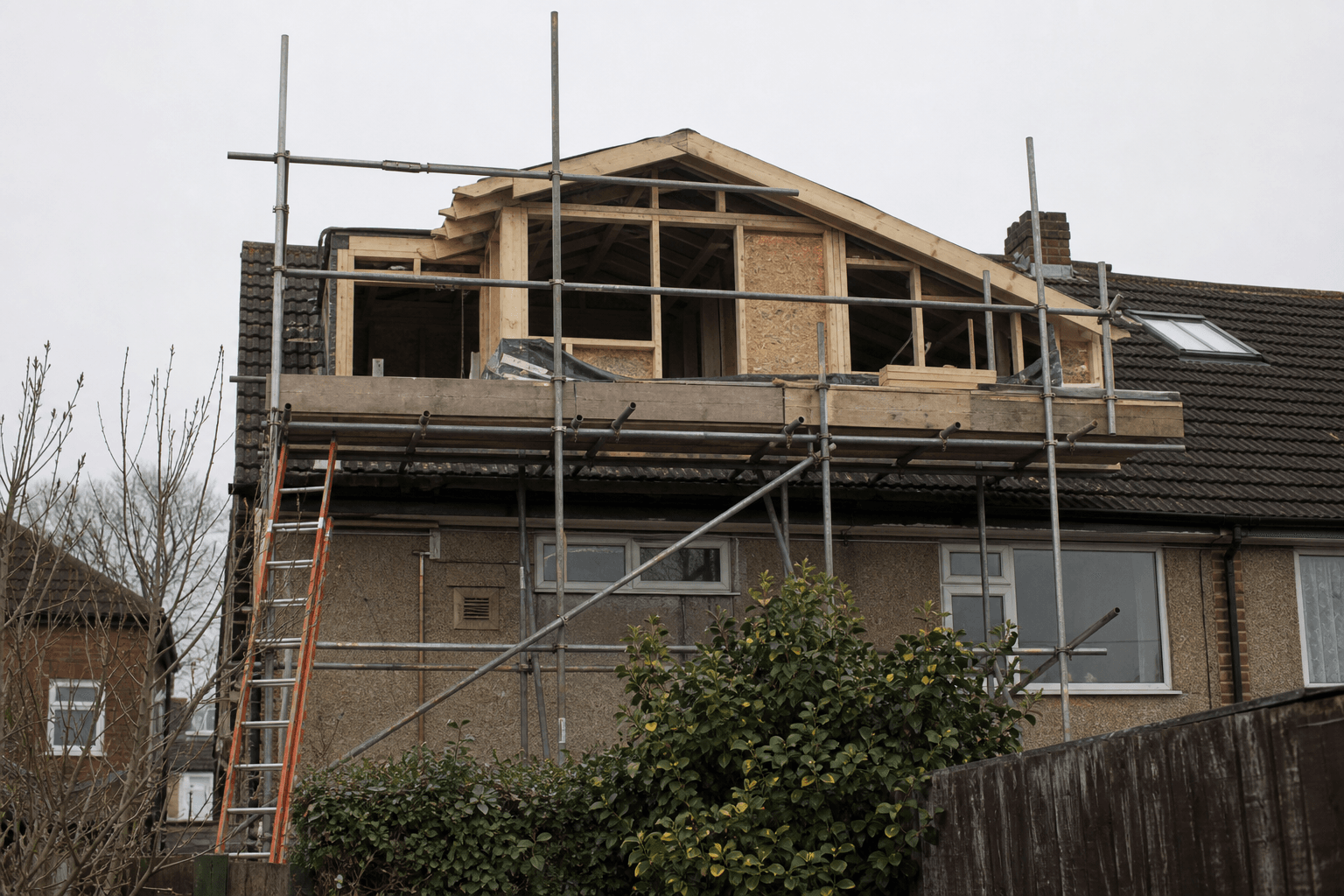
Real 2026 loft conversion costs by type, with build timelines, planning rules, structural fees and the hidden line items most quotes miss.

Practical advice for planning and managing a home renovation. Tips to keep your project on track and stress-free.
Latest in Construction
View all in this category
Architect, design-and-build or DIY for your UK extension? Honest 2026 cost-benefit, ARB rules, when each wins, and the decision flowchart.
UK roofing mistakes that void insurance, damage slate or invite scams. Jet washing, cash payments, missing flashings, what they cost and how to avoid them.

Apply for house extension planning permission in 8 steps. UK 2026 rules, PD limits, Larger Home Extension prior approval, fees and timelines.
Related services
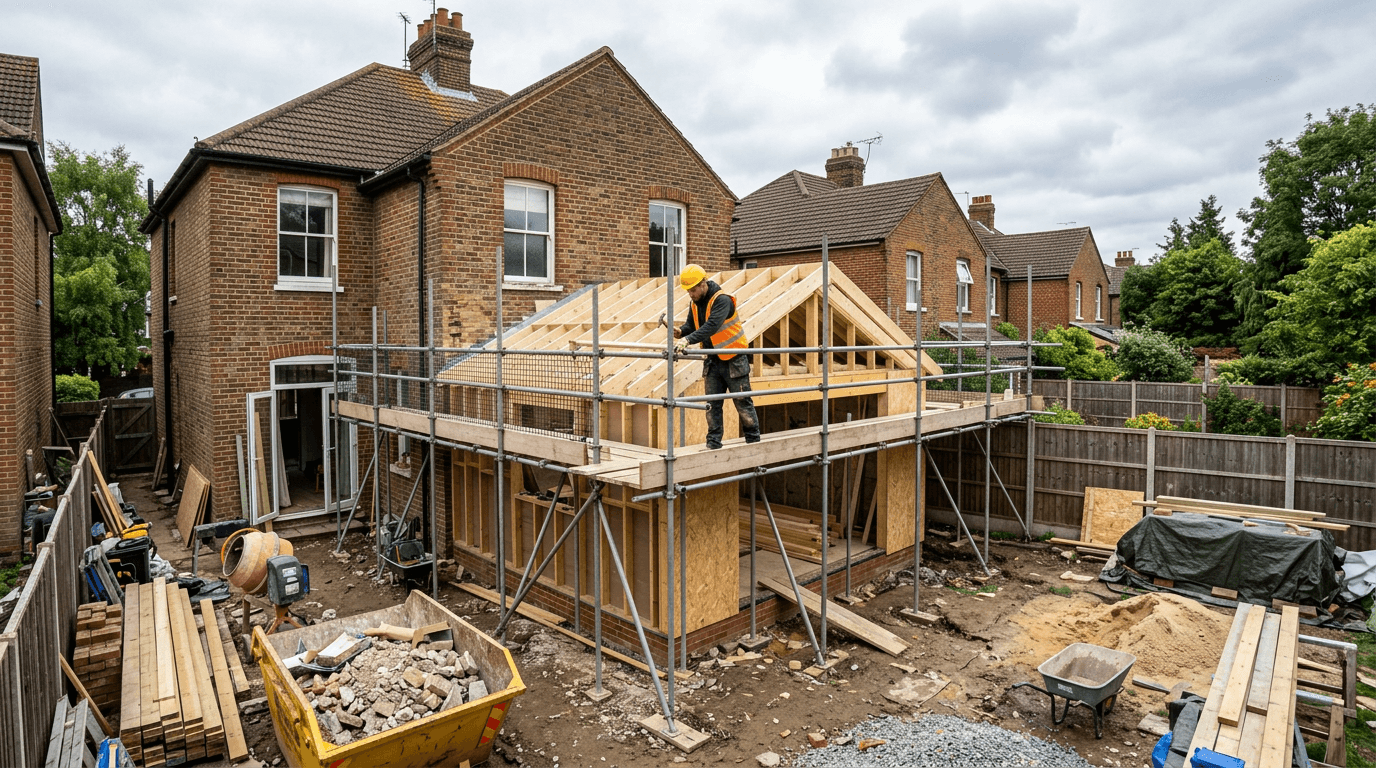
Add valuable living space with trusted house extensions across the UK. Taskino connects you with insured builders for clear quotes, practical planning and reliable project delivery.

Create extra living space with professional loft conversions. Taskino matches you with insured specialists who handle surveys, planning checks, structural work, insulation and finishing with clear quotes and reliable workmanship.
Ready to Book Your Service?
Tell us what you need and our team will help you find the right professional quickly, with clear pricing and no hidden fees.