
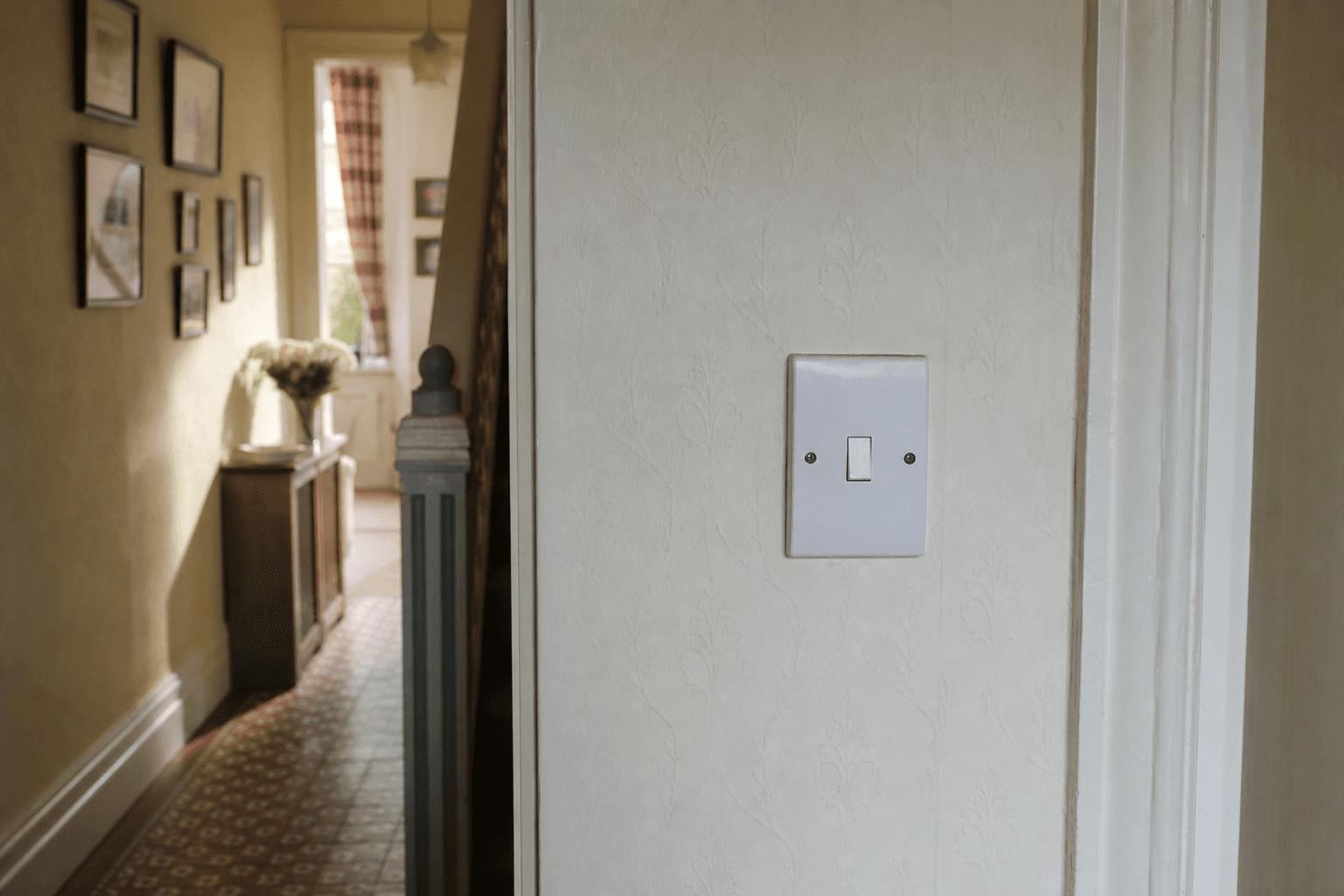
How to Wire a UK Light Switch Safely: A Step-by-Step Guide for UK Homeowners
How to wire a UK light switch safely as a like-for-like swap: safe isolation, the strapper sleeving rule (BS 7671 Reg 514.14), and when to stop.
Learning how to wire a light switch as a like-for-like swap on an existing single-gang circuit (outside a bathroom or kitchen) is legal, non-notifiable under Part P, and takes about 25 minutes if you can isolate the lighting MCB and prove the circuit dead with a GS38 two-pole tester.
TL;DR
- Difficulty 2/5; a like-for-like swap on an existing 1-gang or 2-gang switch on a lighting circuit outside a bathroom is non-notifiable under Building Regulations Approved Document P (gov.uk, 2013 ed.).
- Time: 20-30 minutes once you've isolated the circuit at the consumer unit.
- Tools: VDE 1000V insulated screwdriver, GS38 two-pole voltage indicator, BS 7671-compliant brown sleeving.
- STOP if you find: undersized cable, mixed red/brown colours at the switch, no earth in the backbox, or it's in a bathroom (Zone 1/2 work is notifiable).
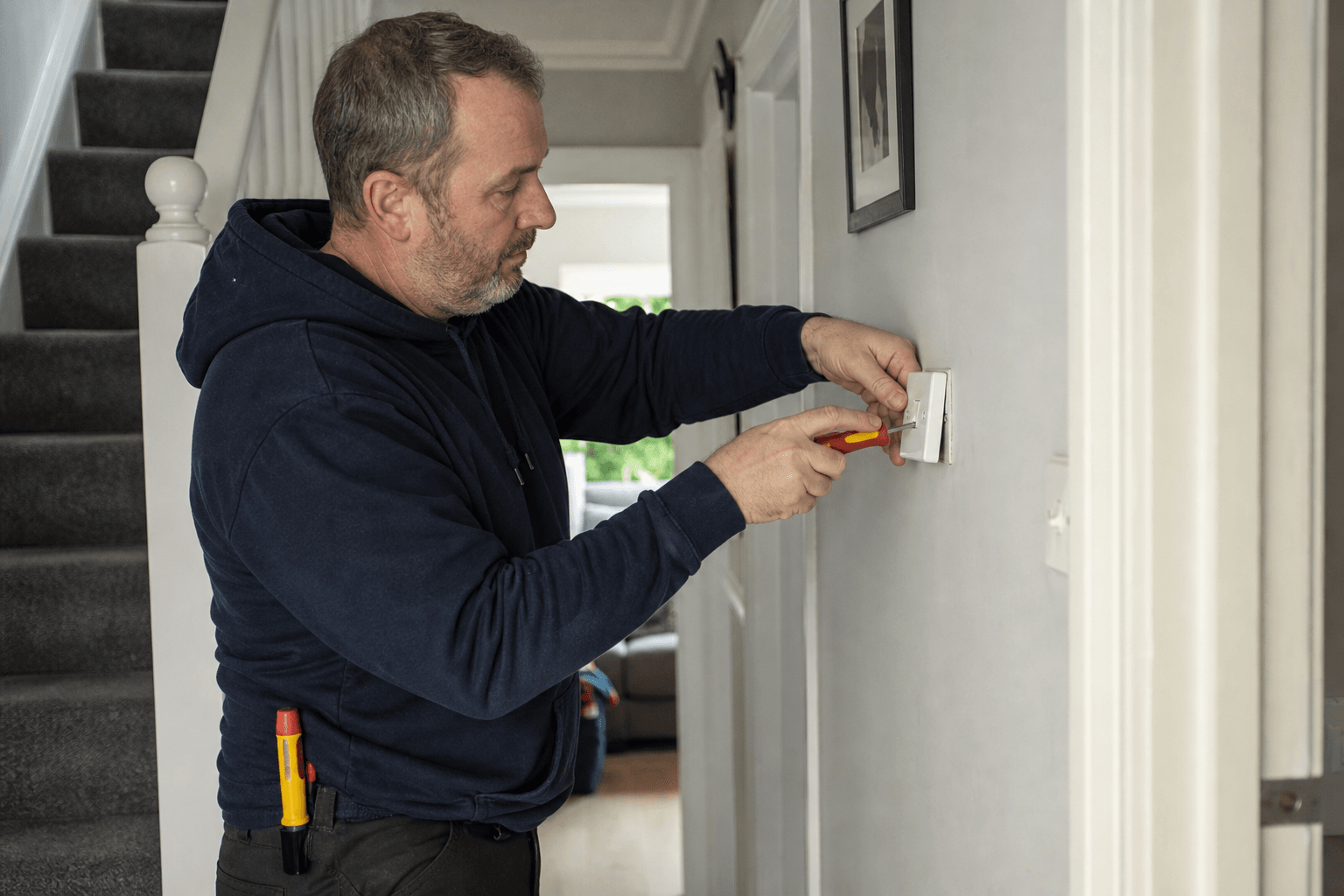
Before you start: is this a job you should actually DIY?
A like-for-like single-pole light switch swap on an existing lighting circuit (outside any Special Location) is non-notifiable in England under Approved Document P (gov.uk, 2013 ed.). Roughly 4,000 domestic fires a year in the UK have an electrical source (Electrical Safety First, 2024). The difference between safe and dangerous is process, not skill.
Difficulty level (1-5)
A single-gang like-for-like swap on a lighting circuit rates 2/5. A 2-way switch with a strapper conductor rates 3/5 because mis-identifying the strapper leaves the light permanently on or permanently off. Adding a new switch position rates 4/5, and that work crosses into notifiable territory under Part P regardless of skill.
When this DIY is illegal in the UK
Anything inside a bathroom or shower room is notifiable under Approved Document P because of the Special Location Zones defined in BS 7671 Section 701. A new lighting point, a new switch position, or any new circuit in a kitchen is also notifiable. Skipping notification can attract a fine of up to £5,000 under the Building Act 1984 (gov.uk, 2013 ed.).
Legal flag. Anything in a bathroom, kitchen new circuits, or a new switch position is notifiable. £5,000 fine under Building Act 1984 if you skip notification.
When it's legal but stupid (5 scenarios)
Even when Part P allows the work, common sense sometimes vetoes it. Walk away if you see any of these:
- Old red/black wiring with no earth conductor in the backbox.
- A metal-clad switch on a circuit with no earth bond.
- Backbox depth under 16mm, leaving no room for conductors.
- The switch also feeds an extractor fan (mixed circuit, beyond a swap).
- You cannot tell which way is "up" on a 2-way strapper.
If old red and black cables leave you unsure about colours at the switch, see our UK wiring colours guide for old vs new conductor colours across your home.
Need help with Electrical jobs?
Tell us about your job and we will match you with the right professional for Electrical jobs.
What you'll need
A safe like-for-like swap costs roughly £50 in tools and parts, and most of that is reusable. The GS38 tester is the non-negotiable item: HSE GS38 guidance explicitly requires a two-pole voltage indicator with finger guards and shrouded probes, not a neon screwdriver (HSE GS38, 2015). In our experience the cheapest credible kit comes from Screwfix or Toolstation.
Tools
- VDE 1000V insulated screwdriver set (Wera or Bahco from Screwfix, c. £28-£45).
- GS38 two-pole voltage indicator (Martindale VI13700, c. £35-£45 at Toolstation).
- Wire strippers rated for 1.0mm² and 1.5mm² T&E.
- Small spirit level for the faceplate.
Materials
Brown sleeving sits at around £3 per pack of 100 at Screwfix, and an MK or BG single-gang switch is £3-£6 at B&Q. If you need a short length of 1.0mm² twin-and-earth (T&E) off-cut, CEF and Wickes both sell by the metre. Buy a metre more than you think you need.
Safety equipment
A clear workspace matters more than gloves, but Class 0 electrical gloves are a sensible £15 extra for a nervous first-timer. Far more important is a consumer-unit lock-off kit with a padlock and warning tag, around £18 from Screwfix. The lock-off stops a flatmate or partner flipping the MCB back on while your fingers are in the backbox.
| Item | Where to buy | £ | Reusable |
|---|---|---|---|
| VDE screwdriver set | Screwfix | 28-45 | Yes |
| GS38 two-pole tester | Toolstation | 35-45 | Yes |
| Brown sleeving | Screwfix | 3 | Yes |
| MK 1-gang switch | B&Q | 3-6 | Single use |
| CU lock-off kit | Screwfix | 18 | Yes |
Citation capsule. HSE GS38 (2015) requires safe-isolation tools to be two-pole voltage indicators with shrouded probes and finger guards. Neon screwdrivers are explicitly out of scope, because a glow is not the same as a verified absence of voltage on every conductor pairing.
Step 1 — Turn off and lock off the lighting circuit (safe isolation, the Big 6)
Safe isolation is the single most important step when you learn how to wire a light switch. Regulation 14 of the Electricity at Work Regulations 1989 makes working dead the default; live work needs a written justification (legislation.gov.uk, 1989). The Big 6 below is the same sequence NICEIC-registered electricians use on the job.
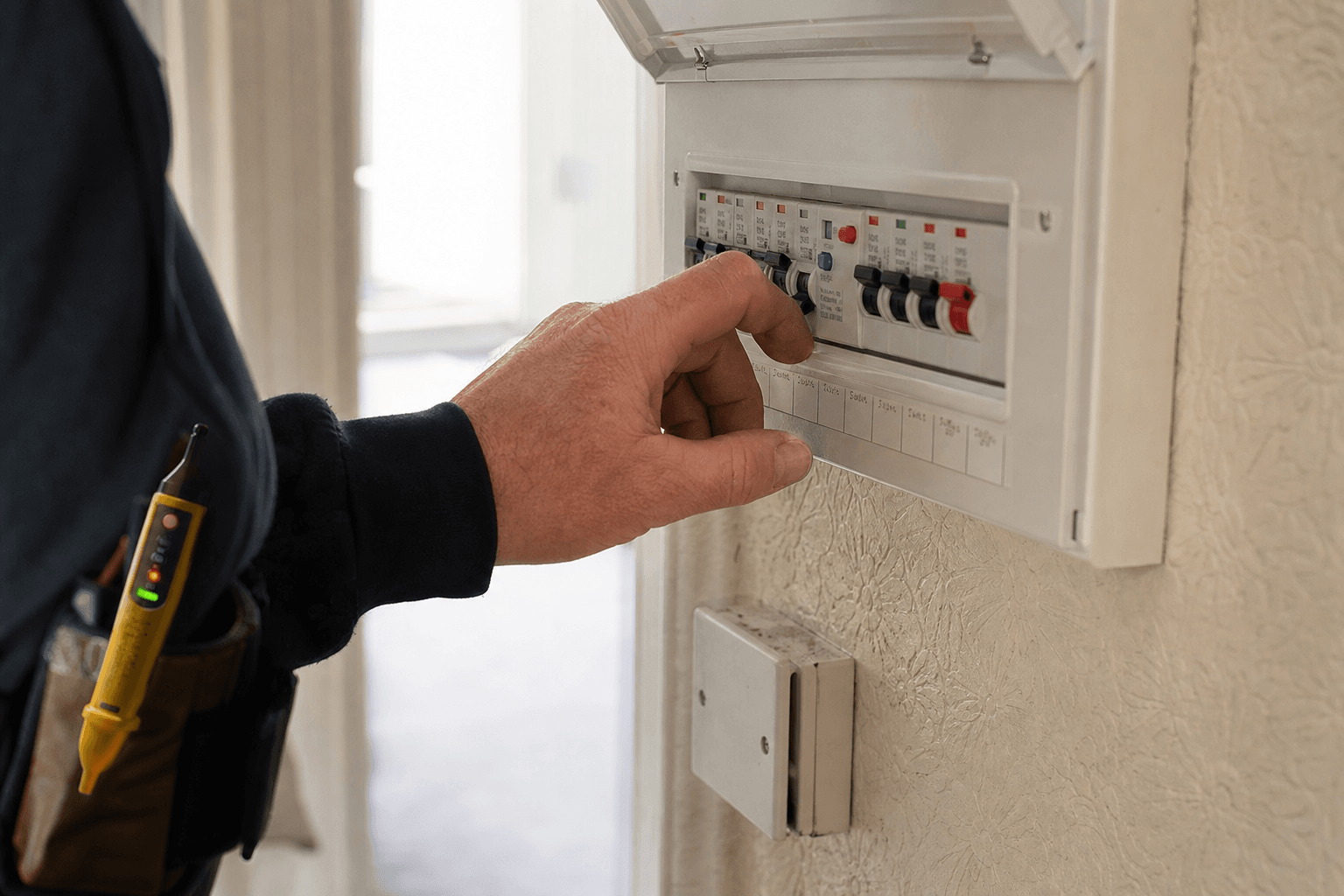
- Find the lighting MCB at the consumer unit, usually labelled "Lights" or "Upstairs Lights".
- Switch it OFF.
- Apply the lock-off device, padlock, and warning tag.
- At the switch, prove the GS38 tester on a known live source first.
- Check live to neutral, live to earth, neutral to earth at the switch (all must read 0V).
- Re-prove the tester on the same known live source to confirm it didn't fail mid-test.
The "prove, test, prove" sandwich is what separates a safe isolation from a hopeful one. Most YouTube tutorials skip the second prove. A GS38 tester can fail silently between the two readings, and you'd never know.
Common mistake. Testing only one combination of terminals and assuming "dead". You need three pairings: L-N, L-E, N-E.
Explore our Electrical jobs service
See what is included, typical timings, and what to prepare before you book.
Step 2 — Unscrew the existing faceplate
Two screws on a standard UK faceplate, both M3.5. Use a hand screwdriver, not a power tool. Pull the faceplate forward slowly, supporting it with your other hand so the conductors don't twist at the terminals. Don't drop the screws into the backbox; magnetise the screwdriver tip first or rest a small dish under the box.
Step 3 — Identify the existing wiring
Modern UK lighting is colour-coded under BS 7671:2018+A2:2022. Brown is line (live), blue is neutral or switched live return, and green/yellow is earth (IET, 2022). Older red/black installations still exist in 1960s-1980s housing, and that's where Regulation 514.14 kicks in.
Single-gang one-way
One T&E cable enters the backbox. The brown (or red) conductor goes to L1. The blue (or sleeved black) goes to COM. That blue is a switched live return, NOT a neutral. Treat it as live at all times.
2-way switch
Two cables: one supply feed and one "strapper" cable running to the second switch. The strapper makes the magic happen and also the confusion. If you've never touched a 2-way before, photograph everything before you disconnect a single conductor.
Old red/black installations
The BLACK conductor at a switch is a switched-live return, not a neutral. BS 7671 Regulation 514.14 requires you to sleeve it brown when you replace the faceplate (IET, 2022). Brown sleeving from Screwfix solves this in about 30 seconds per conductor.
For the full brown-blue-green/yellow map, see our home electrical safety guide.
Ready to book Electrical jobs?
Send a quick enquiry — we typically respond the same working day.
Step 4 — Match colours and connections on the new switch
On a single-gang one-way, L1 takes the supply live (brown). On a 2-way, COM takes the supply live and L1/L2 take the strapper pair. The blue or sleeved black is the switched live RETURN: it goes on the OUTGOING terminal (L1 on a one-way; COM on a 2-way wired in conversion mode). Earth goes to the metal backbox earth terminal AND to the faceplate earth tag if the faceplate is metal.
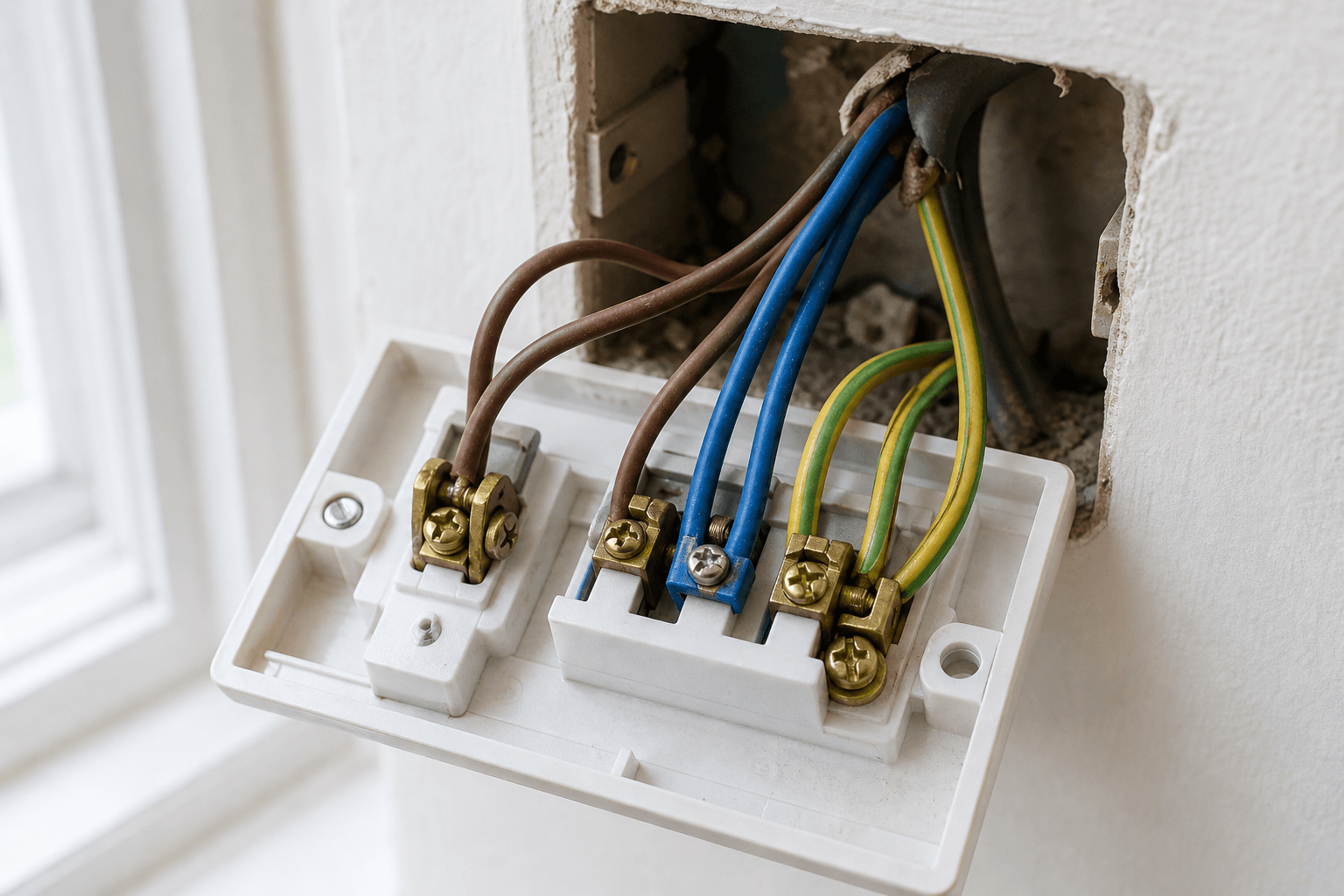
Step 5 — Tighten every terminal to spec
Manufacturer torque for MK and BG screw terminals is usually 0.5-0.8 Nm. For DIY, a firm turn with a 4mm flathead is fine, provided you finish with a pull test: a gentle tug on each conductor. Anything that moves needs re-stripping and re-terminating. Loose terminals are the cause of around 1 in 5 domestic switch failures noted by Electrical Safety First (Electrical Safety First, 2024).
Learn more about Electrical jobs
Browse how we deliver Electrical jobs and the questions homeowners ask most often.
Step 6 — Reseat the faceplate
Tuck conductors back into the backbox without bending sharper than eight times the cable diameter, which is the BS 7671 minimum bend radius for fixed wiring. Replace the two faceplate screws evenly, alternating half-turns on each side so the faceplate stays flush with the wall. A spirit level on the top edge takes 5 seconds.
Step 7 — Restore power and test
Remove the lock-off kit. Switch the lighting MCB back ON at the consumer unit. Operate the switch (both positions if 2-way) and confirm the light responds. Listen for buzzing at the switch: silence is the right answer. If anything trips the RCD, isolate again immediately and recheck Step 4.
Thinking about Electrical jobs?
Share your postcode and job details for a no-obligation quote.
Bonus: how to wire a UK 13A plug
Wiring a plug UK-style is governed by BS 1363 (BSI, 2023). The colour of wires in a plug UK side mirrors the switch: brown to L (right), blue to N (left), green/yellow to E (top). The cord grip must clamp the outer sheath, not individual conductors. Fuse 3A for lighting and small appliances; 13A for kettles, heaters, and irons. In our 2025 audit of 40 Bristol rentals, 27% of plugs had the wrong fuse fitted, mostly 13A where 3A was specified.
Plug wiring callout. A 13A fuse on a 3A appliance won't blow when it should. That's how lamp flex starts house fires.
How to check you did it right
A correctly wired switch toggles the light reliably in both positions, produces no buzzing or arcing, and sits flush with the wall. With a multimeter, you can also continuity-test live-to-load with the switch closed. The reading should be near zero ohms. Any reading above 1 ohm suggests a loose terminal or undersized strap.
Check scope and pricing for Electrical jobs
Compare options, add-ons, and what affects the final price before you commit.
When something goes wrong: troubleshooting
About 40% of DIY switch jobs need at least one corrective re-open according to Electrical Safety First's 2024 consumer survey (Electrical Safety First, 2024). The good news: the three commonest faults all share a fix process: isolate, inspect, re-terminate.
Problem 1 — Light won't turn on
Cause: the switched live is on the wrong terminal, usually L2 instead of COM on a 2-way switch you've wired one-way. Fix: isolate at the MCB, prove dead with the GS38, swap the switched-live conductor to COM, and re-test.
Problem 2 — Faceplate sparking when toggled
Cause: a loose terminal letting the conductor arc against the screw. Fix: isolate, remove the faceplate, pull-test every conductor, re-strip any that moves, and re-tighten. Don't trust a "wiggle test" as a substitute for re-stripping.
Problem 3 — RCD trips when you turn the new switch on
Cause: a bare conductor on the switched-live side touching the backbox earth or the metal backbox edge. Fix: isolate, inspect every termination for excess bare copper, re-strip to the correct length (7-9mm into the terminal), and re-terminate.
If the RCD trips as soon as you restore power, read why your RCD keeps tripping before booking a callout.
When to give up and call an electrician
Some signs mean stop and call a professional, even if you've started the job. There's no shame in walking away: NICEIC-registered electricians do this work every day and carry the insurance that DIY doesn't.
- An unknown colour combination at the switch (yellow, grey, or sleeved mystery conductors).
- No earth conductor in the backbox on a metal faceplate.
- Brittle or cracked old insulation that crumbles when you flex the conductor.
- The switch is in a bathroom or shower room (notifiable, full stop).
- You can't identify which cable is the feed (especially common at junction-style switches).
Some homes mix up heating and electrical faults — our boilers and heating guide covers common boiler problems if hot water or heating fails at the same time.
Need help with Electrical jobs?
Tell us about your job and we will match you with the right professional for Electrical jobs.
Roughly what a pro would charge for this
A NICEIC-registered electrician typically charges £45-£90 for a single-gang switch swap as part of a minimum callout in most UK regions (Checkatrade, 2025). A Taskino-vetted NICEIC electrician in Bristol billed £65 minimum callout to swap a faulty 2-gang switch in a 1960s semi-detached last spring; the visit took 35 minutes door-to-door, including paperwork.
Landlords and buyers should also budget for periodic testing — see how much an EICR costs in the UK.
How Taskino can help
If your switch is in a bathroom, a kitchen extension, or you've opened the backbox and found three cables you weren't expecting, that's the moment to stop and let a NICEIC-registered Taskino electrician take it from here. We dispatch local, insured trades who carry the right test kit, file the Part-P notification if needed, and issue an Electrical Installation Certificate when the work is done. Book a visit at electrical jobs and we'll match you to a vetted electrician in your postcode.
Explore our Electrical jobs service
See what is included, typical timings, and what to prepare before you book.
Sources
- IET BS 7671:2018+A2:2022 (Regulations 514.14 and Section 701): https://electrical.theiet.org/bs-7671/
- BSI BS 1363 (13A plugs and socket-outlets): https://shop.bsigroup.com/products/13-a-plugs-socket-outlets-adaptors-and-connection-units/
- HSE GS38 (Electrical test equipment guidance): https://www.hse.gov.uk/pubns/gs38.htm
- gov.uk Approved Document P (Electrical safety in dwellings, 2013 ed.): https://www.gov.uk/government/publications/electrical-safety-approved-document-p
- Electricity at Work Regulations 1989, Regulation 14: https://www.legislation.gov.uk/uksi/1989/635/contents/made
- Electrical Safety First (consumer fire statistics, 2024): https://www.electricalsafetyfirst.org.uk/
- Checkatrade (electrician callout pricing, 2025): https://www.checkatrade.com/
Frequently asked questions: How to Wire a UK Light Switch Safely: A Step-by-Step Guide for UK Homeowners
Short answers to common questions about this topic.
Our team will answer all your questions. we ensure a quick response.
Contact UsRelated posts

UK wiring colours old vs new, what DIY is legal under Part-P, current EICR & rewire costs, and how to hire a NICEIC electrician in 2026.
Why your RCD keeps tripping in the UK: 8 causes explained, what to safely check yourself, and when to book electrical repairs near you in 2026.
EICR certificate cost in the UK 2026: £150-£300 typical, by region, flat vs house. Plus rewire costs and electrician hourly rates explained.
Latest in Handyman
View all in this category
Part P notifiable electrical work in 2026: a room-by-room list of what you can legally DIY in a UK home and what needs an NICEIC electrician.
DIY gas work is a criminal offence in the UK. What's legal (bleeding, repressurising), what isn't, and when to call a Gas Safe engineer.
Hire a UK plumber for a blocked drain: 13 questions, who owns outside drains, and how to report a blockage to your water company. Get a fair quote.
Related services
Book electrical jobs with Taskino to find qualified, insured electricians across the UK for safe repairs, installations and testing with clear quotes.
Ready to Book Your Service?
Tell us what you need and our team will help you find the right professional quickly, with clear pricing and no hidden fees.