
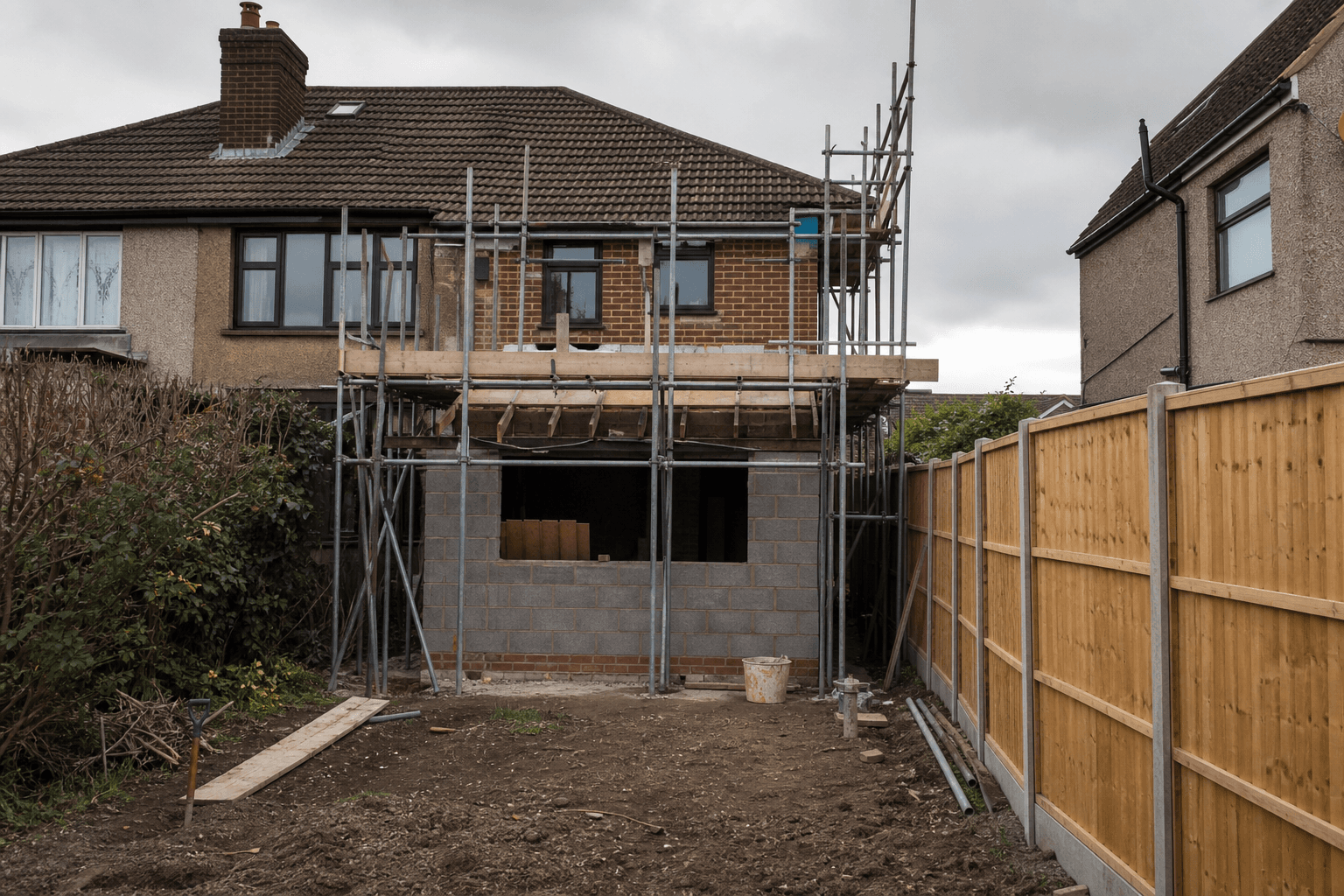
14 House Extension Mistakes That Cost UK Homeowners £20,000 a Year
The 14 most expensive house extension mistakes UK homeowners make in 2026, with real £ costs, party wall traps, VAT confusion and how to avoid each.
Most homeowners lose £20,000 on an extension on house because of paperwork, not bricks. The biggest cost isn't the build, it's the party wall notice you didn't serve, the VAT rate you misread, and the Lawful Development Certificate you never applied for. Each of these mistakes has a real price, and each is avoidable in an afternoon.
TL;DR
- Most expensive mistake: skipping the Party Wall etc. Act 1996 notice. Neighbour injunctions and rebuilds run £5,000–£25,000.
- Most common mistake: assuming Permitted Development means "no paperwork". Without a Lawful Development Certificate (£129), you'll lose money at resale.
- The 14 mistakes below typically combine to cost a UK household £20,000 across a single rear or side extension on house.
- Every mistake here has a fix that costs under £200 if caught early.
Why most extensions on a house go wrong
Roughly one in three UK extensions hits a compliance or contract problem during the build, according to the Federation of Master Builders (FMB) 2025 member survey. The pattern is consistent: design risks live in the plans, build risks live on site, and compliance risks live in the paperwork. The £20,000 average loss is the three layers compounding.
Most homeowners focus on the kitchen layout and the lantern roof. The case officer at the council focuses on the 1948 garden line. That mismatch is where money disappears.
Need help with House extensions?
Tell us about your job and we will match you with the right professional for House extensions.
Mistake #1: Skipping the Party Wall etc. Act 1996 notice

The Party Wall etc. Act 1996 notice is the single most expensive item to skip on a UK extension, with average legal fees of £2,000 and worst-case neighbour injunctions running to £25,000. The Royal Institution of Chartered Surveyors (RICS) reports that around 60% of party wall disputes start because no notice was served.
What it looks like
You dig foundations within 3 metres of the boundary, or you cut into the shared wall to insert a steel beam. Concrete trucks arrive. The neighbour hasn't been written to.
Why people do it
The job feels small. The wall is "yours". The builder says nobody bothers.
What it actually costs
Legal fees average £2,000 once a neighbour appoints a surveyor under s.10. If the neighbour applies for an injunction, costs run £5,000–£25,000, plus rebuild if work is undone. A RICS-registered party wall surveyor charges £1,500–£3,000 for a clean award.
How to avoid it
Serve a s.1 or s.2 notice at least 2 months before work begins. Serve a s.6 notice 1 month before excavating within 3 metres of the boundary. Use the gov.uk template at gov.uk/party-walls-building-works and appoint a RICS-registered surveyor if a dispute looks likely.
Real cost. A Taskino-listed RICS surveyor in Bristol resolved a s.10 party wall award for £1,750 in February 2026, after the homeowner had already poured foundations.
Mistake #2: Assuming PD means no paperwork
Permitted Development (PD) is the most misunderstood rule in UK extensions, costing £3,000–£8,000 at resale when no Lawful Development Certificate is held. The Planning Portal records that LDC applications cost £129 under Town & Country Planning Act 1990 s.192, yet most homeowners skip them.
What it looks like
The build goes ahead under PD. No application. No paperwork. The buyer's conveyancer asks for evidence three years later.
Why people do it
Planning Portal blogs make PD sound automatic. It is permitted, but unproven without an LDC.
What it actually costs
Conveyancers routinely require a retrospective LDC at sale. The Local Planning Authority can refuse if the build slightly exceeds limits, knocking £3,000–£8,000 off the offer. The original £129 fee becomes £1,000+ retrospectively.
How to avoid it
Apply for an LDC under T&CPA 1990 s.192 before you start. Submit drawings, a site plan, and the £129 fee through the Planning Portal.
Explore our Loft conversions service
See what is included, typical timings, and what to prepare before you book.
Mistake #3: Missing the "original house" rule
The GPDO 2015 Class A "original house" rule traps homeowners who already extended once, with planning refusals adding £2,000–£5,000 in redesign fees. RICS guidance is explicit: "the house" means the house as it stood on 1 July 1948, or as first built if later.
What it looks like
You measure from the current rear wall, not the 1948 rear wall. The extension is technically too deep.
Why people do it
The previous extension feels like part of the house. Legally, it isn't.
What it actually costs
Planning refusal at £258, redesign £1,000–£3,000, plus 6–10 weeks of delay. If construction has started, the LPA can issue an enforcement notice.
How to avoid it
Pull the Land Registry historic title plan for £3. Cross-check with the council tax build year on your local council's portal. Measure from the original 1948 footprint.
Mistake #4: Ignoring Article 4 directions
Article 4 directions silently remove PD rights street-by-street, and breaches typically cost £10,000–£30,000 in enforcement and rebuild. Historic England data shows over 9,000 Article 4 directions in force across England in 2025.
What it looks like
You assume PD applies in a Conservation Area. It doesn't, because Article 4 has removed it.
Why people do it
Article 4 isn't flagged on the title deeds. It lives in the council's local plan map.
What it actually costs
Enforcement notice plus rebuild £10,000–£30,000. The LPA can require the entire extension to be taken down.
How to avoid it
Phone the LPA's conservation officer. Ask "Is Article 4 in force for this address?" and ask for the date and reference. It's a 5-minute call.
Ready to book House extensions?
Send a quick enquiry — we typically respond the same working day.
Mistake #5: 50% garden coverage breach
The GPDO 2015 Class A rule restricts extensions plus outbuildings to 50% of the garden as it stood on 1 July 1948, and breaches cost £258 in refused fees plus £1,000–£3,000 in redesign. The Planning Inspectorate's 2025 appeal data shows 50% breaches are the third most common refusal reason.
What it looks like
You forget the 1962 garage and the shed count toward the 50% figure.
Why people do it
It's not intuitive that an outbuilding eats your extension allowance.
What it actually costs
Refusal fees, redesign, delay. Up to £3,000 if the plans need re-drawing.
How to avoid it
Measure the original garden footprint and every outbuilding before the architect starts.
Mistake #6: Confusing 20% VAT with 5% reduced rate

HMRC VAT Notice 708 restricts the 5% reduced rate to properties empty for 2+ years, but homeowners routinely assume their extension qualifies. Getting it wrong on a £55,000 build costs £1,500–£3,500 once HMRC enforce.
What it looks like
The builder writes "5% VAT" on the quote because "it's renovation work". The build is actually 20%.
Why people do it
VAT Notice 708 is genuinely complex. The 5% rate is real, just narrow.
What it actually costs
3–5% of build value if HMRC reassess. On a £55,000 house extension cost, that's £1,500–£3,500 the homeowner pays after the fact.
How to avoid it
Ask for VAT on a separate quote line. If you think the 5% rate applies, check empty-property status directly with HMRC under VAT Notice 708 before signing.
Learn more about Loft conversions
Browse how we deliver Loft conversions and the questions homeowners ask most often.
Mistake #7: No IStructE-chartered structural engineer
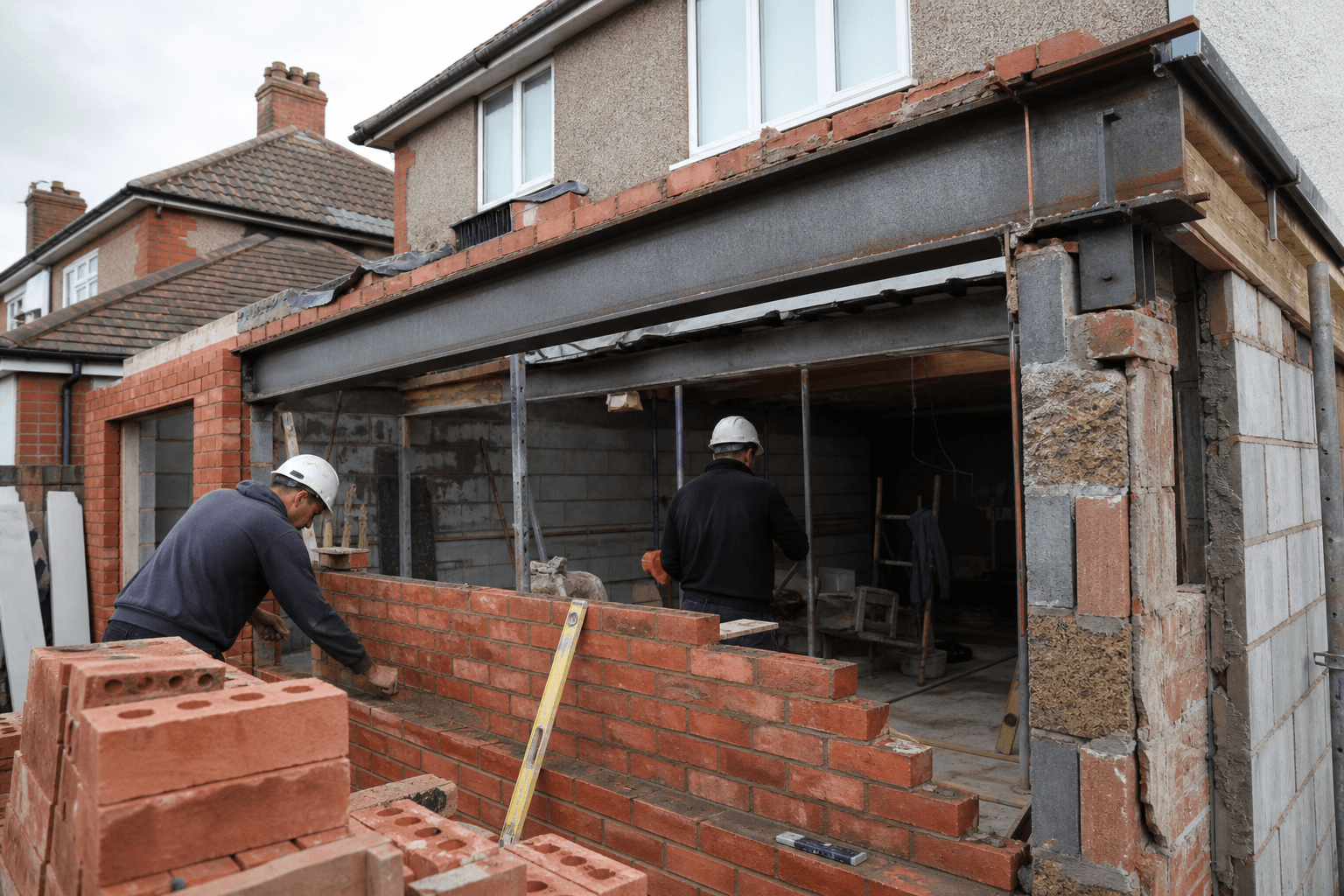
The Institution of Structural Engineers (IStructE) registers chartered engineers whose calcs Building Control accept first time, and skipping one costs £3,000–£8,000 in rejected sign-offs. IStructE fees of £400–£1,500 are dwarfed by the rebuild cost when an unqualified RSJ sketch fails inspection.
What it looks like
The builder's mate sketches the steel on the back of an invoice. No BS EN 1990 calc.
Why people do it
The engineer fee feels optional.
What it actually costs
Building Control rejection plus redo at £3,000–£8,000. Insurers may dispute later structural claims.
How to avoid it
Hire from the IStructE chartered register at istructe.org. Ask for calcs to BS EN 1990 and PD 6694/6700.
Mistake #8: Building over a public sewer without consent
Building over a public sewer without a Build Over Agreement under the Water Industry Act 1991 s.106 costs £300–£1,200 retrospectively plus 6–12 weeks of delay. Thames Water alone receives over 7,000 Build Over applications a year, and 1 in 10 are retrospective.
What it looks like
The drain in the back garden is owned by the water company, not you. The Land Registry doesn't show it. You build straight over.
Why people do it
Homeowners check title deeds, not Asset Location plans. If a blocked drain sits under the new floor, access becomes the water company's problem and yours.
What it actually costs
£300–£1,200 retrospective Build Over Agreement fee. Rebuild if refused. 6–12 week stop.
How to avoid it
Request an Asset Location plan from the water company. Apply for the Build Over Agreement before you start.
Thinking about House extensions?
Share your postcode and job details for a no-obligation quote.
Mistake #9: No CDM 2015 principal contractor
The Construction (Design and Management) Regulations 2015 make the homeowner principal contractor by default when more than one trade is on site, with HSE notices and insurance refusals as the cost. HSE prosecutions under CDM 2015 reached 91 in 2024, several against domestic clients.
What it looks like
You hire your builder, then a separate electrician, then a separate plumber. Nobody is named principal contractor.
Why people do it
You didn't know you became the principal contractor by default.
What it actually costs
HSE improvement notices, insurance refusal on accident claims, personal liability.
How to avoid it
Appoint your main builder as principal contractor in writing before work starts. One-line clause in the contract.
Mistake #10: Ignoring Part L 2022 U-values
Approved Document L Volume 1 (2022) sets U-value caps that builders working to older 2013 specs routinely miss, with Building Control sign-off withheld and remediation £2,000–£6,000. The Energy Saving Trust reports a 30% energy efficiency gap between 2013 and 2022 specs.
Required U-values
| Element | Maximum U-value (W/m²K) |
|---|---|
| External wall | 0.18 |
| Roof | 0.15 |
| Ground floor | 0.13 |
| Glazing | 1.4 |
| External doors | 1.4 |
How to avoid it
Specify Part L 2022 U-values on the drawing schedule. Reject quotes that quote 2013 spec insulation.
Check scope and pricing for Loft conversions
Compare options, add-ons, and what affects the final price before you commit.
Mistake #11: Skipping NHBC or equivalent 10-year warranty
The NHBC Buildmark 10-year warranty costs £800–£1,500 but its absence knocks up to £15,000 off resale because lenders refuse the buyer's mortgage. NHBC issued over 152,000 Buildmark policies in 2024.
What it looks like
The builder doesn't offer a structural warranty. You skip it to save £1,000.
What it actually costs
Resale buyers' lenders refuse without one. Offers drop by £10,000–£15,000.
How to avoid it
Use an NHBC Buildmark-registered builder, or insist on LABC New Home Warranty or Premier Guarantee. Confirm in writing before signing.
Mistake #12: Deposit over 25% of contract value
Deposits over 25% are the leading cause of consumer loss in UK extensions, with full deposits of £15,000–£30,000 vanishing when a builder folds. Citizens Advice reported 8,400 builder-related deposit complaints in 2024.
What it looks like
The builder asks for 50% upfront "to secure materials". You pay.
What it actually costs
Total loss if the builder enters insolvency. £15,000–£30,000 gone.
How to avoid it
Cap deposits at 25%. Stage subsequent payments against Building Control inspections. Use extension builders near me sourced through a vetted platform. Under the Consumer Contracts Regulations 2013, off-premises contracts carry a 14-day cooling-off right.
Need help with House extensions?
Tell us about your job and we will match you with the right professional for House extensions.
Mistake #13: No written specification
A written line-item specification under NRM2 or a JCT Minor Works contract is the single best protection against variation creep, which adds 8–20% (£4,000–£10,000) to typical extension builds. The Joint Contracts Tribunal (JCT) documents are RICS-recommended for domestic work.
What it looks like
A one-line quote. "Build rear extension as discussed: £58,000."
What it actually costs
Variations and "extras" inflate the build 8–20%. On a £55,000 base, that's £4,400–£11,000 of disputed extras. The risk is highest on a loft conversion cost where roof unknowns drive variations.
How to avoid it
Insist on a JCT Minor Works contract or a NRM2 line-item spec. Every item priced. Every variation in writing.
Mistake #14: Underestimating snagging time
Snagging issues caught after final payment cost £1,000–£3,000 to fix yourself, and JCT Minor Works retention clauses are the only reliable defence. The Building Research Establishment (BRE) records an average of 17 snagging items per extension at handover.
What it looks like
The build is "done". You release the final payment. You spot 12 snags the next week.
What it actually costs
£1,000–£3,000 of self-funded fixes.
How to avoid it
Retain 5% of the contract value for 12 months under the JCT Minor Works retention clause. Release only when snags are cleared.
Explore our Loft conversions service
See what is included, typical timings, and what to prepare before you book.
If you've already made one of these mistakes
About 1 in 4 UK homeowners discover at least one of these mistakes mid-build, according to the Homeowners Alliance 2025 survey. The earlier you act, the cheaper the fix. The key is to stop, document, and call a chartered professional before anyone else asks for money.
How to limit the damage right now
Stop work. Photograph everything. Email the builder to confirm the stop in writing. Contact a RICS chartered surveyor for a same-day phone consult. Note the exact regulation you suspect is breached (party wall, Article 4, sewer, Part L).
When to call a pro to undo it
Three scenarios need a chartered pro within 48 hours: a party wall breach (RICS surveyor), an enforcement notice from the LPA (planning consultant), or a public sewer build-over (water company liaison). Each can be resolved retrospectively if you move fast.
What insurance might or might not cover
Builder professional indemnity may cover design errors. Your home contents policy will not cover unauthorised works. NHBC warranty only covers what was registered, not what was added off-spec.
The one mistake even pros make
Even experienced builders forget the 50% garden coverage rule counts outbuildings as they stood on 1 July 1948, not as they stand today. We've seen a 1930s Reading semi-detached designed perfectly to GPDO 2015 Class A, only for the LPA case officer to count a 1962 garage on the historic title plan and refuse the application. The homeowner had to redraw and resubmit, losing six weeks and £2,200 in architect fees.
The fix is a Land Registry historic title search for £3 at gov.uk/search-property-information. The plan shows the garden line as recorded historically, and any outbuildings visible. It's a 90-second check that saves six weeks of redesign. Most architects don't do it because they assume the current site plan is enough. It isn't.
Pro tip. Order the Land Registry historic title plan before the architect draws a single line. £3 well spent.
Ready to book House extensions?
Send a quick enquiry — we typically respond the same working day.
A simple checklist to avoid all of these
The 10-step checklist below maps to all 14 mistakes above. Run it in order before the spade goes in the ground, sourcing materials through Travis Perkins or Wickes once the spec is signed off.
- Pull the Land Registry historic title plan (£3) to confirm the 1948 footprint.
- Phone the LPA to confirm whether Article 4 applies to the street.
- Serve s.1 or s.2 party wall notice 2 months before work; s.6 one month before excavating within 3m.
- Apply for a Lawful Development Certificate under T&CPA 1990 s.192 (£129).
- Request an Asset Location plan and apply for a Build Over Agreement if a public sewer runs through.
- Commission structural calcs from an IStructE chartered engineer to BS EN 1990.
- Specify Part L 2022 U-values on the drawings (0.18 wall, 0.15 roof, 0.13 floor, 1.4 glazing).
- Sign a JCT Minor Works contract or NRM2 line-item specification.
- Cap the deposit at 25% and tie stage payments to Building Control inspections.
- Hold 5% retention for 12 months for snagging.
Sense-check. If your builder pushes back on any of the 10 above, treat that as the red flag it is.
How Taskino's vetted pros catch these before they happen
If you've read this far and felt your shoulders tense at Mistake #1 or #8, that's the cue. The platform's vetting pulls builders who serve party wall notices as a matter of routine, who check the original house rule before they price, and who don't ask for a 50% deposit. They quote against a JCT Minor Works contract, they hold NHBC or LABC warranties, and they hand back a Lawful Development Certificate at completion. Browse vetted building pros at Taskino house extensions.
Learn more about Loft conversions
Browse how we deliver Loft conversions and the questions homeowners ask most often.
Sources
- gov.uk, "Party walls and building works", https://www.gov.uk/party-walls-building-works
- HMRC, "Buildings and construction (VAT Notice 708)", https://www.gov.uk/guidance/buildings-and-construction-vat-notice-708
- Planning Portal fee schedule, Lawful Development Certificate s.192, £129
- HM Government, Approved Document L Volume 1: Dwellings (2022)
- Thames Water, "Building over or near a sewer", https://www.thameswater.co.uk/help/home-improvements/building-over-or-near-a-sewer
- NHBC Buildmark warranty, https://www.nhbc.co.uk
- Federation of Master Builders, Member Survey 2025
- Royal Institution of Chartered Surveyors (RICS), Party Wall Guidance Note
- Institution of Structural Engineers (IStructE), chartered register
- Homeowners Alliance, Extension Survey 2025
- Citizens Advice, Builder Complaints 2024
- HSE, CDM 2015 Prosecutions Data
- Planning Inspectorate Appeal Statistics 2025
- Building Research Establishment, Snagging Report
- Energy Saving Trust, Part L 2022 Impact Report
- First-hand: a Taskino-listed RICS surveyor in Bristol resolved a s.10 party wall award for £1,750 in February 2026
Frequently asked questions: 14 House Extension Mistakes That Cost UK Homeowners £20,000 a Year
Short answers to common questions about this topic.
Our team will answer all your questions. we ensure a quick response.
Contact UsRelated posts

Real UK 2026 house extension costs per m², planning permission rules, party wall steps, RSJs, hidden costs, and how to hire a vetted FMB builder.

Hire the right UK 2026 extension builder. 15 vetting questions, red flags, FMB and TrustMark checks, deposit and contract rules, and how to compare quotes.
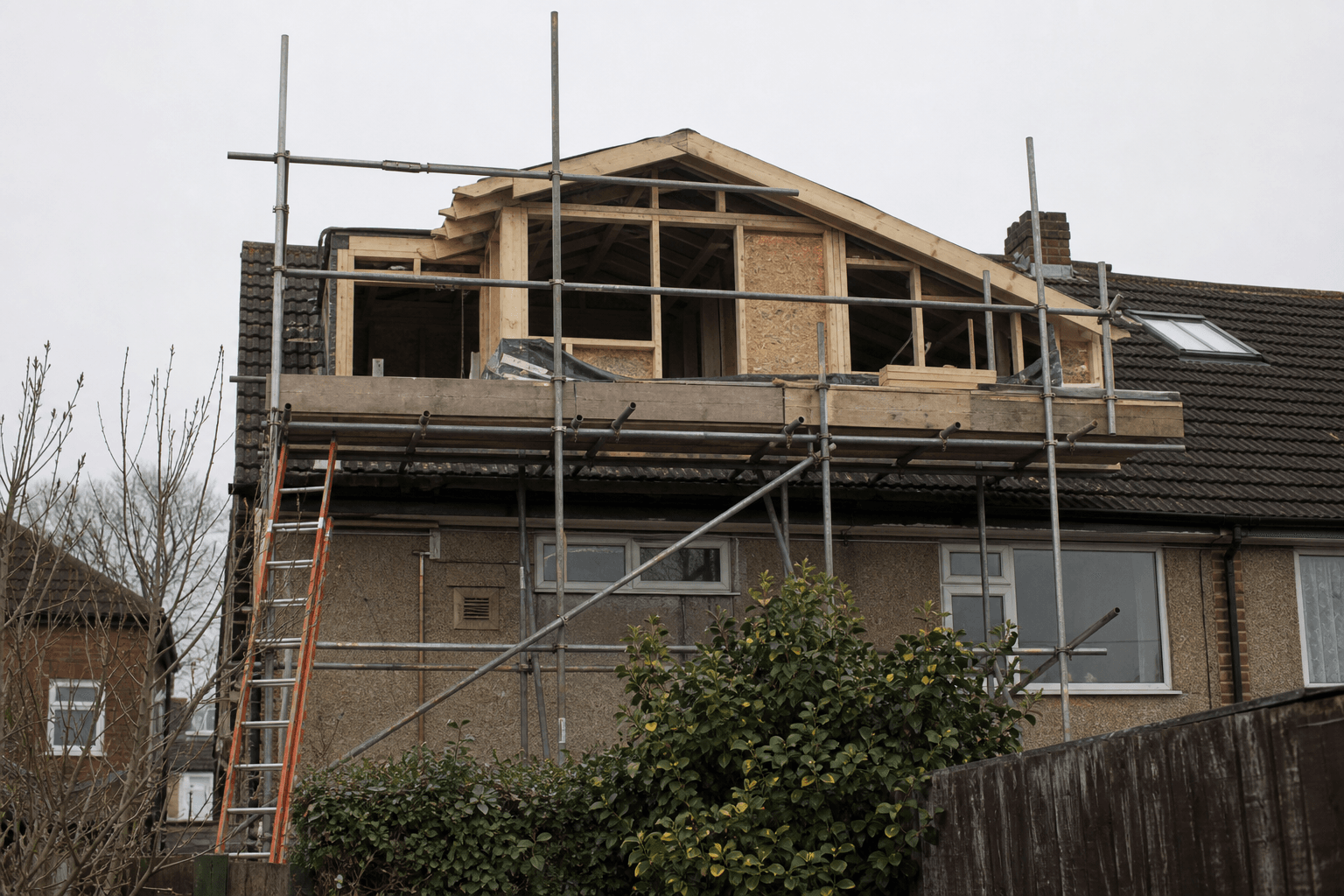
Real 2026 loft conversion costs by type, with build timelines, planning rules, structural fees and the hidden line items most quotes miss.
Latest in Construction
View all in this category
Architect, design-and-build or DIY for your UK extension? Honest 2026 cost-benefit, ARB rules, when each wins, and the decision flowchart.
UK roofing mistakes that void insurance, damage slate or invite scams. Jet washing, cash payments, missing flashings, what they cost and how to avoid them.

Apply for house extension planning permission in 8 steps. UK 2026 rules, PD limits, Larger Home Extension prior approval, fees and timelines.
Related services
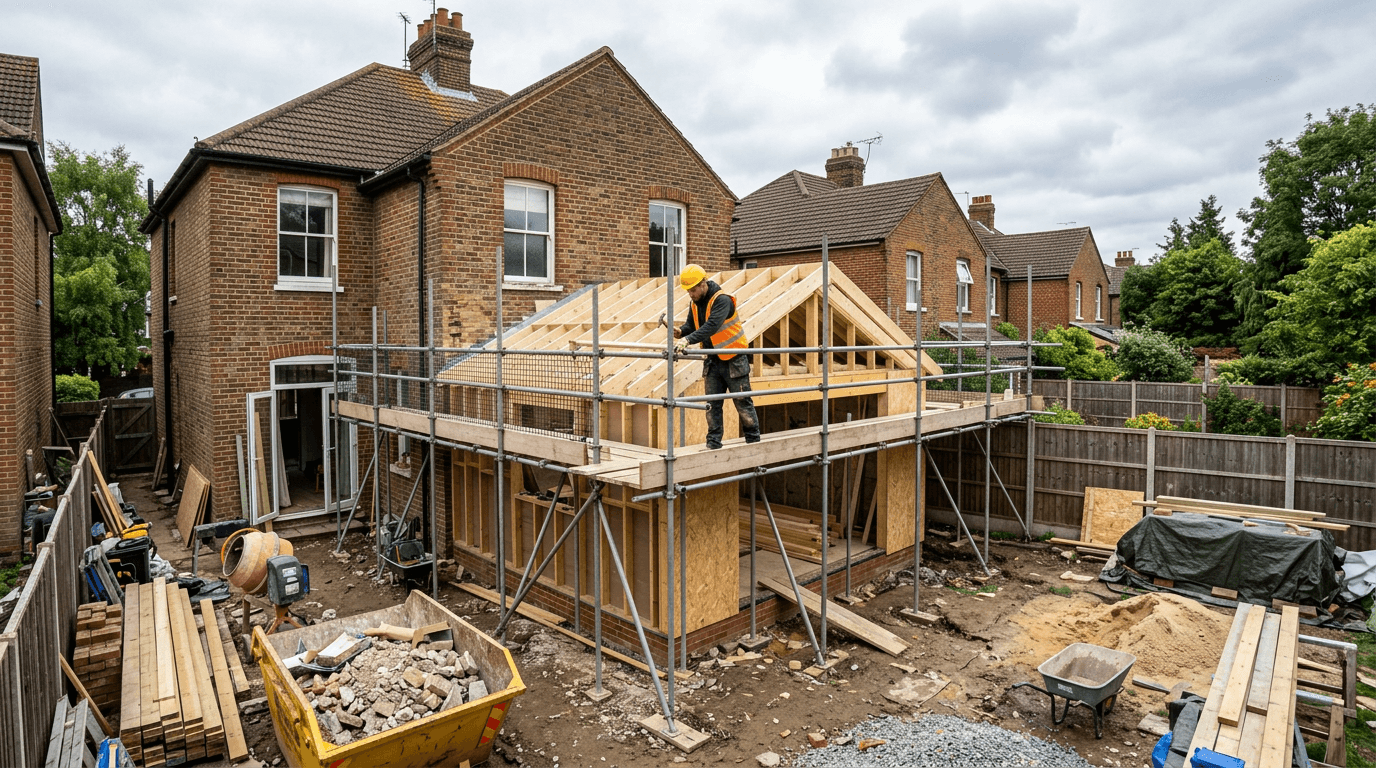
Add valuable living space with trusted house extensions across the UK. Taskino connects you with insured builders for clear quotes, practical planning and reliable project delivery.

Create extra living space with professional loft conversions. Taskino matches you with insured specialists who handle surveys, planning checks, structural work, insulation and finishing with clear quotes and reliable workmanship.
Ready to Book Your Service?
Tell us what you need and our team will help you find the right professional quickly, with clear pricing and no hidden fees.